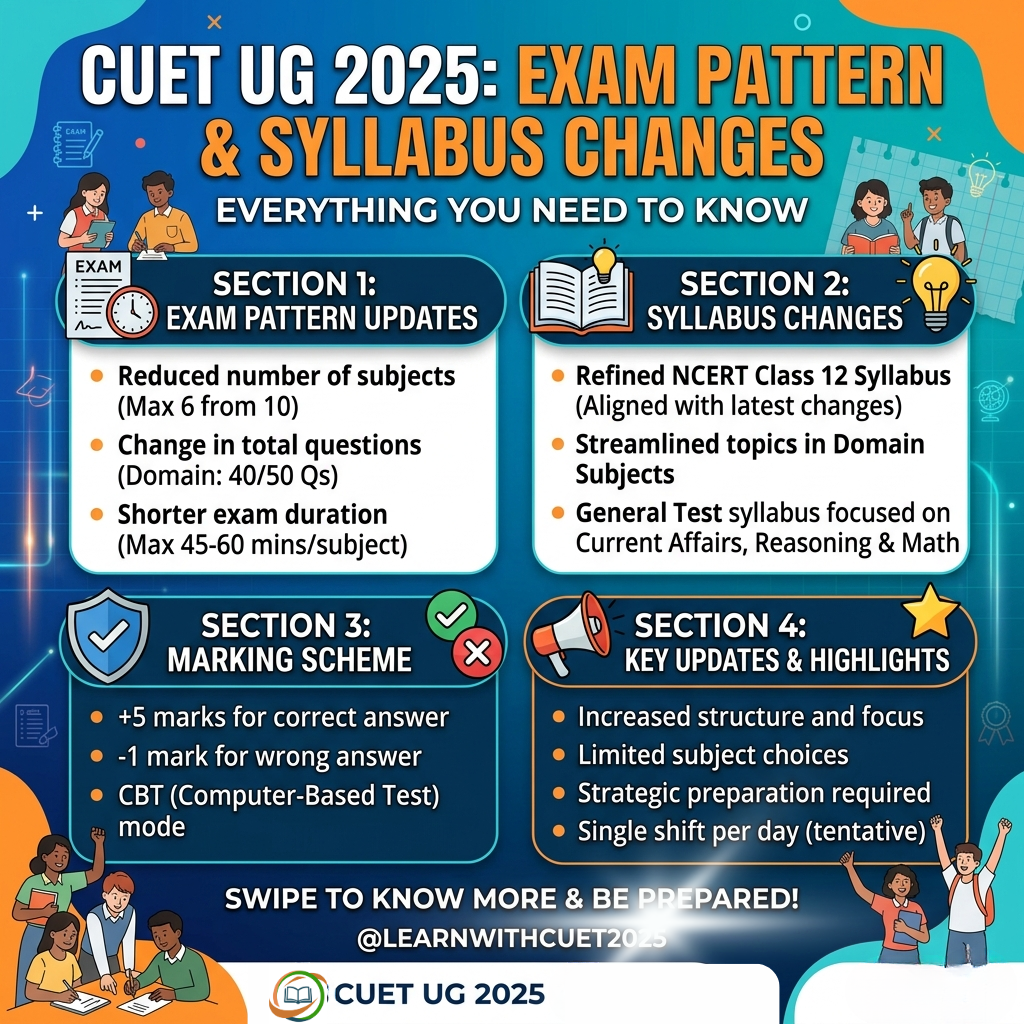
The Common University Entrance Test (CUET UG) 2025 has arrived with some of the most significant structural overhauls since the exam was first introduced. Whether you are a Class 12 student planning your undergraduate admission or a parent trying to make sense of the new format, staying updated with the latest changes is absolutely critical. Ignoring these updates can mean wasted preparation time — and a lower score.
This article breaks down everything that has changed in CUET UG 2025: the exam structure, section-wise pattern, marking scheme, deleted subjects, and key syllabus revisions you must act on right now.
What Is CUET UG 2025?
CUET UG is the centralized entrance test conducted by the National Testing Agency (NTA) on behalf of the University Grants Commission (UGC). It serves as the primary gateway for undergraduate admissions across Central Universities, State Universities, Deemed Universities, and many private institutions across India. Top destinations like Delhi University (DU), Banaras Hindu University (BHU), University of Hyderabad, Aligarh Muslim University (AMU), and Jamia Millia Islamia (JMI) all use CUET UG scores as a key admissions criterion.
For the 2025 cycle, the exam was conducted between May 13 and June 3, 2025, across hundreds of cities in India and abroad.
CUET UG 2025: Key Changes at a Glance
The NTA introduced a sweeping set of reforms for the 2025 edition. Here is a quick summary before we dive deeper:
| Feature | CUET UG 2024 | CUET UG 2025 |
| Exam Mode | Hybrid (Online + OMR) | 100% CBT (Online Only) |
| Total Subjects | 63 | 37 |
| Max Subject Selection | 6 | 5 |
| Duration Per Section | Varied | 60 minutes (uniform) |
| Marking (Correct) | +5 | +5 |
| Marking (Incorrect) | -1 | -1 |
| Unattempted Questions | 0 | 0 |
CUET UG 2025 Exam Pattern: Section-Wise Breakdown
The revised exam retains a three-section structure, but with important modifications in each.
Section 1A — Language Test (13 Languages)
This section evaluates a candidate’s command over their chosen language. It includes reading comprehension passages, grammar-based questions, and vocabulary exercises. The exam is offered in 13 major Indian languages including Hindi, English, Tamil, Bengali, Urdu, Gujarati, Marathi, Kannada, Malayalam, Odia, Punjabi, Assamese, and Telugu. Each paper contains 50 questions, of which students must attempt 40, within a 60-minute window.
Section 1B — Additional Language (Optional)
Students who wish to add a second language as a domain paper can opt for Section 1B. This section also carries 50 questions to be attempted in 60 minutes.
Section 2 — Domain-Specific Subjects (23 Subjects)
This is the heart of the CUET exam. Section 2 tests subject knowledge directly based on the NCERT Class 12 syllabus. Students can select up to 3 domain subjects from the revised list of 23 available papers. The questions are predominantly MCQ-based, covering conceptual, application-based, and comprehension-style problems.
Section 3 — General Test (GT)
The General Test assesses broader academic aptitude. Topics include General Knowledge, Current Affairs, Mental Ability, Quantitative Reasoning, Logical and Analytical Reasoning, and Basic Mathematics. The GT is particularly important for students applying to multidisciplinary or interdisciplinary courses where no specific domain subject is mandated.
Exam Mode: Full Shift to CBT
One of the most significant changes for 2025 is the complete shift to Computer-Based Test (CBT) mode. In previous years, a hybrid approach was followed where some subjects were conducted in OMR (pen-paper) mode. That has now been completely eliminated. Every paper — across every section — will now be conducted on a computer terminal.
This change has an important practical implication: students who are not comfortable navigating a computer-based interface must begin practising on CBT mock platforms immediately. The NTA provides free official mock tests on its portal, and experts recommend attempting at least 10 to 15 full-length CBT mocks before the actual exam.
CUET UG 2025 Syllabus: What Has Been Removed?
Perhaps the most talked-about change in CUET 2025 is the drastic pruning of the subject list — from 63 subjects down to just 37. This is not a cosmetic trim; it reflects a deliberate policy decision to streamline the exam and reduce student burden.
Dropped Domain Subjects (6 Subjects Removed)
The following six domain-specific subjects have been completely discontinued from CUET UG 2025:
- Entrepreneurship
- Teaching Aptitude
- Fashion Studies
- Tourism
- Legal Studies
- Engineering Graphics
For students who had intended to apply for programs linked to these subjects, admissions will now be processed on the basis of General Test (GAT) scores by the respective universities.
Foreign Languages Removed
Several foreign language papers have also been dropped from the exam, including French, Spanish, German, Nepali, Arabic, and a few others. Students who had planned to use a foreign language paper as part of their subject combination must revisit their application strategy.
Science Syllabus: Topic-Level Deletions
Beyond removing entire subjects, the NTA has also pruned specific topics from within science subjects. Students preparing for Physics, Chemistry, and Biology must carefully cross-check the updated official syllabus PDF available at cuet.nta.nic.in and avoid studying any deleted chapters. Preparing deleted topics is not just a waste of time — it can create confusion during the exam if your study materials are misaligned.
Marking Scheme for CUET UG 2025
The marking scheme for CUET UG 2025 is as follows:
- Correct Answer: +5 marks
- Incorrect Answer: −1 mark (negative marking applies)
- Unattempted Question: 0 marks (no penalty)
The negative marking policy makes strategic answering crucial. Students should not guess randomly — unattempted questions do not carry any penalty, so it is better to skip a question you are uncertain about than risk losing a mark.
Subject Flexibility: A Student-Friendly Reform
One of the more student-friendly reforms introduced in CUET UG 2025 is the freedom to choose any domain subject regardless of your Class 12 stream. A Science student can opt for Economics or Political Science. A Commerce student can attempt Biology. This opens up cross-stream admission possibilities at several universities.
However, students must verify the subject eligibility conditions of their target universities independently, as each institution may impose its own restrictions on subject combinations for specific programs.
CUET UG 2025 vs 2024: Why These Changes Matter
The 2025 changes are not arbitrary. They reflect a broader effort by UGC and NTA to:
- Reduce exam complexity for students juggling board exams and entrance preparation simultaneously.
- Align the exam more closely with what universities actually need for admission decisions.
- Improve the integrity and uniformity of the test by removing the hybrid CBT + OMR format.
The net result is a leaner, more focused exam — but one that demands sharper, more targeted preparation.
Quick Preparation Tips for CUET UG 2025
- Download the updated official syllabus from cuet.nta.nic.in before studying anything else. Avoid older PDFs and coaching materials that may still include deleted topics.
- Prioritise NCERT Class 12 books for all domain subjects. CUET is built almost entirely on NCERT content.
- Practice Reading Comprehension daily — 60 to 70% of the language paper consists of RC passages.
- Attempt CBT mock tests regularly to build comfort with the online interface and improve time management.
- Do not skip the General Test if you are applying to multidisciplinary or interdisciplinary programs — its weightage in those admissions can be decisive.
CUET UG 2025 represents a meaningful evolution in India’s centralized undergraduate admissions process. The shift to full CBT mode, the trimmed subject list, and the topic-level syllabus pruning all signal an exam that is more efficient — but also less forgiving of outdated preparation. Students who align their strategy with the 2025 pattern from Day 1 will have a clear, measurable advantage over those who do not.
Stay tuned to this website for more CUET UG updates, college-wise cutoff analysis, and subject-wise preparation guides.
Frequently Asked Questions
Yes, one of the most impactful changes for 2025 is that the exam is now conducted entirely in Computer-Based Test (CBT) mode. The earlier practice of allowing certain subjects in OMR (pen-and-paper) format has been completely discontinued. Every section — Languages, Domain Subjects, and the General Test — will now be attempted on a computer terminal. Students are strongly advised to practise on digital platforms well before their actual exam date.
In CUET UG 2025, a candidate can select a maximum of 5 subjects in total. This is a reduction from the earlier limit of 6 subjects. The combination typically includes one language from Section 1A, optional additional language from Section 1B, up to three domain subjects from Section 2, and the General Test from Section 3. Students should cross-check the subject requirements of their target university before finalising their selection.
The NTA has dropped six domain-specific subjects for the 2025 session. These are Entrepreneurship, Teaching Aptitude, Fashion Studies, Tourism, Legal Studies, and Engineering Graphics. Additionally, several foreign language papers — including French, Spanish, German, Nepali, and Arabic — have also been removed from the available subject list. The overall subject count has been trimmed from 63 to 37.
For programs whose corresponding CUET subject has been discontinued, universities will base their admissions on the General Test (GAT) score instead. If you were planning to appear in any of the six removed domain subjects, revise your preparation plan to focus on the General Test, and confirm the updated admission criteria directly with your target university.
The marking scheme for CUET UG 2025 is straightforward:
Correct Answer → +5 marks
Incorrect Answer → −1 mark (negative marking is applicable)
Unattempted Question → 0 marks (no penalty)
Given the negative marking rule, students should avoid blind guessing. If you are unsure about a question, it is safer to leave it unattempted rather than risk losing a mark.
Each section or subject paper in CUET UG 2025 carries a uniform duration of 60 minutes. This applies to the Language Test, Domain Subject papers, and the General Test equally. The overall time a candidate spends at the exam centre will depend on how many subjects they have opted for and the shift allocation done by the NTA.
Yes, and this is one of the more progressive changes in CUET UG 2025. Students are permitted to select any domain subject irrespective of the stream they studied in Class 12. A Science student can opt for Economics, Political Science, or History, and a Commerce student can choose Biology or Physics. However, it is important to verify whether the specific university and program you are applying to accepts that subject combination, as eligibility rules vary institution to institution.
The General Test is not universally compulsory, but it is essential for students applying to multidisciplinary, general, or interdisciplinary undergraduate programs where no specific domain subject is required. Many universities assign significant weightage to GT scores for such courses. Even if your primary focus is on domain subjects, attempting the General Test is a smart strategy to keep more admission options open.
Based on current indications, the CUET UG 2026 exam is expected to follow the same structure introduced in 2025 — including the full CBT mode, the reduced subject list of 37 papers, and the 60-minute uniform duration per section. The NCERT Class 12 alignment for domain subjects is also likely to continue. That said, NTA may introduce minor modifications, so students targeting 2026 should keep an eye on official announcements as the registration season approaches.
No Comments yet!