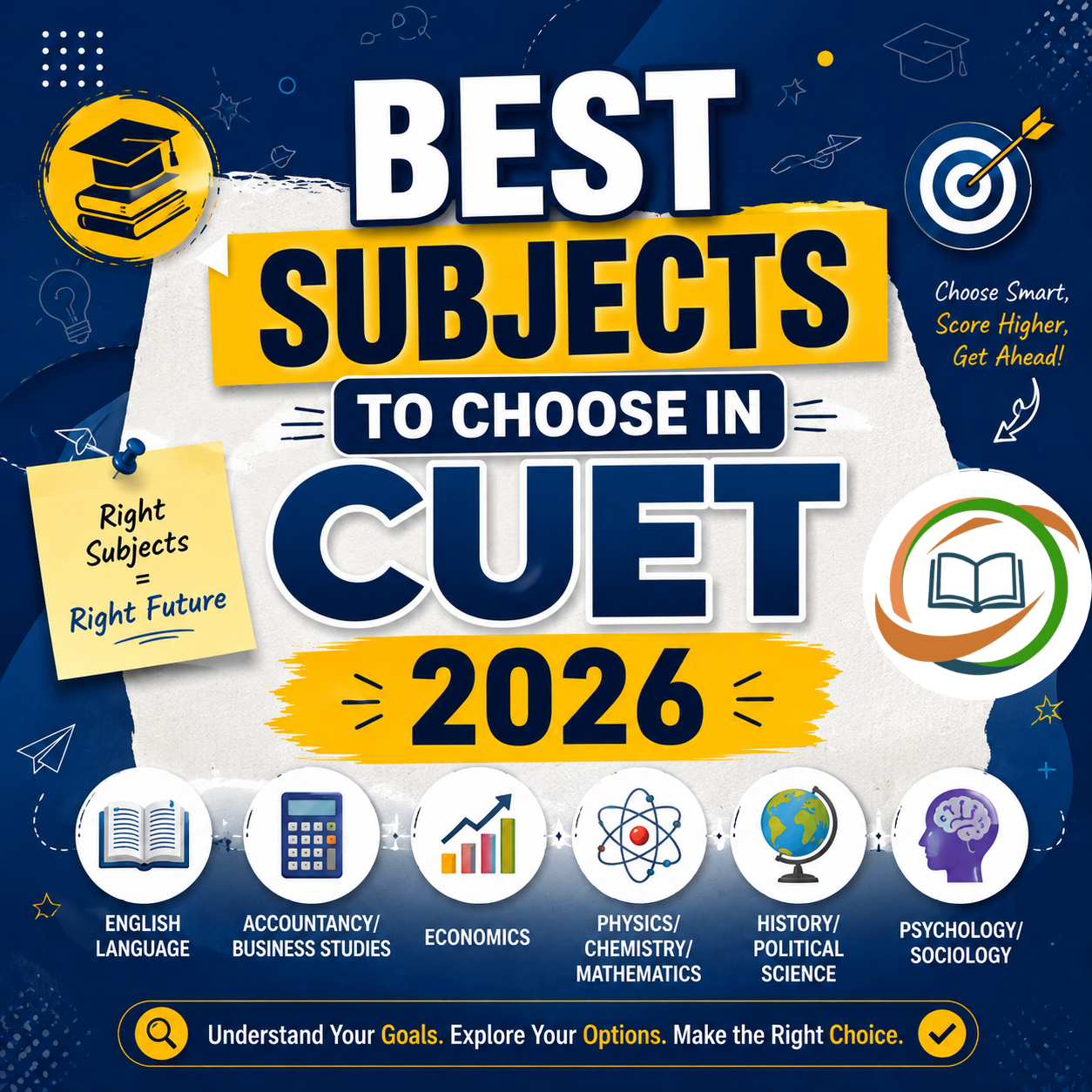
Subject-Wise Selection Criteria, Scoring Potential, Stream-Wise Guidance, Preparation Roadmap & Strategic Insights for CUET UG 2026
Selecting the right subjects for CUET 2026 is one of the most consequential decisions an aspirant will make throughout the entire preparation journey. Unlike board examinations — where subject choice is fixed by stream — CUET UG 2026 offers considerable flexibility in domain paper selection, and that flexibility is a strategic advantage when exercised thoughtfully. The subjects you select determine not just how hard you need to prepare, but how competitive your NTA Score will be relative to the applicant pool, how well your CUET combination aligns with your target programme requirements, and whether your preparation timeline is realistic given your board exam commitments.
This comprehensive guide from cuet-nta.com provides a structured, data-informed framework for selecting the best CUET 2026 subjects for your specific stream, programme targets, and preparation timeline. Whether you are a Humanities student deciding between Sociology and Political Science, a Commerce student weighing Business Studies against Entrepreneurship, or a Science student exploring which domain to add as an optional paper — this guide gives you the analytical tools to make the right choice rather than relying on guesswork or peer pressure.
Best Subjects to Choose in CUET 2026: Quick Reference Overview
| Parameter | Details |
| Article Topic | Best Subjects to Choose in CUET 2026 |
| Exam | CUET UG 2026 — Common University Entrance Test |
| Conducting Body | National Testing Agency (NTA) |
| Exam Mode | Computer-Based Test (CBT) — MCQ format |
| Marking Scheme | +5 for correct, −1 for incorrect answer |
| Top Recommended Domains | Sociology, Political Science, Legal Studies, Home Science, General Test |
| Questions Per Paper | 50 questions (40 to be attempted) in 45 minutes |
| Selection Criteria | Programme alignment, stream background, preparation time, scoring potential |
| Official Portal | cuet.nta.nic.in |
| Article Source | cuet-nta.com |
Important: Subject acceptability varies by programme and university. Always verify accepted CUET domain papers in the official prospectus of your target institution before finalising your selection at cuet.nta.nic.in.
What Makes a CUET Subject the Best Choice? Five Decision Factors
Identifying the best CUET subjects is not simply a matter of ranking them from easiest to hardest. The optimal subject combination is a function of five interconnected factors that together determine how efficiently your preparation translates into a competitive NTA Score:
1. Programme Acceptability at Target Universities
This is the non-negotiable filter. Every CUET domain paper you select must be accepted by at least one of your target programmes at your target universities. A university admitting students to B.Sc. Physics will require Physics and Mathematics as CUET domain papers. A programme admitting students to B.A. (Hons.) Sociology will require Sociology. Before evaluating difficulty or scoring potential, verify the CUET subject requirements of every programme you intend to apply to. Subjects that do not meet programme requirements cannot contribute to your admission, regardless of how well you score in them.
2. Alignment with Class 12 Background
Subjects you studied in Class 12 carry a built-in preparation advantage for CUET. Your Class 12 curriculum — whether CBSE, ICSE, or State Board — covers most of the same NCERT content that CUET domain papers test. A student who studied Sociology in Class 12 has already encountered the key sociologists, Indian society concepts, and social change frameworks that CUET will test. This background alignment means fewer additional preparation hours are needed to reach competitive accuracy levels. All else being equal, prioritise subjects from your Class 12 curriculum when building your CUET paper combination.
3. Scoring Potential Under CUET’s Marking Scheme
CUET’s +5/−1 marking scheme creates a structural difference between subjects with recall-based question patterns and subjects with application-based or calculation-intensive question patterns. In recall-based subjects — Sociology, Political Science, Legal Studies, Home Science — a student who has read NCERT thoroughly can reliably eliminate two to three wrong options per question, making the attempt decision straightforward and keeping negative marking risk low. In calculation-intensive subjects — Mathematics, Physics, Accountancy numericals — even a well-prepared student may face questions where all four options are numerically plausible without a full calculation, increasing the probability of a costly incorrect attempt. High scoring potential under negative marking conditions is a decisive quality criterion.
4. Syllabus Scope and Preparation Efficiency
Subjects with clearly bounded, NCERT-complete syllabuses are more preparation-efficient than subjects with open-ended or application-heavy content requirements. Home Science, Physical Education, Legal Studies, and Sociology draw all their CUET questions from NCERT Class 11 and 12 textbooks — meaning every question has a traceable, verifiable source. There are no surprises outside the NCERT boundary. Physics and Mathematics, by contrast, require deep conceptual application beyond passive NCERT reading: derivations, multi-step calculations, and numerical reasoning under time pressure. Narrower, better-defined syllabuses are more preparation-efficient for the same preparation investment.
5. Competition Density and NTA Score Dynamics
NTA Scores are percentile-based — your score reflects your performance relative to all students who attempted the same subject paper. A subject where the applicant pool is smaller and composed primarily of well-prepared students (like Legal Studies or Home Science) produces a different percentile distribution than a subject with millions of applicants spanning every preparation level (like English Language). Understanding the competition density of each subject helps you anticipate how your raw accuracy will translate into NTA Score percentile. In niche easy subjects with small, well-prepared pools, the competition for top percentile positions is actually more concentrated than in large-pool subjects with broad preparation variance.
CUET 2026 Subject Selection Ratings: Complete Analysis
The table below evaluates all major CUET 2026 domain and language subjects across difficulty level, average student scoring percentage, scoring potential, and best-fit student profile. Green rows indicate the best choices for high-scoring combinations; amber rows indicate the most preparation-intensive options.
| Subject | Difficulty | Avg. Score % | Score Potential | Ideal For |
| Home Science | Very Easy | 82–92% | Very High | Science/Arts students who want high scores with a narrow NCERT syllabus |
| Physical Education | Very Easy | 82–90% | Very High | Students with PE background; theory-only, no calculations |
| Sociology | Easy | 78–88% | Very High | Humanities students; NCERT-aligned, definition-based |
| Political Science | Easy | 76–86% | Very High | Humanities students; factual and constitution-focused |
| Legal Studies | Easy | 74–84% | High | Humanities/Law aspirants; small candidate pool, scoring edge |
| English (Language) | Easy | 80–88% | Very High | English-medium students; comprehension and grammar |
| Hindi (Language) | Easy | 78–86% | Very High | Hindi-medium students; familiar language skills |
| General Test | Easy–Moderate | 75–85% | High | All streams; reasoning, GK, quantitative — no fixed textbook |
| Psychology | Easy–Moderate | 72–82% | High | Students who studied Psychology in Class 12 |
| Entrepreneurship | Easy | 76–85% | High | Commerce students; concept-light, case-study based |
| Business Studies | Moderate | 70–80% | High | Commerce students; NCERT definitions are key |
| Accountancy | Moderate | 65–78% | Moderate | Commerce students; daily numerical practice essential |
| Economics | Moderate | 68–78% | Moderate | Both streams; graphs and applied reasoning required |
| Biology | Moderate | 65–78% | High | Medical-stream students; NCERT-heavy but familiar |
| Computer Science | Moderate | 65–78% | High | CS background students; theory plus programming |
| Chemistry | Moderate–Hard | 58–72% | Moderate | Science students; organic, inorganic, physical covered |
| Mathematics | Difficult | 55–70% | Moderate | PCM students; calculation-intensive under tight time |
| Physics | Difficult | 52–68% | Moderate | Science students; derivation and numerical heavy |
Note: Difficulty ratings and scoring ranges are based on analysis of CUET 2022–2025 paper patterns, NTA data, and observed student performance trends. Individual results vary based on Class 12 background, preparation depth, and board curriculum alignment.
Top 6 Best Subjects to Choose in CUET 2026: Detailed Analysis
The following six subjects represent the strongest combination of scoring potential, preparation efficiency, and broad programme acceptance across CUET 2026’s domain and language paper options. Understanding what makes each of them strategically valuable — and where their limitations lie — allows you to build the optimal subject combination for your specific targets.
1. Sociology — The Gold Standard for Humanities Aspirants
Sociology stands out as the most strategically valuable mainstream CUET 2026 domain subject. Its preparation path is entirely NCERT-driven — CUET Sociology questions consistently trace back to Class 11 and 12 NCERT textbooks covering Indian Society, Change and Development in India, and the Introduction to Sociology series. Questions test knowledge of sociologists and their frameworks, classification of social institutions, and conceptual definitions — all of which reward systematic reading over rote memorisation.
What distinguishes Sociology from other easy subjects is its broad programme acceptance. It qualifies students for B.A. (Hons.) Sociology applications at DU, BHU, JNU, and dozens of other CUET-participating universities, while also being accepted as a domain paper for general B.A. programmes across streams. Students who covered Sociology in Class 12 can realistically achieve 80–88% accuracy with 4–6 weeks of dedicated NCERT revision and MCQ practice. Even students approaching Sociology fresh can reach competitive scores within 6–7 weeks of structured preparation.
2. Political Science — Predictable, Factual, and Broadly Accepted
Political Science is built on one of the most predictable question patterns in CUET 2026. The NCERT Class 11 and 12 Political Science textbooks cover clearly defined content — Indian Constitution and its provisions, political institutions, democratic governance, federalism, international relations, and social movements — all of which are tested through factual recall and definitional understanding. The constitutional content is particularly stable: Article numbers, government powers, and institutional structures do not change, making them reliable memorisation targets that reward consistent investment.
Political Science is the required domain paper for B.A. (Hons.) Political Science applications at major universities, and simultaneously one of the highest-scoring options for Humanities students. Historical CUET scoring data places well-prepared Political Science students at 76–86% accuracy — a consistently strong range. The 4–6 week preparation timeline is realistic for students who covered Political Science in Class 12, and the subject’s factual structure makes it one of the most reliable high-scorers in the Humanities stream.
3. Home Science — Maximum Scoring Efficiency, Minimal Competition
Home Science is the single highest-scoring CUET domain subject by objective difficulty and preparation efficiency metrics. Drawing exclusively from NCERT Class 11 and 12 Home Science textbooks across Food and Nutrition, Human Development, Fabric and Apparel, Resource Management, and Community Development, the subject tests straightforward factual and definition-based MCQs with no calculations, no derivations, and no application reasoning beyond NCERT text comprehension.
The competitive advantage of Home Science extends beyond its content accessibility. Because it is perceived as a niche elective, far fewer aspirants choose it relative to Sociology or Political Science — creating a smaller, less dense applicant pool that benefits prepared students in percentile terms. Students who studied Home Science in Class 12 can target 88–95% accuracy with 3–4 weeks of NCERT revision. Students new to the subject can reach competitive scores within 5–6 weeks. The key limitation: Home Science is not accepted by all programmes at all universities — confirm acceptance for your target programme before selecting it.
4. Legal Studies — Small Pool, High Reward
Legal Studies is among CUET 2026’s most underappreciated scoring opportunities. The NCERT Class 11 and 12 Legal Studies textbooks — covering the Nature and Sources of Law, Constitutional Law, Criminal Law, Family Law, International Law, and Legal Professions — provide a well-structured, NCERT-complete preparation path with no content outside the textbook boundary. Questions are consistently factual and definitional, testing knowledge of legal concepts, constitutional provisions, and court structures as explained in NCERT rather than requiring legal reasoning or case analysis.
Legal Studies has a compact but motivated candidate pool, which means that a well-prepared student has a real percentile advantage over partially prepared competitors. The preparation requirement is genuinely modest for an easy subject: 4–5 weeks of thorough NCERT revision combined with CUET previous year paper practice. For students targeting BA LLB or Law-related programmes at CUET-participating universities, Legal Studies is simultaneously a programme-relevant domain and a reliably high-scoring option.
5. Physical Education — Underestimated, Consistently High-Scoring
Physical Education is CUET 2026’s second easiest domain subject behind Home Science, and it is significantly underestimated by mainstream CUET aspirants. The CUET Physical Education paper tests theory from NCERT Class 12 Physical Education across Management of Sporting Events, Children and Women in Sports, Yoga, Test and Measurement in Sports, Training in Sports, and Sports Psychology. These topics are accessible, vocabulary-friendly, and tested through recall-based MCQs with no mathematical or computational elements.
Students who studied Physical Education in Class 12 have a natural preparation advantage, but the subject’s accessibility means even students without a PE background can reach competitive accuracy within 3–5 weeks using NCERT. Historical scoring data places prepared students at 82–90% accuracy — among the highest of any CUET domain subject. As with Home Science, verify programme acceptance before selecting Physical Education: it is widely accepted for Sports Science, Physical Education teacher training, and general Humanities-track applications.
6. General Test — The Universal Strategic Addition
The General Test holds a unique strategic position in CUET 2026 as the only Section III paper applicable to students from every stream. Its content — quantitative reasoning, logical reasoning, general knowledge, English language, and basic numerical ability — has no fixed textbook, which creates preparation flexibility rather than difficulty. Students comfortable with daily reading, logical thinking, and basic arithmetic find the General Test highly manageable with systematic preparation through reasoning workbooks, current affairs capsules, and CUET previous year papers.
The General Test is used by several DU colleges and other CUET-participating universities as a tiebreaker or secondary merit criterion in addition to domain paper scores. Even where it is not strictly required for primary programme admission, a strong General Test score adds a useful buffer to your CSAS composite aggregate. For Science-stream students who may be required to include Physics or Mathematics as domain papers, the General Test provides a reliable high-scoring addition to balance their combination.
| Subject | Syllabus Size | Question Type | −Mark Risk | Score Ceiling | Best Approach |
| Home Science | Very Small | Factual MCQ | Very Low | 200/200 | Full NCERT Class 11 & 12; very low competition pool |
| Physical Education | Small | Theory MCQ | Very Low | 200/200 | NCERT theory chapters; no calculations needed |
| Sociology | Medium | Concept MCQ | Low | 200/200 | Key NCERT terms and sociologists; chapter-by-chapter reading |
| Political Science | Medium | Factual/Concept | Low | 200/200 | NCERT definitions and constitutional provisions |
| Legal Studies | Small | Factual MCQ | Low | 200/200 | NCERT Legal Studies Class 12; small competitor pool |
| General Test | Broad | Mixed MCQ | Moderate | 200/200 | Reasoning workbooks + current affairs + basic arithmetic |
Subject-Wise Preparation Time: Realistic Planning Framework
Effective subject selection must account for realistic preparation time. Choosing a theoretically easy subject that you cannot prepare adequately within your available timeline will produce worse results than choosing a moderately challenging subject you can master thoroughly. Use this preparation framework to align your subject selection with your actual CUET 2026 calendar:
| Subject | Difficulty | Prep Time (Score 150+/200) | Preparation Focus |
| Home Science | Very Easy | 3–4 weeks | Full NCERT Class 11 & 12; MCQ drill from previous papers; no guides needed |
| Physical Education | Very Easy | 3–4 weeks | NCERT theory units only; no practicals tested; past CUET paper practice |
| Legal Studies | Easy | 4–5 weeks | NCERT Legal Studies; constitutional law chapters; previous CUET papers |
| Sociology | Easy | 4–6 weeks | Complete NCERT Class 11 & 12; key sociologists; Indian society chapters |
| Political Science | Easy | 4–6 weeks | NCERT Political Science; Indian Constitution; international relations |
| English Language | Easy | 4–6 weeks | Daily comprehension passages; grammar rules; CUET English previous papers |
| General Test | Easy–Moderate | 6–8 weeks | Reasoning workbook + current affairs (last 6 months) + basic quant practice |
| Psychology | Easy–Moderate | 5–7 weeks | NCERT Class 11 & 12 Psychology; key concepts, theories, research methods |
| Business Studies | Moderate | 6–8 weeks | Full NCERT Class 12 both volumes; precise terminology memorisation |
| Biology | Moderate | 7–10 weeks | Full NCERT Class 11 & 12 Biology; diagrams, processes, classification |
| Accountancy | Moderate | 8–10 weeks | NCERT Class 12 Accountancy Parts I & II; numerical practice every day |
| Economics | Moderate | 7–9 weeks | NCERT Micro + Macro Economics Class 12; graphs and application questions |
| Mathematics | Difficult | 10–16 weeks | Full NCERT Class 12 Maths; concept clarity plus high-volume problem solving |
| Physics | Difficult | 12–18 weeks | Full NCERT Class 12 both parts; derivations and numerical problem sets |
| Chemistry | Moderate+ | 10–14 weeks | NCERT Class 12 organic + inorganic + physical; reaction mechanisms |
Planning Note: Preparation time estimates assume 2–3 hours of daily CUET-specific study alongside Class 12 board preparation. Students with more dedicated daily study hours can compress these timelines proportionally. With fewer than 4 weeks before CUET, prioritise subjects you are already substantially prepared in rather than starting new ones from scratch.
Stream-Wise Best Subject Recommendations for CUET 2026
The ideal subject combination varies by stream background. A student who has spent two years with Physics derivations will find a CUET Physics paper significantly more manageable than a Humanities student approaching it fresh. A Commerce student who has covered NCERT Business Studies in Class 12 has a preparation head start that makes Business Studies a better strategic choice than a subject they have never studied. Use this stream-wise framework as your starting point:
| Stream | Best Domain Subjects | Language Option | Why These Work |
| Humanities / Arts | Sociology, Political Science, Legal Studies, Home Science | English or Hindi (medium of instruction) | Direct NCERT alignment; conceptual; no calculations; consistent high scoring |
| Commerce | Business Studies, Entrepreneurship, Home Science | English (English-medium students) | NCERT-definition focused; Entrepreneurship is concept-light; Home Science adds scoring flexibility |
| Science (PCM) | General Test, Psychology, Home Science (elective) | English (strong for PCM students) | Leverages existing logical reasoning; non-calculation subjects to balance PCM |
| Science (PCB) | Biology, Psychology, Home Science (elective) | English (strong for PCB students) | Familiar Class 12 pattern; Psychology is conceptual and highly manageable |
| All Streams | General Test (universal option) | Hindi or English based on medium | No fixed textbook; rewards broad preparation; applicable to every stream combination |
The fundamental principle behind stream-wise recommendations is preparation efficiency: the best subjects for you personally are those where your existing Class 12 knowledge creates the shortest path to competitive CUET accuracy. Deviation from your stream background is possible and sometimes strategically sound, but it requires additional preparation time to build the NCERT familiarity that your Class 12 background would otherwise provide.
Step-by-Step Framework: How to Choose Your CUET 2026 Subjects
Use this structured decision framework to translate the subject ratings and stream-wise recommendations above into your personalised CUET 2026 subject combination:
Step 1 — List Your Target Programmes and Their CUET Subject Requirements
Compile a list of every programme and university combination you intend to apply to through CUET 2026. For each programme, identify the required CUET domain papers as specified in the official university prospectus and the CSAS requirements. Create a master list of all the domain papers that appear across your target programmes — these are your non-negotiable required subjects. Your subject selection must cover this master list before you consider any strategic optional additions.
Step 2 — Identify Overlap with Your Class 12 Subjects
From your required subject list, identify which papers you have already studied in Class 12. These are your strongest starting positions — they require the least additional preparation to reach CUET-competitive accuracy levels. Flag subjects on your required list that you have not studied in Class 12 — these will require more preparation time and may benefit from earlier prioritisation in your study schedule.
Step 3 — Evaluate Strategic Optional Additions
Once your required subjects are identified, consider whether adding one or two strategically chosen easy subjects can improve your overall NTA Score profile. Home Science, Physical Education, and Legal Studies are the strongest candidates for strategic additions — they offer high scoring potential, narrow preparation requirements, and can be added to a combination without displacing required subjects. The rule is: add an optional subject only if you can prepare it adequately within your available timeline. A high score in an optional easy subject raises your aggregate; a low score in a poorly prepared optional subject has no benefit under CUET’s per-subject scoring structure.
Step 4 — Run a Baseline Mock Test for Each Shortlisted Subject
Before committing to any subject, spend 30–40 minutes on a timed practice test of 20 questions in that subject using your current preparation state. Your baseline accuracy reveals both your starting position and your realistic ceiling with additional effort. A 60–65% baseline in Sociology suggests a clear path to 80–85% with 4–6 weeks of focused preparation. A 25–30% baseline in a subject you have never studied indicates a longer preparation gap that may not be bridgeable within your timeline. Run baseline tests before finalising your selection — they are the most reliable predictor of preparation effort required.
Step 5 — Finalise and Prepare Every Selected Subject Thoroughly
Once your subject combination is finalised, commit to thorough preparation for every subject you have selected. The negative marking environment of CUET means that each subject you select must be prepared to the point where you can confidently attempt 35–40 of the 50 questions with high accuracy. Partial preparation in any selected subject will generate incorrect attempts that erode your NTA Score. Selecting fewer, well-prepared subjects consistently outperforms selecting many partially prepared ones.
Myth-Busting: Common Misconceptions About CUET 2026 Subject Selection
| Common Myth | The Reality |
| Picking easy subjects means you do not have to prepare seriously | CUET’s −1 negative marking penalises careless attempts in every subject. A student who chooses Sociology but skips NCERT reading will score below a student who prepares Political Science rigorously. Easy subjects lower the preparation barrier — not the effort requirement for top-decile scores. |
| The General Test is the hardest because it has no textbook | For well-rounded students comfortable with reasoning and general knowledge, the absence of a fixed textbook is a preparation advantage. There are no lengthy NCERT chapters to complete and no risk of missing a key topic. Systematic preparation through reasoning workbooks and current affairs capsules yields 75–85% accuracy for most prepared students. |
| Home Science weakens your university application | Home Science is a fully legitimate CUET domain subject that is accepted by participating universities for Humanities, Education, and Health Sciences programmes. Selecting it does not negatively impact any application where it is an accepted domain — it can actually strengthen your application by raising your composite NTA Score. |
| You should always choose subjects from your Class 12 stream | Choosing subjects outside your Class 12 stream is allowed by CUET registration and can be strategic for certain programme applications. However, your Class 12 background reduces preparation time for familiar subjects — so deviating from your stream background should be done only when the preparation timeline and programme requirements clearly support it. |
| More subjects means more chances — always attempt the maximum | Attempting more subjects than you can genuinely prepare for is counterproductive. Partial preparation in a subject under CUET’s negative marking scheme produces lower NTA Scores than focused, thorough preparation in fewer subjects. Select your subjects deliberately, prepare every one of them thoroughly, and only add additional papers when you have the preparation capacity to do so. |
Expert Preparation Strategies for Your Best CUET 2026 Subject Combination
Strategy 1: NCERT is the Complete Resource for Easy Subjects
For Sociology, Political Science, Legal Studies, Home Science, and Physical Education, the NCERT Class 11 and 12 textbooks are the definitive and complete preparation resource. There is no need for reference books, coaching guides, or supplementary material beyond NCERT for these subjects. Every CUET question in these papers has a direct NCERT source. Students who invest their preparation time in thorough, active NCERT reading — highlighting key definitions, noting theorists and their contributions, flagging constitutional provisions and their NCERT chapter sources — consistently outperform students who attempt to shortcut this process through guide books.
Strategy 2: Previous Year CUET Papers are the Best Practice Tool
After completing your NCERT reading, solving all available previous year CUET papers — from the 2022, 2023, 2024, and 2025 cycles — is the most valuable preparation activity. Previous papers reveal the exact question phrasing patterns NTA uses, the specific NCERT chapters that appear most frequently, and the precise calibration of options — which is essential for developing effective elimination techniques. For Sociology and Political Science, you will observe that approximately 60–70% of questions follow predictable patterns from recurring high-frequency chapters. Visit cuet-nta.com for organised previous year question banks sorted by subject, chapter, and difficulty level.
Strategy 3: Develop a Systematic Option Elimination Habit
In all CUET subjects, develop the habit of reading all four options systematically before selecting your answer. In easy subjects, incorrect options typically misattribute theories to wrong theorists, use terminology that does not appear in NCERT, or describe concepts that belong to a different NCERT chapter. A student who has genuinely read every NCERT chapter can identify these inconsistencies reliably — reducing the choice set from four options to two, and making the final selection much more confident. This elimination discipline must be practised under timed conditions during mock tests — it cannot be improvised effectively on exam day.
Strategy 4: Use the 40-Question Selection Rule Actively
Every CUET paper presents 50 questions but requires you to attempt only 40. This selection opportunity is itself a scoring tool. At the start of each paper, spend 2–3 minutes reviewing all 50 questions and tagging them mentally as high-confidence (attempt first), possible (apply elimination before deciding), and skip (leave unanswered). Complete all high-confidence questions first, then return to possible questions with the elimination technique. Leave skip-tagged questions unanswered. In easy subjects, a larger proportion of questions fall in the high-confidence category — giving you more control over the 40-question selection and reducing the pressure of difficult questions.
Strategy 5: Simulate Exam Conditions Weekly
Regular full-length timed practice under exam conditions is essential regardless of subject difficulty. The 45-minute time limit for 40 questions creates time pressure that does not feel significant until you are solving MCQs against a running timer. Practise at least one complete section test per week for each subject you have selected, tracking accuracy, time per question, and negative marking incidence. If you are regularly marking incorrect answers in subjects you consider easy, there is either a content gap or a question-reading habit to address before exam day. Weekly timed practice identifies these gaps while preparation time remains.
Final Word: Making the Right CUET 2026 Subject Decision
The best subjects for CUET 2026 are not a universal list — they are a personalised combination built from three aligned factors: the domain papers required by your target programmes, the subjects most efficiently prepared given your Class 12 background, and the strategic additions that raise your overall NTA Score profile within your available preparation timeline.
By the objective data, Home Science and Physical Education offer the highest scoring efficiency for students who can use them. Sociology, Political Science, and Legal Studies offer the strongest mainstream combination for Humanities aspirants. General Test and English Language offer the most reliable additions for every stream. Commerce students are best served by Business Studies or Entrepreneurship as their primary domain, potentially combined with Home Science or Psychology as strategic additions.
The consistent principle across all these recommendations is preparation depth. In CUET’s negative marking environment, the best subject is the one you prepare most thoroughly — not the one that appears easiest on paper. Thorough NCERT coverage, systematic previous year paper practice, disciplined option elimination, and weekly timed full-length mock tests are the preparation habits that separate top scorers from the competition regardless of which subjects they select.
Visit cuet-nta.com for subject-wise CUET 2026 mock tests, previous year paper analysis, difficulty-based preparation guides, NTA notification updates, and every preparation resource you need to select the right CUET subjects, prepare strategically, and achieve the NTA Score your target programme demands.
Frequently Asked Questions
Home Science and Physical Education consistently deliver the highest average student scores — 82–92% and 82–90% respectively — because of their narrow NCERT syllabuses, recall-based question types, and low negative marking risk. Among mainstream, broadly accepted domain subjects, Sociology and English (Language) lead scoring potential with historical averages of 78–88% and 80–88% respectively.
Yes. CUET registration allows any student to select any domain subject regardless of Class 12 stream. There is no eligibility restriction at the registration stage. However, check whether your target programme at your target university accepts Sociology or Political Science from a Science-stream applicant — some programme eligibility criteria specify required Class 12 subjects separately from CUET domain papers.
No — the General Test is Section III and is not universally compulsory. Some university programmes require it as part of the CUET subject combination for their admission criteria, while others do not. Check the official prospectus of each university and programme you are applying to in order to determine whether the General Test is required for your specific applications.
Most students choose 3–4 domain papers in addition to their Language section paper. You can select up to six domain papers, but the practical recommendation is to select only as many as you can prepare thoroughly within your available timeline. Given CUET's negative marking, three well-prepared domain papers will almost always outperform six partially prepared ones.
NTA Scores are percentile-based and normalised across all students who attempted the same subject paper. A very popular subject has a larger applicant pool, which means the competition for top percentile positions is higher. However, a well-prepared student will still score at the top of the distribution in any subject. The strategic concern is not popularity per se, but ensuring that you can perform at the highest level in whichever subjects you select.
With 6–8 weeks of preparation time, subjects like Home Science, Physical Education, Sociology, Political Science, and Legal Studies are fully achievable starting from scratch — provided you commit to daily NCERT reading and MCQ practice. With fewer than 4 weeks remaining, focus on subjects you are already partially prepared in rather than starting a completely new one, to avoid the risk of partial preparation under negative marking conditions.
No Comments yet!