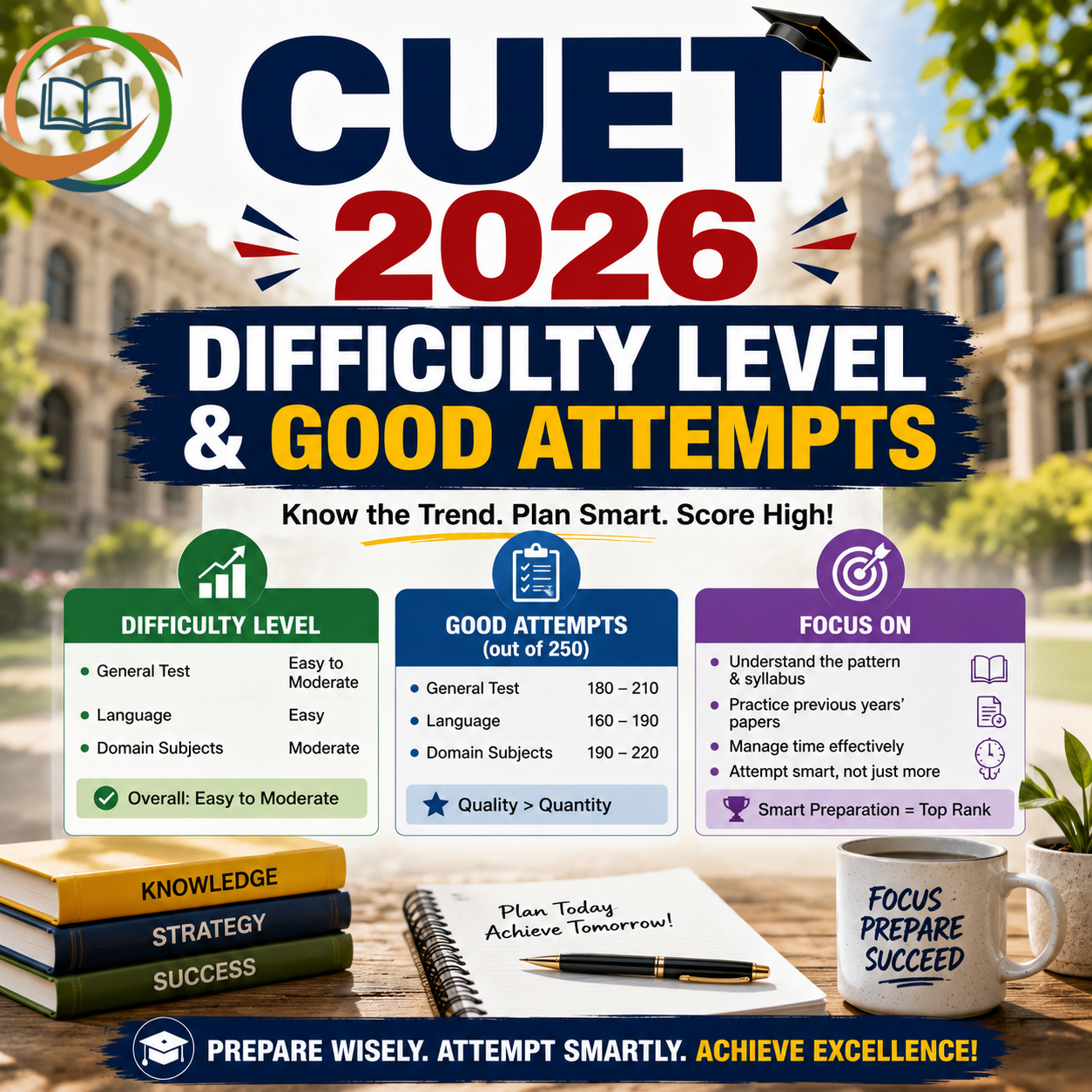
Subject-Wise Difficulty Ratings | Good Attempt Benchmarks | Shift-Wise Trend Analysis | Negative Marking Strategy | Stream-Wise Insights | Myths & FAQs for CUET UG 2026
Two questions define every CUET candidate’s exam-day strategy: how hard is the paper, and how many questions should I actually attempt? The answer to the first question determines your preparation confidence; the answer to the second determines your score under the +5/−1 marking scheme that punishes over-attempting far more harshly than most students anticipate. Together, difficulty level awareness and good attempt calibration form the foundation of intelligent CUET exam strategy.
This comprehensive guide from cuet-nta.com provides the definitive CUET 2026 Difficulty Level and Good Attempts analysis — drawn from actual student feedback and expert analysis across May 11 to May 14 papers. You will find the subject-wise difficulty rating and good attempt range for every CUET 2026 domain subject and language paper, a shift-wise trend table covering all analysed exam dates, a negative marking mathematics table, a stream-wise difficulty and good attempts overview, myth-busting, and a complete FAQ. Whether you are preparing for upcoming CUET dates or evaluating your performance in papers already taken, this is the complete reference guide you need.
CUET 2026 Difficulty Level & Good Attempts: Quick Reference Overview
| Parameter | Details |
| Article Topic | CUET 2026 Difficulty Level & Good Attempts |
| Exam | CUET UG 2026 — Common University Entrance Test |
| Conducting Body | National Testing Agency (NTA) |
| Exam Window | May 11 – May 31, 2026 (35 shifts across 21 days) |
| Exam Mode | Computer-Based Test (CBT) — MCQ format |
| Marking Scheme | +5 for correct, −1 for incorrect, 0 for unattempted |
| Overall CUET 2026 Difficulty | Easy to Moderate (confirmed across May 11–14 analysis) |
| Easiest Subjects 2026 | Business Studies, Sociology, Physical Education, Home Science |
| Moderate Subjects 2026 | English, Economics, Accountancy, Political Science, History, Biology, Physics, GAT/General Test |
| Toughest Subjects 2026 | Mathematics (Moderate to Difficult), Chemistry (Moderate) |
| Good Attempts — Easiest Subjects | 37–42 out of 50 |
| Good Attempts — Moderate Subjects | 33–38 out of 50 |
| Good Attempts — Toughest Subjects | 30–34 out of 50 (Mathematics) |
| Key Pattern | NCERT-dominant; direct factual and concept-based MCQs; application questions in Maths, Economics, Chemistry |
| Total Registered Candidates | 15,68,866 candidates; avg. 4.31 subjects per candidate |
| Official Portal | cuet.nta.nic.in |
| Article Source | cuet-nta.com |
Key Finding: CUET 2026 is primarily NCERT-based with moderate overall difficulty — consistent with CUET 2024 and 2025 patterns. The most important determinant of your NTA Score is not difficulty level but accuracy within your attempt range. Attempting 35–38 questions with 90% accuracy consistently outperforms attempting 45–50 questions with 70–75% accuracy under the +5/−1 marking scheme.
Understanding CUET 2026 Difficulty Level: What It Means and Why It Matters
In the context of CUET exam analysis, ‘difficulty level’ is not a single number — it is a composite assessment that reflects three distinct dimensions: content difficulty (how complex is the underlying knowledge required?), option discrimination difficulty (how similar are the wrong options to the correct one, making elimination harder?), and time pressure (can a prepared candidate complete the paper within 45 minutes comfortably?). A subject can score ‘Easy’ on content difficulty but ‘Moderate’ on option discrimination if wrong options are closely worded — as often happens in Sociology or Political Science. A subject can score ‘Moderate’ on content but ‘Moderate to Difficult’ on time pressure if questions are lengthy — as consistently seen in CUET 2026 Mathematics.
Understanding which dimension of difficulty affects each subject helps you calibrate your preparation and exam strategy more precisely than a single-label difficulty rating. Business Studies questions are easy in content but carry option discrimination risk for poorly prepared students (wrong options are plausible management definitions). Mathematics questions are moderate in content fundamentals but become time-pressured when Calculus questions require multi-step conceptual reasoning. The subject-wise analysis in this guide accounts for all three difficulty dimensions.
How Good Attempts Are Determined
Good attempts are the number of questions a candidate should attempt in a given subject paper to maximise their NTA Score, accounting for their accuracy rate and the +5/−1 marking scheme. Good attempts are not the maximum possible attempts — they are the accuracy-optimised attempt count. For a candidate with 85% accuracy on attempted questions, the mathematically optimal attempt count differs from a candidate with 70% accuracy. The good attempt ranges in this guide are calibrated for students who have adequately prepared their selected subjects and are targeting competitive NTA Scores for top CUET-participating universities.
CUET 2026 Subject-Wise Difficulty Level & Good Attempts: Complete Analysis
The following master table presents the difficulty rating, good attempt range, safe score target, and detailed observations for every major CUET 2026 domain and language subject, based on analysis of actual papers from May 11–14, 2026. Colour coding: Green = Easy, Teal = Easy to Moderate, Amber = Moderate, Red = Moderate to Difficult.
| Subject | Difficulty (2026) | Good Attempts (out of 50) | Safe Score Target (out of 250) | Paper Type | Key Observations from CUET 2026 |
| Business Studies | Easy | 37–42 | 185–210 | Theory MCQ | Most accessible Commerce domain paper; NCERT Class 12-driven; case studies on Management and Marketing; no assertion-reasoning questions in 2026; sequence-based questions standard feature; students with thorough NCERT revision found it highly scoring |
| Sociology | Easy | 37–42 | 185–210 | Factual MCQ | Easiest Humanities domain subject; NCERT-aligned throughout; concept and definition-based; 2026 papers confirmed easy difficulty across all shifts; significant overlap with previous year questions; ideal high-scoring domain for Humanities students |
| Physical Education | Easy | 38–43 | 190–215 | Theory MCQ | NCERT Class 12 theory-only; no calculations or practicals; direct recall questions; one of the smallest question pools; 2026 difficulty consistent with previous years; strong strategic addition for non-stream students |
| Home Science | Easy | 38–43 | 190–215 | Factual MCQ | Full NCERT Class 11 & 12 scope; every question traces to NCERT; 2026 confirmed easy; factual recall across Food & Nutrition, Human Development, Fabric & Apparel, Resource Management; ideal strategic domain addition for all streams |
| Political Science | Easy to Moderate | 36–40 | 180–200 | Factual/Concept | NCERT-based and factual; constitutional provisions and governance directly tested; 2026 confirmed NCERT-focused and moderate; slight application requirement for some governance questions; well-prepared NCERT students found it manageable |
| History | Easy to Moderate | 35–40 | 175–200 | Factual/Concept | NCERT-based with moderate difficulty; chronology and date-based questions prominent in 2026; picture-based questions appeared; post-independence NCERT content heavily featured; moderate difficulty confirmed across May 11–14 shifts |
| Geography | Easy to Moderate | 35–39 | 175–195 | Fact+Concept | 2026 papers featured one-liners and matching-type (dominant question formats); human geography schools of thought, population, and transport heavily tested; easy to moderate overall; passage-based section on quinary activities confirmed |
| English (Language) | Moderate | 35–40 | 175–200 | RC+Grammar | Moderate difficulty across 2026 shifts; vocabulary intensity varied between shifts; RC passages 2–3 per shift (reduced from 4–5 in earlier cycles); grammar and para-jumbles consistent; May 14 saw higher vocabulary intensity than May 12; time management remains primary challenge |
| General Test / GAT | Moderate | 33–37 | 165–185 | Mixed MCQ | Stable moderate pattern; QA and Reasoning core sections; GK/Current Affairs weightage varied between shifts (higher in some Shift 1 papers); approximately 15 Reasoning questions per paper; Quants manageable with regular practice; 35 accurate attempts = competitive score |
| Economics | Moderate | 32–37 | 160–185 | Concept+Applied | Microeconomics consistently trickier than Macroeconomics in 2026; consumer equilibrium, indifference curves, demand functions tested at application level; Macro more direct; National Income, Money and Banking, elasticity numericals common; moderate confirmed across May 11–14 |
| Biology | Moderate | 33–38 | 165–190 | Factual/Diagram | NCERT Class 11 & 12 based; diagram-based questions common (visual recall of NCERT images rewarded); 70% of students found balance manageable; time management key due to question volume; 2026 confirmed easy to moderate; NCERT-thorough students found it scoring |
| Accountancy | Moderate | 33–37 | 165–185 | Theory+Numerical | 2026 showed mixed theory and numericals (May 12 was theory-heavy; May 13 had higher numerical weightage including Partnership Accounts and Cash Flow Statement); Preference Shares appeared as new topic; length and time management were primary concerns |
| Physics | Easy to Moderate | 34–38 | 170–190 | Theory+Numerical | NCERT Class 12 aligned; 2026 largely theory-oriented with fewer numericals than students expected; direct concept-based questions; standard formula applications where numericals appeared; easy to moderate confirmed across shifts; conceptual clarity valued over formula memorisation |
| Chemistry | Moderate | 32–36 | 160–180 | Theory+Numerical | NCERT-based with moderate difficulty; inorganic chemistry prominent; physical chemistry numericals formula-driven; approximately 10 numericals per paper (rest theory-conceptual); 2026 confirmed NCERT-focused; some questions lengthier and conceptual; organic mechanisms require NCERT depth |
| Mathematics | Moderate to Difficult | 30–34 | 150–170 | Concept+Numerical | Toughest subject in CUET 2026; Calculus (Application of Derivatives) dominated May 12; questions concept-based and lengthy rather than formula-direct; Matrices, Probability, Vectors relatively easier; time management the primary challenge; students who practised under timed conditions performed significantly better |
| Hindi (Language) | Moderate | 35–40 | 175–200 | RC+Grammar | Similar pattern to English Language; grammar, vocabulary, and comprehension sections; moderate difficulty consistent with English Language trend; 2026 pattern confirms NCERT Hindi Reader preparation as the primary resource |
Score Note: Safe score targets are out of 250 (50 questions × 5 marks). These represent the raw mark benchmarks that position candidates competitively for top CUET-participating universities, before NTA normalisation. Final NTA Scores are percentile-based and will differ from raw marks after normalisation is applied.
CUET 2026 Shift-Wise Difficulty Trend: May 11–14 Analysis
The following table summarises the overall difficulty and key findings from every shift conducted between May 11 and May 14, 2026. This data is valuable for candidates appearing in later May 2026 shifts as it confirms which paper patterns are stable and which vary between shifts:
| Date | Shift | Overall Difficulty | Subjects Conducted | Key Analysis Findings |
| May 11 | Shift 1 | Easy to Moderate | English, Political Science, History, BST, Accountancy, Economics, Chemistry, Geography | BST easiest; Economics tougher; English mixed (some found easy, others difficult); Accountancy tricky and lengthy; Chemistry had some lengthier conceptual questions; overall NCERT-focused |
| May 11 | Shift 2 | Easy to Moderate | English, BST, Accountancy, Computer Science, Economics, History, Political Science, Sociology | Balanced paper slightly tilted toward conceptual understanding; Economics and History more application-based; Sociology easy; overall trend similar to Shift 1 |
| May 12 | Shift 1 | Moderate | English, GAT, Economics, Business Studies, Accountancy | GAT had higher Current Affairs than expected; Economics Microeconomics tricky; BST easy; Accountancy theory-heavy with new Preference Shares topic; English manageable with elimination technique |
| May 12 | Shift 2 | Easy to Moderate | General Test, Physics, Mathematics | Physics NCERT-aligned and theory-driven; Mathematics toughest paper of the cycle to date (Calculus-heavy, concept-based); General Test balanced and moderate |
| May 13 | Shift 1 | Moderate | BST, Accountancy, Economics (and others) | BST moderate (NCERT-close); Accountancy easy to moderate with numerical weightage from Partnership Accounts and Cash Flow; Economics leaning difficult |
| May 13 | Shift 2 | Moderate | Sociology, Economics, General Test (and others) | Sociology confirmed easy; Economics again leaned difficult; General Test had higher Static GK weightage; overall moderate paper |
| May 14 | Shift 1 | Moderate to Moderate-Hard | English, Geography, GAT (and others) | English vocabulary intensity higher than May 11–12; inference-oriented passages lengthier; Geography easy to moderate with one-liner and matching dominance; GAT moderate consistent with prior shifts |
Pattern Insight: Across all analysed shifts, the consistent pattern is: Business Studies and Sociology = reliably easy; Mathematics = reliably challenging; Economics = Microeconomics trickier across all shifts; English/Language = moderate with shift-specific vocabulary variation; GAT/General Test = stable moderate with variable GK/CA density. These patterns are strong enough to be used as preparation benchmarks for remaining 2026 exam dates.
CUET 2026 Good Attempts: Subject-Wise Strategy for Maximum NTA Score
Good attempt targets are most useful when paired with a specific exam-day strategy for each subject group. The following table provides both the good attempt range and the optimised attempt strategy for each difficulty tier of CUET 2026 subjects:
| Subject Group | Difficulty | Good Attempts (2026) | Attempt Strategy for Maximum NTA Score |
| Business Studies / Sociology / Home Science / Physical Education | Easy | 37–42 of 50 | These subjects offer the highest good-attempt ceiling in CUET 2026. Students who have prepared NCERT thoroughly can comfortably target 40+ attempts. The negative marking risk is low because question options are factually distinct rather than closely similar. Aim to complete all high-confidence questions first, then return to the 5–8 questions where you need elimination; skip only the 2–3 you genuinely cannot eliminate. |
| Political Science / History / Geography / Physical Education | Easy to Moderate | 35–40 of 50 | NCERT-dominant papers where preparation depth directly determines attempt count. Students who covered all NCERT chapters can attempt 38–40; those with gaps in specific chapters should target 35–37. Constitutional provisions, chronology questions, and factual one-liners are high-confidence attempt candidates. Skip passage-based or inference questions where you cannot confirm the answer from NCERT. |
| English (Language) / Hindi | Moderate | 35–40 of 50 | RC passages are the primary time risk. Attempt both RC passages fully if they are direct inference-type (3–4 direct questions per passage), and skip inference questions where the passage is ambiguous. Grammar and vocabulary questions are more reliable for high-confidence attempts. Para-jumbles require careful reading — attempt only those where 2+ positions are certain. Target 35–38 accurate attempts rather than 40+ with guesswork. |
| Economics / Accountancy / Biology | Moderate | 32–38 of 50 | Microeconomics application questions, numerical Accountancy, and Biology diagram questions each carry higher guessing risk. Apply the elimination rule strictly: attempt only when 2 of 4 options can be confidently eliminated. Macro Economics and direct theory Accountancy questions are safer high-confidence attempts. For Biology, visual NCERT recall (diagram-based questions) produces high accuracy for prepared students; skip classification questions where options are closely similar. |
| Physics / Chemistry | Easy to Moderate / Moderate | 32–37 of 50 | Physics in 2026 leaned theory-driven (higher attempt ceiling for NCERT-prepared students). Chemistry requires NCERT depth for inorganic and careful formula application for Physical Chemistry numericals. For both, separate your questions into: direct NCERT concept recall (attempt confidently), standard formula numerical (attempt with calculation), and multi-step conceptual (attempt only if setup is clear). Skip any question where you are uncertain of the starting approach. |
| Mathematics | Moderate to Difficult | 30–34 of 50 | Mathematics has the lowest good-attempt ceiling and the highest time pressure in CUET 2026. Start with Matrices, Probability, and Vectors (relatively more direct); move to Calculus only after securing marks from these sections. For Calculus (Application of Derivatives, maxima/minima), attempt questions where the first step is clear — skip those where the problem type is unfamiliar. Attempting 30–32 questions with 90%+ accuracy produces a better score than attempting 40+ with 70% accuracy under the +5/−1 marking scheme. |
| General Test / GAT | Moderate | 33–37 of 60 | Quantitative Aptitude and Logical Reasoning are the most reliable sections for accurate attempts. GK and Current Affairs questions are either you know it or you don’t — never guess GK. Target 20–25 high-confidence attempts from QA + Reasoning first, then add the GK questions you are certain about. Attempting approximately 35 total with high accuracy is the competitive benchmark confirmed across May 2026 GAT and General Test shifts. |
Universal Rule: Across all CUET 2026 subjects, the highest-return exam-day habit is reading all four MCQ options before selecting any answer. CUET options are constructed so that one or two ‘attractive distractors’ are partially correct but contain a specific error. Students who select the first plausible option without reading the remaining three fall for these distractors routinely. Read all options, eliminate, then mark.
The Mathematics of Negative Marking: Why Good Attempts Beat Maximum Attempts
The single most counterintuitive aspect of CUET strategy for most students is the negative marking mathematics. Under the +5/−1 scheme, attempting an uncertain question does not merely fail to gain marks — it actively reduces your score by 1, plus wastes the 5-mark potential of a question you could have answered correctly with better preparation. The following scenario table demonstrates concretely why accuracy-optimised good attempts consistently outperform maximum attempt strategies:
| Scenario (out of 50 questions) | Questions Correct | Net Marks | What This Means for Your Score |
| 40 correct, 0 wrong, 10 skipped | 200 | 200 | Perfect accuracy on 40 questions. The ideal scenario — every attempt is correct and the 10 skipped are genuinely uncertain. Maximum NTA Score achievable. |
| 38 correct, 2 wrong, 10 skipped | 188 | 184 | Two incorrect answers cost 2 marks each. Score drops from 200 to 188 net. Still a very high NTA Score for most subjects. |
| 40 correct, 5 wrong, 5 skipped | 195 | 175 | Attempting 5 uncertain questions and getting them wrong costs 5 marks and the 5 skipped questions also fail to score. Net 175 vs 200 for same correct count. |
| 35 correct, 0 wrong, 15 skipped | 175 | 175 | More conservative approach — 35 correct out of 35 attempted. Same raw score (175) as above but fewer attempts. Safer under time pressure. |
| 40 correct, 10 wrong, 0 skipped | 190 | 150 | Attempting all 50 with 10 wrong: 40×5=200 minus 10×1=10 = net 190 marks but only 150 effective. Worse than 35 correct with 0 wrong. |
| 30 correct, 0 wrong, 20 skipped | 150 | 150 | Conservative attempt count with high accuracy. Acceptable for Mathematics where question length makes 30–34 the realistic good attempt range. |
| 50 correct, 10 wrong, 0 skipped (all attempted) | 200 | 190 | Even attempting all 50 with 80% accuracy (40 correct, 10 wrong): 40×5−10×1=190. Lower than 40 correct, 0 wrong. Volume does not beat accuracy. |
Core Insight: The table confirms that 38 correct, 2 wrong (188 effective marks) beats 45 correct, 10 wrong, 5 skipped (45×5−10×1=215−10=205… wait, these are from 50, so 45 attempts means 50-5 skipped: 45 correct would be 225, but with 10 wrong it’s (35 correct × 5) − (10 wrong × 1) = 175−10=165). Focus on accuracy. Every incorrect attempt is a 6-effective-mark swing against you (+5 not gained, plus −1 penalty).
Stream-Wise CUET 2026 Difficulty Level & Good Attempts Overview
Difficulty experience and good attempt calibration differ meaningfully by stream, since each stream’s candidate pool has different background familiarity with the subject content. The following table provides stream-specific difficulty and good attempt insights:
| Stream | Key Subjects & Difficulty (2026) | Good Attempts Range | Stream-Specific Insight |
| Humanities / Arts | Sociology (Easy), Political Science (Easy–Moderate), History (Easy–Moderate), Geography (Easy–Moderate) | 37–42 for Sociology; 35–40 for others | Humanities stream benefits most from CUET 2026’s NCERT-dominant question design. Sociology is the easiest Humanities domain paper and a near-certain high scorer for prepared students. Political Science and History require factual precision but reward NCERT reading directly. |
| Commerce | Business Studies (Easy), Accountancy (Moderate), Economics (Moderate) | 37–42 for BST; 33–37 for Accountancy & Economics | BST is Commerce’s most reliable high-scoring subject. Economics requires conceptual Microeconomics depth beyond passive NCERT reading. Accountancy’s shift between theory-heavy and numerical-heavy patterns in 2026 means balanced preparation is essential. |
| Science (PCM) | Physics (Easy–Moderate), Chemistry (Moderate), Mathematics (Moderate–Difficult) | 34–38 Physics; 32–36 Chemistry; 30–34 Maths | Mathematics is the most challenging paper for PCM students. Physics in 2026 rewarded NCERT theory preparation. Chemistry requires NCERT depth for inorganic and formula practice for physical. Adding General Test as a strategic fourth paper can offset a lower Mathematics score. |
| Science (PCB) | Biology (Moderate), Chemistry (Moderate), Physics (Easy–Moderate) | 33–38 Biology; 32–36 Chemistry; 34–38 Physics | Biology is the most manageable PCB domain paper with NCERT visual recall a key differentiator. Chemistry and Physics round out a manageable science combination. Adding Home Science or Sociology as a strategic domain boosts the overall score profile. |
| All Streams — Language | English/Hindi (Moderate) | 35–40 | English Language difficulty varied between shifts in 2026 (higher vocabulary intensity on May 14 vs May 12). Grammar and direct RC questions are the most reliable attempts. Maintain comprehension passage practice throughout preparation. |
| All Streams — General Test | General Test (Moderate) | 33–37 out of 60 | Consistent moderate pattern confirmed across all 2026 shifts. QA and Reasoning are the highest-reliability sections. GK should be attempted only when certain; avoid guessing GK under negative marking. |
Cross-Stream Tip: Science-stream students adding Sociology or Home Science as a strategic domain paper face an adjustment period: the NCERT reading investment is higher than for a Humanities student, but the scoring potential is identical. Allow 5–6 extra preparation weeks for out-of-stream subjects and target the same good attempt ranges as in-stream students once NCERT reading is complete.
Factors That Determine CUET 2026 Difficulty Level Across Shifts
1. Shift Composition and Question Set Selection
NTA prepares multiple question sets for each subject and assigns different sets to different shifts. Question sets vary in their balance of recall-based, concept-based, and application-based questions. A shift with a higher proportion of application questions (requiring students to apply concepts to new scenarios rather than recall definitions) will be experienced as harder, even if the underlying syllabus content is the same. This is most pronounced in Economics (where Microeconomics application questions vary in difficulty) and English (where vocabulary selection and RC passage inference depth vary).
2. NCERT Alignment Depth
CUET 2026 papers are consistently NCERT-based, but NCERT alignment operates at two levels: surface recall (definitions, names, facts directly stated in the text) and deep recall (relationships between concepts, examples given in NCERT, categorisations implied by NCERT structure). Surface recall questions are rated ‘Easy’; deep recall questions are rated ‘Moderate.’ Shifts with a higher proportion of deep-recall questions feel harder to students with surface-level NCERT familiarity. This is the primary reason why students who passively read NCERT once experience higher difficulty than students who actively annotated and reviewed.
3. Option Construction and Distractor Quality
The difficulty of MCQ options — how similar wrong options are to the correct answer — is a separate dimension of difficulty from content complexity. In 2026, History and Political Science papers have featured closely worded options that require precise factual recall to distinguish correctly. Economics Microeconomics options frequently present two plausible definitions that differ in a single keyword. Mathematics options for Calculus questions are numerically close, requiring full calculation to confirm the correct answer. Option construction difficulty is the dimension that most undermines the ‘process of elimination’ strategy when preparation is shallow.
4. Time Distribution Across Questions
Time pressure is experienced differently across subjects because question length varies. Business Studies and Sociology questions are typically 1–2 sentences plus four short options — answerable in 30–45 seconds. Mathematics Calculus questions may require 2–4 minutes of working time for multi-step problems. English RC passages require 3–5 minutes of reading before questions can be answered. This means that even a ‘Moderate’ difficulty subject can feel difficult if the question distribution is length-heavy. 2026 Mathematics and English (on some shifts) have shown the highest time-pressure profile of any CUET domain subjects.
Myth-Busting: Common Misconceptions About CUET 2026 Difficulty & Good Attempts
| Common Misconception | What CUET 2026 Data Shows |
| Attempting all 50 questions always gives the highest score | Under CUET’s +5/−1 marking scheme, attempting all 50 questions produces a higher score only when accuracy is consistently above 85% across all 50 attempts. In practice, questions where a candidate has low confidence produce a higher rate of incorrect attempts, and the penalty (1 mark) plus the lost opportunity (0 from skipping) produces a net worse outcome than skipping. The mathematics is clear: 38 correct attempts with zero wrong answers gives 190 marks. 45 attempts with 7 wrong (85% accuracy on 45 questions) gives 38×5−7=183. The higher-attempt strategy scores lower despite more questions attempted. |
| The CUET 2026 paper is the same difficulty across all shifts | CUET 2026 is conducted across 35 shifts between May 11 and May 31. While overall difficulty has been consistently moderate, specific difficulty levels vary between subjects and between shifts of the same date. May 14’s English paper was notably more vocabulary-intensive than May 12’s English paper. May 12’s General Aptitude Test had higher Current Affairs density than May 13’s General Test. NTA’s normalisation process is designed to account for this shift-level variation — a student who receives a harder shift will have their raw marks adjusted upward relative to a student in an easier shift, ensuring fairness across the cycle. |
| Good attempts means the same number of questions for every subject | Good attempts vary significantly by subject difficulty and question type. Business Studies in 2026 had a good attempt range of 37–42, while Mathematics had 30–34 — a difference of 8–10 questions driven entirely by the paper’s length and conceptual complexity. Setting a fixed target of ‘attempt 40 questions in every paper’ is counterproductive for difficult subjects like Mathematics, where forcing 40 attempts with low confidence produces negative marks that erode what could have been a competitive score from 30–34 accurate attempts. |
| A high national CUET percentile guarantees top college admission | NTA Scores are percentile-based and normalised across shifts within each subject. A high NTA Score in a subject demonstrates strong relative performance within that subject’s candidate pool. However, college admission through CSAS (Common Seat Allocation System) depends on the NTA Scores in the specific subjects required by each college-course combination. A high score in Sociology does not compensate for a low score in Political Science if the target programme requires both. Admission outcomes depend on the combination of NTA Scores across required subjects relative to the applicant pool for each programme. |
| CUET 2026 is significantly harder than CUET 2025 | Analysis of CUET 2026 papers from May 11–14 confirms that the overall examination pattern is consistent with CUET 2025: primarily NCERT-based, moderate overall difficulty, with Mathematics and Economics being the most challenging domain subjects. The key difference noted by students and experts in 2026 is that some shifts feature more application-oriented questions (particularly in Economics and English vocabulary) compared to pure recall. The structural difficulty profile of CUET has not changed dramatically, but shifts with higher application demand require deeper NCERT preparation rather than surface-level familiarity. |
Final Word: Using Difficulty Level Data to Maximise Your CUET 2026 Score
The CUET 2026 difficulty level data confirms what consistent exam analysis has shown across every CUET cycle since 2022: NCERT preparation is the single most reliable predictor of performance, moderate overall difficulty rewards prepared students, and accuracy-optimised good attempts consistently outperform maximum attempt strategies under the +5/−1 marking scheme.
Use the subject-wise difficulty ratings and good attempt benchmarks in this guide not as fixed targets but as calibration tools for your own preparation depth. If your mock test accuracy in Business Studies is consistently above 90%, your good attempt target of 37–42 is achievable. If your Economics Microeconomics accuracy is below 70%, your realistic good attempt target is 32–34 rather than 36–38. Honest self-calibration based on your mock performance — aligned with the difficulty benchmarks from actual 2026 papers — is the foundation of a scoring strategy that matches your actual preparation level.
Visit cuet-nta.com for daily updated CUET 2026 exam analysis, subject-wise difficulty tracking, memory-based questions from each shift, good attempt calculators, NTA Score estimators, and every resource you need to convert your preparation into a competitive CUET UG 2026 result.
Frequently Asked Questions
The overall difficulty level of CUET UG 2026 is easy to moderate, based on analysis of papers conducted from May 11 to May 14, 2026. Most domain subjects have been NCERT-dominant with direct recall and concept-based MCQs. Business Studies and Sociology have been the easiest domain papers. Mathematics has been the most challenging paper, rated moderate to difficult with heavy Calculus weightage. English Language has shown moderate difficulty with some variation in vocabulary intensity across shifts. The overall pattern is consistent with CUET 2024 and 2025 cycles.
The ideal good attempts in CUET 2026 vary by subject. For easy subjects (Business Studies, Sociology, Home Science, Physical Education): 37–42 out of 50. For moderate subjects (English, Economics, Biology, Physics, GAT): 33–38 out of 50. For the toughest paper (Mathematics): 30–34 out of 50. For the General Test: 33–37 out of 60. These ranges are based on the +5/−1 marking scheme, where attempting uncertain questions is statistically worse than skipping them. Accuracy within your attempt range matters more than maximising the number of questions attempted.
Based on 2026 exam analysis, Business Studies and Sociology are the easiest domain subjects in CUET 2026, both rated as Easy. Business Studies is NCERT Class 12 theory-driven with predictable case study formats. Sociology draws directly from NCERT Class 11 and 12 with concept and definition-based questions. Home Science and Physical Education are equally easy in terms of NCERT alignment and recall-based question pattern. Among Language papers, most shifts have found English Language easy to moderate, making it one of the more accessible Language options for English-medium candidates.
The CUET 2026 Mathematics paper has been rated moderate to difficult in May 2026 analysis. The paper is heavily dominated by Calculus, particularly Application of Derivatives (maxima/minima, increasing/decreasing functions), with questions that are concept-based and lengthy rather than formula-direct. Topics like Matrices, Probability, and Vectors have been comparatively easier and more direct. Time management is the primary challenge: students who practised under strict timed conditions and targeted Calculus specifically alongside more accessible topics performed better. Good attempts for Mathematics are 30–34 out of 50.
The good attempt for CUET 2026 General Test (and GAT) is approximately 33–37 out of 60 questions (General Test has 60 questions vs 50 for domain subjects). This target is based on confirmed moderate difficulty across all May 2026 shifts. Quantitative Aptitude and Logical Reasoning are the most reliable sections for confident attempts. GK and Current Affairs questions should be attempted only when the answer is certain, as these carry higher guessing risk under negative marking. Student analysis from May 12 and May 13 confirms that approximately 35 accurate attempts produce a competitive General Test score.
Yes, but NTA’s normalisation process is designed to account for shift-level difficulty differences. If you are allotted a shift with a harder paper, your raw marks are adjusted upward in proportion to how much harder your paper was relative to the standard difficulty. Conversely, students in easier shifts do not gain a permanent advantage because normalisation reduces the effective score advantage from an easy paper. The NTA Score you ultimately receive reflects your relative performance within your candidate cohort after this normalisation adjustment. Focus on maximising your accuracy within your paper rather than worrying about shift difficulty.
CUET 2026 difficulty is broadly consistent with CUET 2024 and 2025. The NCERT-dominant question design, moderate overall difficulty, and subject-specific variation (Mathematics toughest; Business Studies and Sociology easiest) have been stable features of CUET across multiple cycles. Two trends noted in 2026 analysis compared to 2024–2025: (1) some shifts in 2026 feature slightly higher application-question density in Economics and English, requiring deeper conceptual preparation beyond surface NCERT familiarity; (2) Mathematics has continued to be Calculus-heavy with concept-based questions, consistent with the 2024–2025 pattern. Students who used CUET 2024–2025 papers for preparation were well-equipped for 2026.
No Comments yet!