Introduction: Navigating Higher Education Admissions via CUET Score Bands
The release of the Common University Entrance Test (CUET) UG 2026 results marks the official start of university counseling. With over 250 participating institutions including central, state, deemed, and private entities, interpreting your normalized score can feel overwhelming. Many candidates look at their scorecards and ask: “Which institutions can I realistically target with my specific score?”
The competitive landscape is highly decentralized. While elite programs at premier institutions require near-perfect totals, a mid-range score opens doors to reputable centrally funded universities across the country. Understanding how your marks map to different institutional tiers is key to building a successful counseling strategy.
This comprehensive guide from cuet-nta.com provides an extensive breakdown of the expected college list for different CUET score ranges. We segment scores into clear, actionable bands, map them to matching target institutions, analyze stream-specific trends, and provide an advanced counseling blueprint to help you land your desired seat.
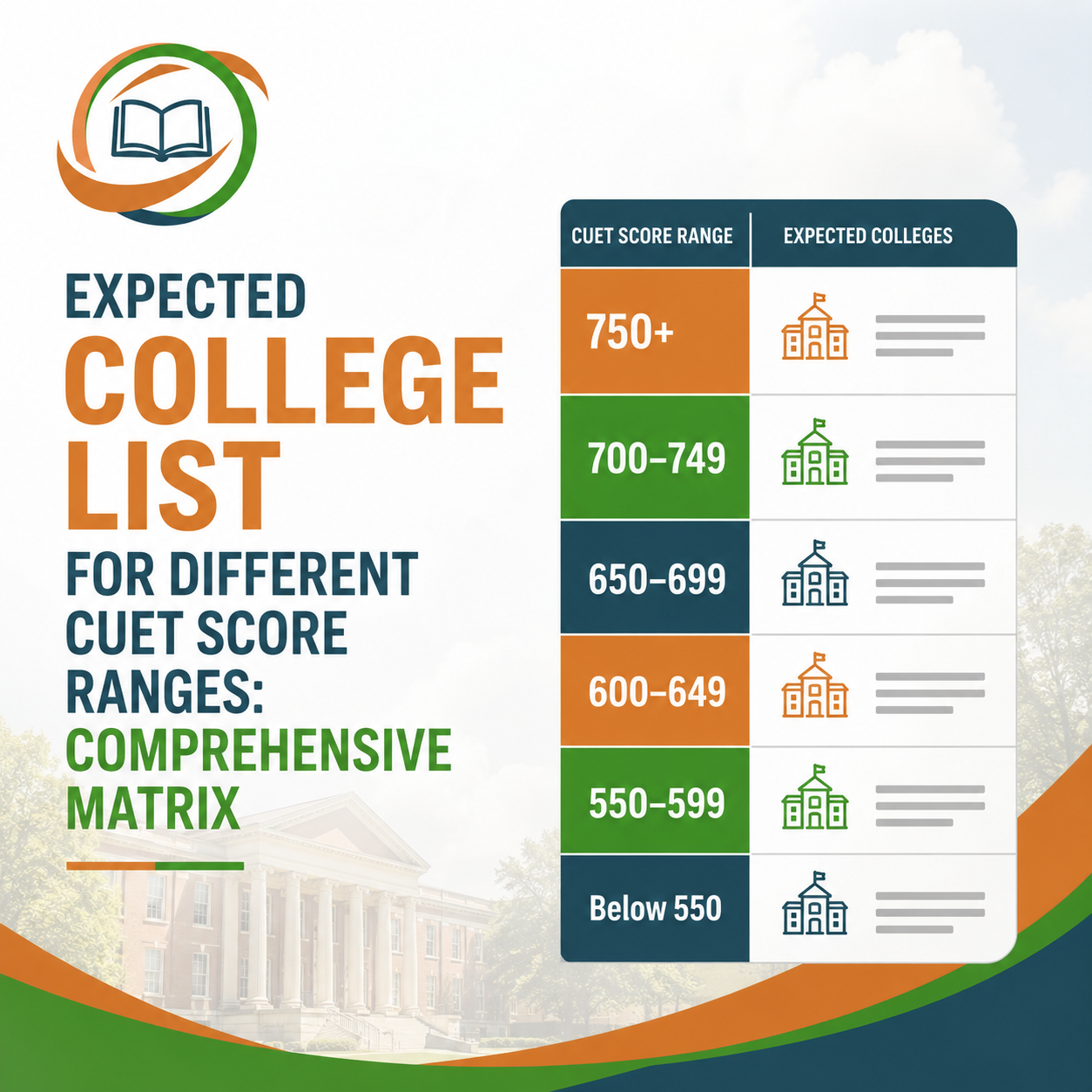
At-a-Glance: Macro Institutional Matrix by Score Range
To help you visualize your standing instantly, the table below aligns normalized score ranges (based on an 800-mark aggregate metric for Arts/Commerce or 600-mark metric for Science) with approximate percentile standings and target categories:
| Score Range (Out of 800 / 600) | Approx. Percentile Band | Institutional Classification | Illustrative Target Destinations |
|---|---|---|---|
| 700 – 800 (Arts/Comm) 530 – 600 (Sciences) | 95.0 – 100.0 | Tier 1: Premier Elite | DU North Campus (SRCC, Hindu, LSR), BHU Main (FMC Top Courses), JNU Language tracks |
| 600 – 699 (Arts/Comm) 450 – 529 (Sciences) | 85.0 – 94.9 | Tier 2: Top Central & State | DU South Campus (Venky, Gargi, ARSD), JMI Main Campus, HCU Integrated Programs, AMU, AUD Delhi |
| 500 – 599 (Arts/Comm) 350 – 449 (Sciences) | 65.0 – 84.9 | Tier 3: Established Regional Central | Pondicherry University, Tezpur University, Central Universities of Rajasthan (CURAJ), Haryana (CUH), Gujarat (CUG) |
| Below 500 (Arts/Comm) Below 350 (Sciences) | Under 65.0 | Tier 4: State, Private & Open | Regional State Universities (DAVV Indore), Premium Private Universities (Amity, LPU, Chandigarh Univ) |
Granular Deep-Dive Analysis of Different CUET Score Ranges
1. The Premier Elite Band: 700 to 800 Marks (Arts/Commerce) or 530+ Marks (Science)
Scoring in this elite tier places you in the top 5% of test-takers nationwide. This is a highly competitive bracket that unlocks India’s legacy public institutions.
• Target Colleges (Delhi University): This range is standard for North Campus institutions. You can confidently target Shri Ram College of Commerce (SRCC), Hindu College, St. Stephen’s College, Miranda House, Hansraj, and Kirori Mal College for flagship programs like B.Com (Hons), B.A. (Hons) Political Science, Economics, and B.Sc. (Hons) Physics or Mathematics.
• Target Colleges (BHU & JNU): Cleanly clears the thresholds for Banaras Hindu University’s Faculty Main Campus (FMC) for highly sought-after honors like Geography and Economics, alongside Jawaharlal Nehru University’s premium 3-year foreign language programs.
• Strategy: Place these premium destinations at the absolute top of your preference sheets. Because margins are incredibly thin here, your Class 12 board marks remain crucial as automated tie-breakers.
2. The Top Central & State Band: 600 to 699 Marks (Arts/Commerce) or 450 to 529 Marks (Science)
This bracket represents the highly rewarding “sweet spot” of CUET admissions, capturing the 85th to 94th percentile standing. It opens doors to exceptional central campuses.
• Target Colleges (Delhi University): While North Campus honors are less likely for general category applicants, this range is ideal for DU’s South Campus. You can target premium institutions like Sri Venkateswara College, Atma Ram Sanatan Dharma (ARSD), Gargi College, Delhi College of Arts & Commerce (DCAC), and College of Vocational Studies (CVS) for major honors and valuable B.A. Program combinations.
• Target Colleges (Other Hubs): Highly competitive for Jamia Millia Islamia (JMI), Aligarh Muslim University (AMU), University of Hyderabad (HCU) integrated master’s programs, and Dr. B.R. Ambedkar University Delhi (AUD).
• Strategy: Approach preference filling with focus. Opting for a B.A. Program or a B.Com (Program) at a top South Campus college is a reliable tactic to secure a respected degree.
3. The Established Regional Central Band: 500 to 599 Marks (Arts/Commerce) or 350 to 449 Marks (Science)
Earning a score in the 500s indicates solid subject competency, placing you comfortably in the 65th to 84th percentile range. This tier features extensive programmatic choices.
• Target Colleges (Central University Network): This is a strong range for centrally funded institutions located outside primary metro hubs. You can realistically target the Central University of Rajasthan (CURAJ), Central University of Haryana (CUH), Central University of Gujarat (CUG), Central University of Odisha (CUO), Central University of Karnataka (CUK), and Dr. Harisingh Gour University (DHSG Sagar).
• Target Colleges (DU Off-Campus): Accessible for various off-campus evening programs and specific language honors degrees at DU.
• Strategy: These universities receive generous central government funding, maintain modern residential facilities, and feature low tuition fees. They serve as excellent “Target-to-Safe” options on a well-constructed application map.
4. The State, Private & Open Band: Below 500 Marks (Arts/Commerce) or Below 350 Marks (Science)
If your normalized scores land below expectations, your academic track is far from stopped. The CUET ecosystem provides diverse secondary pathways.
• Target Colleges: Highly realistic for prominent state universities like Devi Ahilya Vishwavidyalaya (DAVV Indore) and Barkatullah University. Additionally, top private institutions like Lovely Professional University (LPU), Amity University, and Chandigarh University accept CUET scorecards, frequently awarding substantial merit scholarships and fee waivers to mid-range percentilers.
• Strategy: Focus on participating in spot allocation rounds and mop-up counseling phases, where cutoffs regularly drop as seats clear.
Category-Wise Variance: How Reservation Quotas Shift the Safe Marks Base
The safe score parameters listed across this guide reflect the Unreserved (General Merit) pool. Central institutions strictly follow the central government reservation roster (OBC-NCL, EWS, SC, ST, and PwBD), which heavily shifts the required safe score boundaries:
• OBC-NCL & EWS Candidates: Benefit from a structural relaxation of roughly 20 to 40 marks across major course cutoffs. An OBC candidate carrying a score of 660 can frequently compete for seats that demand a 710 from a General category applicant.
• SC & ST Candidates: Face significantly lower cutoff thresholds. An SC or ST applicant with a score in the 500 to 550 range possesses highly realistic chances of securing a seat across premium North and South Campus programs, provided they clear base subject eligibility rules.
Strategic Counseling Roadmap: Navigating Multiple University Portals
Securing a strong normalized score is only half the battle won; navigating the seat allotment process effectively determines your ultimate success. Implement this professional roadmap:
1. Monitor Independent Registration Portals: There is no single centralized counseling window for all CUET universities. You must independently register on the portals of your target institutions (such as DU’s CSAS link or bhuonline.in), clear their platform processing fees, and submit your custom preference sheets before their separate deadlines.
2. Apply the “Accept and Upgrade” Rule: When an initial allocation round grants you a lower preference option, you must immediately accept the seat and pay the admission fee to hold your spot. You can then select the “Upgrade” route rather than freezing. As high scorers clear out for alternative programs, the queue shifts upward, helping you move toward your dream program.
3. Flawless Subject Mapping Verification: Ensure the specific test papers you attempted in the NTA exam perfectly match the elective course credits verified on your high school board marksheets. Mismatches here can trigger automated system rejections during portal verification.
Conclusion: Navigating Your Admission Horizon
Analyzing the expected college list for different CUET score ranges reveals a highly structured, options-rich admissions environment across India. Whether your normalized marks put you in the elite tiers of Delhi University’s North Campus or map comfortably to the modern, expanding campuses of the newer central universities, a viable path forward exists for every dedicated test-taker.
Remember that your NTA scorecard is only the administrative beginning. Your final outcome relies heavily on how meticulously you follow deadlines across individual university dashboards and how strategically you build your preference entries. Approach the counseling phase with clarity and purpose.
To track live cutoff releases, verify seat matrices, and access custom preference-sheet templates throughout the 2026 counseling season, keep your browser locked to cuet-nta.com.
Frequently Asked Questions
With 750 marks out of 800, you are in an elite bracket. You can target top-tier North Campus colleges under Delhi University (Hindu, Hansraj, Miranda House, Ramjas) for competitive honors programs, alongside premium main-campus tracks at BHU and JNU.
Yes, absolutely. A score of 500 maps perfectly to established regional central institutions such as the Central Universities of Haryana, Rajasthan, Gujarat, and South Bihar, which offer excellent academic infrastructure and low fees.
Yes, 600 out of 800 is a highly strategic score for DU South Campus. It clears the safe score thresholds for B.A. Program combinations, commerce program tracks, and specific honors streams across colleges like ARSD, DCAC, and Ramanujan.
No. The National Testing Agency only formalizes your individual scorecard containing normalized marks and percentiles. Every university drafts its own localized rank lists based on applicants registered on their independent portals.
Raw marks represent your direct test performance (+5 for a correct answer, -1 for negative marking). Normalized scores are calculated via NTA's equi-percentile method across multiple shifts to smooth out differences in paper difficulty.
Stream switching is highly realistic under CUET, but you must adhere to individual university criteria. Delhi University mandates that you must appear in the same subjects you passed in Class 12, calculating your humanities merit using those science scores.
Devi Ahilya Vishwavidyalaya (DAVV Indore), Dr. B.R. Ambedkar University Delhi (AUD), and Panjab University serve as premium public-funded alternatives that offer excellent brand value and career placement records.
Class 12 marks do not carry direct weight in your base merit index. However, they act as the primary tie-breaker. If two candidates carry matching normalized marks for a final seat, the system awards it to the applicant with higher board marks.
Spot rounds are organized late in the counseling cycle to fill vacant seats left by student withdrawals. Borderline candidates or those who didn't receive an initial allotment should participate, as cutoffs drop significantly.
Once your preference sheet closes, its order is absolute. If you place a lower-ranked option above your dream college, the computer will automatically assign you that lower option if your score clears it, blocking you from upgrading.
No Comments yet!