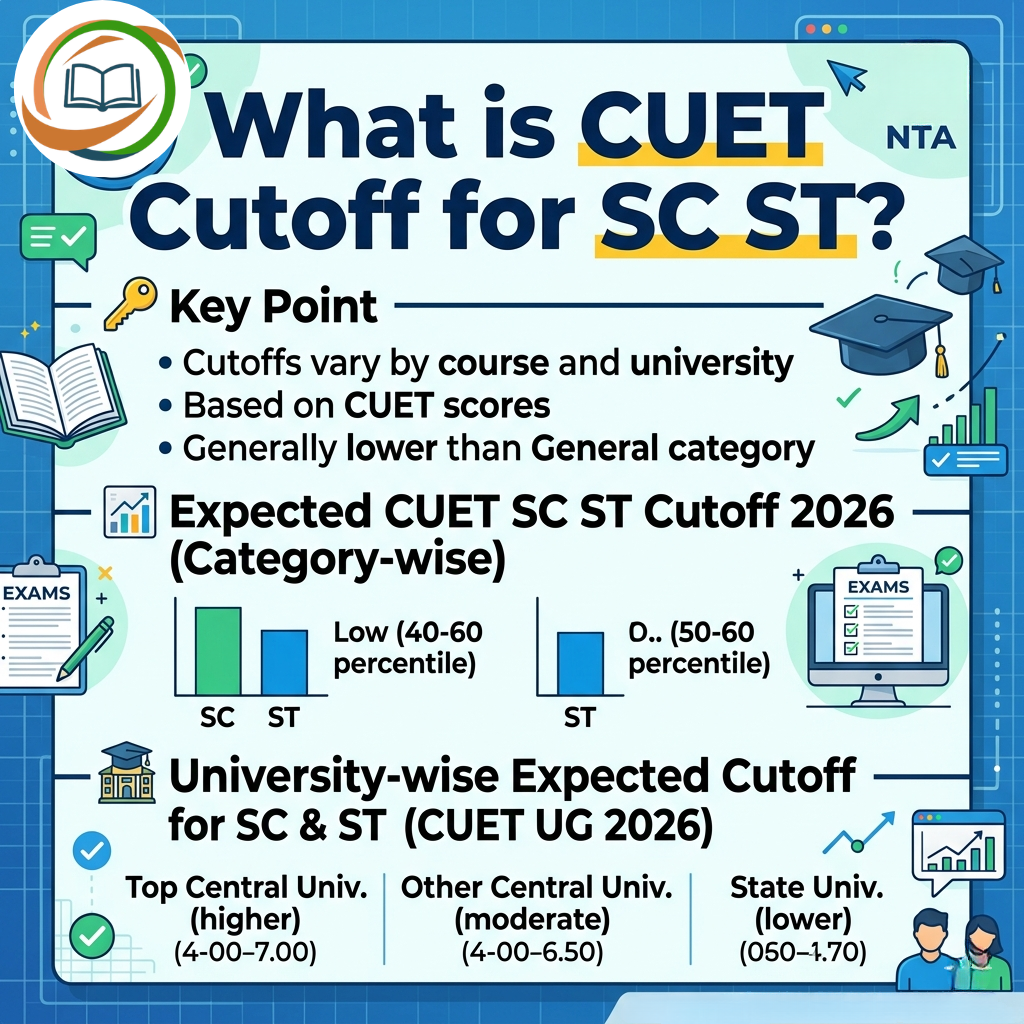
The CUET Cutoff for SC ST 2026 refers to the minimum qualifying score that candidates belonging to the Scheduled Caste (SC) and Scheduled Tribe (ST) categories must secure in the Common University Entrance Test (CUET UG/PG) to be eligible for admission at participating universities.
Unlike a single universal threshold, the CUET cutoff is determined individually by each participating university after NTA declares the results. This means the minimum score required for Delhi University may differ significantly from that of BHU, JNU, or a state university. Reserved category candidates benefit from lower cutoffs compared to the General category, reflecting India’s constitutional reservation policy.
🔑 Key Point: NTA does not release a single CUET cutoff. Every participating university publishes its own course-wise and category-wise cutoff list after the CUET result is declared. SC and ST candidates benefit from relaxed cutoff norms under the government reservation policy — typically 15% seats for SC and 7.5% for ST.
For CUET UG 2026, the exam follows a scoring pattern where each subject carries a maximum of 250 marks, and candidates can choose up to 5 subjects. Total marks depend on the subject combination selected. Understanding where SC and ST cutoffs typically land — based on previous years — helps you set a realistic target score.
Expected CUET SC ST Cutoff 2026 (Category-wise)
Based on the patterns observed in CUET UG 2024 and 2025, along with projected competition levels for 2026, the expected category-wise cutoff ranges are as follows:
| Category | Cutoff out of 250 (per subject) |
|---|---|
| General | 180-230 |
| OBC-NCL | 150-200 |
| SC | 120-170 |
| ST | 100-155 |
These figures represent the expected admission cutoff for popular UG courses at mid-to-top-tier central universities. Cutoffs for less competitive courses or regional/state universities are lower. Science and commerce courses (like B.Sc. Physics, B.Com Hons) tend to have higher cutoffs even within reserved categories at premier institutions.
📌 Note: The minimum eligibility marks required to apply for most CUET-participating universities is 45% in Class 12 for SC/ST/OBC-NCL candidates (compared to 50% for General). This is separate from the admission cutoff set by individual colleges.
University-wise Expected Cutoff for SC & ST (CUET UG 2026)
The table below gives a comprehensive view of the expected CUET UG 2026 cutoff marks for SC and ST candidates across top central universities and popular undergraduate courses. These projections are based on 2024–2025 admission data and current application trends.
| University | Course | General | SC | ST |
|---|---|---|---|---|
| Delhi University (DU) | BA (Hons) Economics | 220–230 | 165–180 | 145–160 |
| Delhi University (DU) | B.Com (Hons) | 210–225 | 155–175 | 135–155 |
| Delhi University (DU) | B.Sc. (Hons) Computer Science | 215–228 | 160–178 | 140–160 |
| Delhi University (DU) | BA (Hons) Political Science | 200–218 | 148–168 | 128–150 |
| Banaras Hindu University (BHU) | B.Sc. (Hons) Physics | 195–215 | 145–165 | 125–148 |
| Banaras Hindu University (BHU) | BA (Hons) English | 185–205 | 138–158 | 115–138 |
| Banaras Hindu University (BHU) | B.Com (Hons) | 190–210 | 140–162 | 118–142 |
| Jawaharlal Nehru University (JNU) | BA (Hons) / Integrated Programs | 180–210 | 130–160 | 110–140 |
| Jamia Millia Islamia (JMI) | BA (Hons) Political Science | 175–200 | 128–152 | 108–132 |
| Aligarh Muslim University (AMU) | BA / B.Com Programs | 170–195 | 122–148 | 100–128 |
| Hyderabad University (UoH) | BA / B.Sc. Programs | 165–185 | 115–140 | 95–120 |
| Allahabad University | BA / B.Sc. Programs | 155–175 | 108–132 | 88–115 |
| Punjab University | BA / B.Com Programs | 150–170 | 105–130 | 85–110 |
*All marks are out of 250 per subject. These are expected ranges based on 2024–25 trends. Actual cutoffs will be released by universities after CUET UG 2026 results.
DU CUET Cutoff for SC ST 2026 – Delhi University
Delhi University remains the most sought-after destination for CUET aspirants, and it consistently records among the highest cutoff scores in India. However, SC and ST candidates benefit from a meaningful relaxation under the reservation system.
For popular DU colleges like Miranda House, SRCC, Hindu College, and Lady Shri Ram (LSR), the General category cutoff can touch 220–230 marks in subjects like Economics and B.Com (Hons). In contrast, SC candidates can expect admission in the 155–180 range, while ST candidates generally qualify in the 135–160 range for the same courses.
💡 DU CUET SC ST Insight: DU uses the CSAS (Common Seat Allocation System) portal for admissions. After CUET UG results are declared, candidates must register separately on the DU CSAS portal. Seat allocation is done based on CUET scores, category, and college preferences.
At top DU colleges, even within the SC/ST quota, competition can be intense for courses like B.Sc. Computer Science and B.Com (Hons). It is advisable for SC/ST aspirants targeting DU to aim for at least 160+ marks per subject to be in a safe zone for most popular programs.
BHU CUET Cutoff for SC ST 2026 – Banaras Hindu University
Banaras Hindu University conducts its own counselling after CUET results. BHU typically has lower cutoffs than DU but remains highly competitive for science and commerce courses. The university releases cutoffs in multiple rounds.
| BHU Course | General | SC | ST |
|---|---|---|---|
| B.Sc. (Hons) Physics | 195–215 | 145–165 | 125–148 |
| B.Sc. (Hons) Chemistry | 190–210 | 140–162 | 120–145 |
| B.Sc. (Hons) Mathematics | 188–208 | 138–160 | 118–142 |
| BA (Hons) History | 175–195 | 128–150 | 108–132 |
| BA (Hons) English | 185–205 | 135–158 | 112–138 |
| B.Com (Hons) | 190–210 | 140–162 | 118–140 |
*Expected figures based on BHU CUET UG 2025 cutoff trends. Marks are out of 250.
JNU & JMI CUET Cutoff for SC ST 2026
Jawaharlal Nehru University (JNU) and Jamia Millia Islamia (JMI) both participate in CUET and release their own cutoffs. JNU is particularly known for its social sciences and language programs, while JMI offers a blend of arts, sciences, and engineering.
At JNU, the General category percentile requirement for popular programs can reach 98–99th percentile. For SC and ST students, the cutoff is considerably lower — broadly in the 130–160 range for SC and 110–140 for ST for most undergraduate integrated and language programs.
At JMI, the expected SC cutoff ranges between 125–155 marks and the ST cutoff around 105–130 marks for popular humanities and social science courses, out of 250.
SC ST Reservation Policy in CUET 2026
Understanding the reservation framework is essential for every SC/ST aspirant appearing in CUET 2026. The Government of India’s reservation policy mandates the following seat distribution for central universities and centrally-funded institutions:
| Category | Reservation % | Eligibility (Class 12 Min.) | CUET Cutoff Trend |
|---|---|---|---|
| General | No reservation (Open merit) | 50% | Highest |
| EWS | 10% | 50% | Close to General |
| OBC-NCL | 27% | 45% | Moderate |
| SC | 15% | 45% | Lower than General |
| ST | 7.5% | 45% | Lowest among all |
SC candidates get 15% of total seats reserved at all central universities, while ST candidates are allocated 7.5% of seats. This means the admission cutoff for SC/ST candidates is evaluated only within their respective quota — not against General category competition. This is why SC/ST cutoffs are significantly lower than General category cutoffs at the same college and for the same course.
📌 Important: Reservation benefits in CUET admissions apply only to central and most state universities. Private universities participating in CUET may follow their own admission policies and may not follow the same reservation percentages.
Factors Affecting CUET SC ST Cutoff 2026
The CUET cutoff for SC/ST 2026 is not a fixed number. Several dynamic factors influence where the cutoff finally lands each year:
- 👥
Number of SC/ST Applicants: A higher number of reserved category applicants competing for the same reserved seats naturally pushes the cutoff upward within the SC/ST quota. - 📋
Exam Difficulty Level: When the CUET paper is relatively easier, students score higher overall, which elevates the cutoff. A tougher paper lowers it across all categories. - 🎓
Seat Availability: The number of reserved seats for SC/ST in each program directly determines how many candidates can be admitted. Fewer seats means a higher competition cutoff. - 🏛️
Course Popularity: High-demand courses like B.Com (Hons), BA Economics, and B.Sc. Computer Science have higher cutoffs even within SC/ST quotas. Less popular programs naturally have lower thresholds. - 📊
NTA Score Normalisation: Since CUET is conducted across multiple sessions, NTA uses a normalisation process to ensure fairness. The normalised score — not raw marks — is what universities use to set cutoffs. - 🏆
University Ranking and Prestige: Top-tier central universities like DU, JNU, and BHU attract more applicants and therefore record higher cutoffs even for reserved categories compared to state or private universities.
How to Score Above the CUET SC ST Cutoff 2026
While the reserved category cutoff gives SC/ST students a meaningful advantage, competition within the SC/ST quota itself can be intense — especially for top courses at DU, BHU, and JNU. The following strategies can help you score well above the cutoff and maximize your admission chances:
📚 Master the NCERT Base
Most CUET domain subject questions are NCERT-aligned. A thorough command of Class 11 and 12 NCERT textbooks is your strongest foundation.
🧪 Practice Mock Tests
Regular mock tests on the official NTA pattern help you improve speed and accuracy. Aim to attempt 3–4 full-length mocks per week in the final month.
📅 Plan Subject-wise
Identify your strongest domain subjects and allocate more preparation time to them. Focus on securing 180+ in your top 2–3 subjects for a competitive score.
🎯 Analyse Previous Cutoffs
Study 2023, 2024, and 2025 SC/ST cutoffs for your target university and course. Set a score 15–20 marks above the historical SC/ST cutoff as your personal target.
⚡ Focus on General Test
Several universities like JNU and BHU consider the General Test score heavily. A strong score in this section can improve your overall percentile significantly.
📝 Apply to Multiple Universities
Don’t limit yourself to one university. Apply to 5–8 universities where your expected score qualifies under SC/ST cutoffs, increasing your chances of securing a seat.
Conclusion
The CUET Cutoff for SC ST 2026 offers reserved category candidates a structured and fair pathway to some of India’s premier universities. With SC cutoffs typically ranging from 120–180 marks and ST cutoffs from 100–160 marks per subject (out of 250) at top central universities, the bar is achievable — but competitive within the quota.
The key is not just to meet the minimum cutoff, but to aim for a score 15–20 marks above historical trends to ensure a strong position in the merit list. Plan your preparation strategically, focus on NCERT-aligned domain subjects, and apply to multiple universities to maximize your admission prospects in 2026.
Stay tuned to cuet-nta.com for the latest updates on CUET 2026 results, university-wise SC/ST cutoff announcements, counselling schedules, and more.
Frequently Asked Questions
For popular courses like B.Com (Hons) and BA Economics at DU, SC candidates are expected to need approximately 155–180 marks out of 250 per subject. For less competitive DU courses, the SC cutoff may be 120–145 marks.
No. Each participating university releases its own CUET cutoff independently. Top central universities like DU and BHU have higher SC/ST cutoffs than regional or state universities. Always check the official website of your target university.
While there is no fixed universal qualifying mark, ST candidates are generally expected to qualify with scores in the 100–155 range per subject (out of 250), depending on the university and course. ST cutoffs are the lowest among all categories due to the 7.5% reservation mandate.
NTA does not release any admission cutoff. It only declares the CUET result and shares scores with universities. Each participating university then separately releases its cutoff list for General, EWS, OBC, SC, and ST categories.
Yes. SC/ST reservation benefits at central universities are available to candidates from any state, provided they hold a valid SC/ST certificate issued by the competent authority in their home state. The certificate must be submitted at the time of counselling.
For SC candidates targeting popular programs at DU or BHU, a score of 165+ per subject (out of 250) is generally considered safe. For highly competitive programs like B.Sc. Computer Science at DU, aim for 175+ to ensure a strong position in the merit list.
CUET UG 2026 results are expected in July 2026. Participating universities will release their SC/ST category-wise cutoff lists within a few weeks of the result declaration, typically in August–September 2026, as part of their admission/counselling process.
No Comments yet!