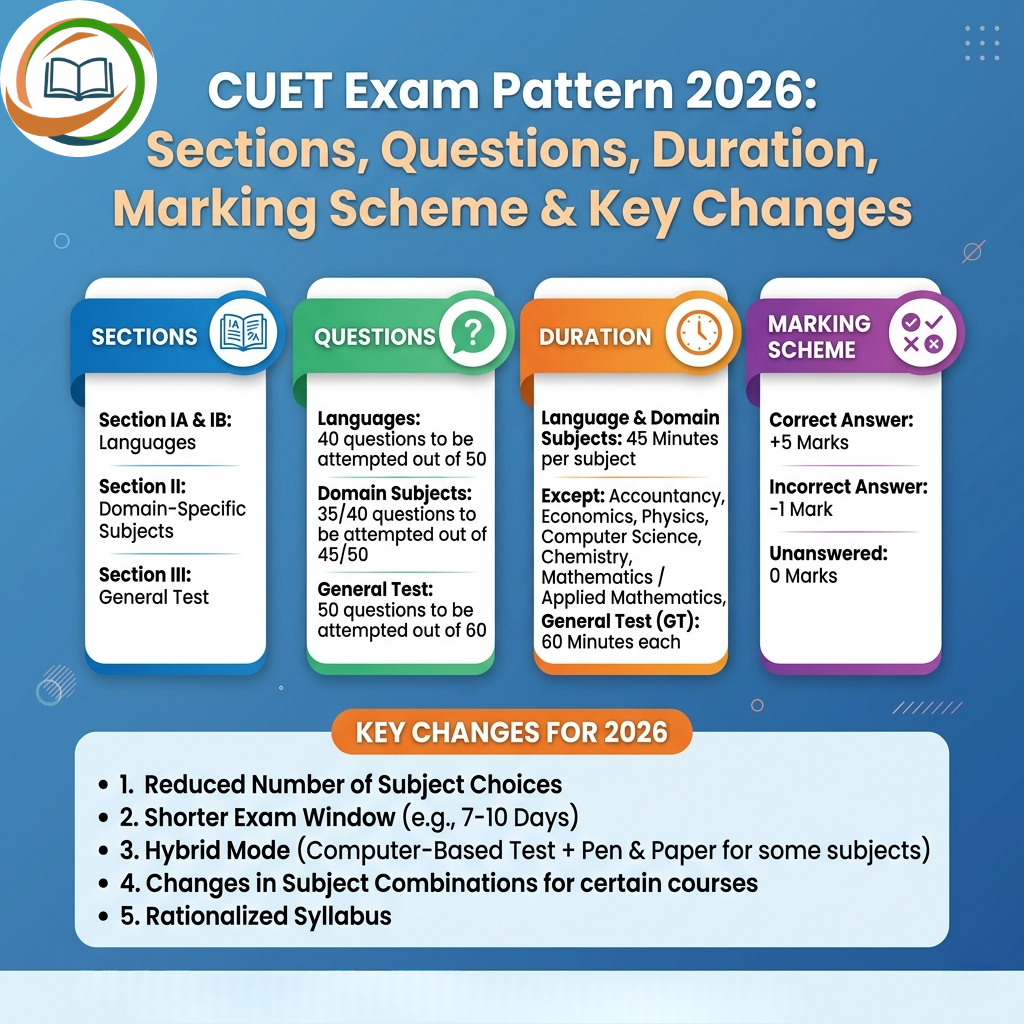
Understanding the CUET Exam Pattern 2026 is the first and most essential step in building a winning preparation strategy. Before you open a single NCERT textbook, you must know exactly how the exam is structured — how many sections there are, how many questions you must attempt, how long each paper lasts, how marks are awarded, and what has changed from previous years.
The CUET UG 2026 exam pattern has been released along with the official notification by the National Testing Agency (NTA) on 3rd January 2026 on its official website, cuet.nta.nic.in. This comprehensive guide covers every aspect of the CUET UG 2026 exam pattern — section-wise breakdown, question format, duration, marking scheme, key changes for 2026, subject combinations, and smart preparation tips.
CUET Exam Pattern 2026: Quick Overview
| Feature | Details |
|---|---|
| Conducting Body | National Testing Agency (NTA) |
| Exam Name | CUET UG 2026 |
| Official Notification Released | January 3, 2026 |
| Exam Mode | Computer-Based Test (CBT) only |
| Question Type | Multiple Choice Questions (MCQs) |
| Total Sections | 3 — Language, Domain Subjects, General Test |
| Total Subjects Available | 37 subjects |
| Maximum Subjects a Candidate Can Choose | 5 subjects |
| Marks per Correct Answer | +5 marks |
| Marks Deducted per Wrong Answer | −1 mark |
| Marks for Unattempted Question | 0 marks |
| Max Marks per Subject | 250 marks |
| Exam Duration per Subject | 60 minutes (uniform for all papers) |
| Optional Questions | None — all questions are compulsory |
| Exam Medium | English + 12 regional languages (13 total) |
| CUET 2026 Exam Dates | May 11–31, 2026 |
| Result (Expected) | First week of July 2026 |
| Official Website | cuet.nta.nic.in |
Key Changes in CUET Exam Pattern 2026
NTA has introduced several significant changes to the CUET UG exam pattern for 2026. Every candidate must be fully aware of these updates before finalizing their preparation strategy:
Change 1 — Number of Subjects Reduced from 63 to 37
The number of subjects has been reduced from 63 to 37, with Entrepreneurship, Teaching Aptitude, and Legal Studies removed. This streamlines the exam and narrows the preparation scope.
Change 2 — No Optional Questions
The exam will no longer include optional questions, ensuring a uniform question pattern. In previous years, candidates could attempt a selection from a larger pool. In CUET 2026, all questions in each paper are compulsory.
Change 3 — Uniform 60-Minute Duration for All Papers
Each subject exam will now have a fixed duration of 60 minutes. This is a change from earlier years where different sections had varying durations (45 minutes for languages vs 60 minutes for domain subjects).
Change 4 — Maximum 5 Subjects per Candidate
Candidates are allowed to select up to five subjects, a reduction from the previous limit of six.
Change 5 — No Subject Restrictions Based on Class 12
Students can now choose any subject for CUET UG, regardless of their Class 12 subjects. This provides greater flexibility, especially for candidates who wish to change streams.
Change 6 — General Aptitude Test for Discontinued Subjects
Admissions for subjects that have been removed will be based on General Aptitude Test scores. Universities that earlier mapped their programs to discontinued subjects will now use the General Test as an alternative.
CUET 2026 Exam Pattern: Section-Wise Breakdown
CUET UG 2026 is divided into three main sections — Languages (Section I), Domain-Specific Subjects (Section II), and General Test (Section III).
Section I — Language Test
The Language section tests your reading comprehension and language proficiency in the medium you choose. It is a compulsory section for most university programs.
Languages Available in CUET 2026:
The medium of the exam will be in English, Hindi, Assamese, Kannada, Malayalam, Bengali, Gujarati, Marathi, Odia, Punjabi, Tamil, Telugu, and Urdu — a total of 13 languages.
| Feature | Details |
|---|---|
| Number of Languages Available | 13 |
| Questions per Language Paper | 50 MCQs |
| All Questions Compulsory? | Yes — all 50 questions must be attempted |
| Duration | 60 minutes |
| Maximum Score per Paper | 250 marks (50 × 5) |
| What It Tests | Reading comprehension, vocabulary, grammar, language proficiency |
| Maximum Languages a Candidate Can Choose | Up to 2 languages |
Pro Tip: Most candidates choose English or Hindi as their language paper, as these are the most familiar. However, candidates who are native speakers of a regional language may find it advantageous to choose that language for a higher score.
Section II — Domain-Specific Subjects
This is the core academic section of CUET 2026. Domain subjects are directly based on the NCERT Class 12 curriculum and carry the highest weight in the overall merit score for most university programs.
Domain Subjects Available in CUET 2026:
There are a total of 23 domain-specific subjects available in Section II. These span all major academic streams:
Science Stream Subjects: Physics, Chemistry, Biology / Biological Studies, Mathematics, Computer Science / Informatics Practices, Environmental Science
Commerce Stream Subjects: Accountancy / Book Keeping, Business Studies, Economics
Humanities / Arts Stream Subjects: History, Political Science, Geography / Geology, Sociology, Psychology, Philosophy, Home Science, Physical Education, Fine Arts / Visual Arts, Performing Arts
Other Subjects: Agriculture, Mass Media / Mass Communication, Anthropology
| Feature | Details |
|---|---|
| Total Domain Subjects | 23 |
| Questions per Domain Paper | 50 MCQs |
| All Questions Compulsory? | Yes — all 50 questions must be attempted |
| Duration | 60 minutes |
| Maximum Score per Paper | 250 marks (50 × 5) |
| Syllabus Basis | NCERT Class 12 curriculum |
| Maximum Domain Subjects a Candidate Can Choose | Up to 4 domain subjects (within the 5-subject total limit) |
Important: The domain subjects you choose must match the specific subject requirements of your target university and program. Always verify the required subject combination from the official admission prospectus of each university you plan to apply to.
Section III — General Aptitude Test (GAT)
The General Aptitude Test is a broad-based paper that tests a candidate’s general intellectual abilities rather than subject-specific knowledge. It is required by several universities for programs like BBA, B.Com, Integrated Law, Hotel Management, and other non-stream-specific programs.
| Feature | Details |
|---|---|
| Number of Papers | 1 (single General Test) |
| Questions | 50 MCQs |
| All Questions Compulsory? | Yes — all 50 questions must be attempted |
| Duration | 60 minutes |
| Maximum Score | 250 marks |
| Is it Compulsory? | Optional — depends on your target university and program |
Topics Covered in the General Test:
- General Knowledge and Current Affairs (national and international)
- Quantitative Reasoning and Basic Arithmetic
- Numerical Ability
- Logical and Analytical Reasoning
- General Mental Ability
- Language Comprehension and Reading Skills
Note: Check whether the General Aptitude Test is required by your target university before registering for it. Registering for an unnecessary paper does not affect your candidacy, but it adds to exam-day preparation load.
CUET 2026 Exam Pattern: Consolidated Section Summary
| Section | Content | Papers Available | Questions per Paper | Duration | Max Score per Paper |
|---|---|---|---|---|---|
| Section I — Language | Reading comprehension, language proficiency | 13 languages | 50 (all compulsory) | 60 mins | 250 |
| Section II — Domain | NCERT Class 12 subject knowledge | 23 subjects | 50 (all compulsory) | 60 mins | 250 |
| Section III — General Test | Aptitude, reasoning, GK, current affairs | 1 paper | 50 (all compulsory) | 60 mins | 250 |
CUET 2026 Marking Scheme
The marking scheme for CUET UG 2026 is uniform across all sections:
| Response Type | Marks Awarded |
|---|---|
| Correct Answer | +5 marks |
| Wrong / Incorrect Answer | −1 mark |
| Unattempted / Skipped | 0 marks |
| More than one option correct (if applicable) | +5 marks for any correct option marked |
Maximum Marks Calculation
Since every paper in CUET 2026 has 50 compulsory questions at 5 marks each:
Maximum Score per Paper = 50 × 5 = 250 marks
If a candidate chooses 5 subjects, the combined maximum score = 5 × 250 = 1,250 marks
Important Note on No Optional Questions: In CUET 2025 and earlier years, candidates were given a choice of attempting a set number of questions from a larger pool (e.g., attempt 40 out of 50). In CUET 2026, this choice has been removed — all 50 questions in every paper are compulsory. This significantly impacts time management and requires candidates to practice completing all questions within 60 minutes.
CUET 2026 Subject Selection: How to Choose Your 5 Subjects
One of the most critical decisions in CUET 2026 preparation is selecting the right combination of subjects. Here is a structured approach:
Maximum Subject Combinations Allowed
Candidates have the option to select a maximum of 1 language from Section I. It is mandatory for one of the chosen languages to be a domain-specific language. Additionally, in Section II, candidates can choose a maximum of 3 subjects out of the 23 available options. The General Aptitude Test is part of Section III.
The possible combinations within the 5-subject limit are:
Combination A: 1 Language + 4 Domain Subjects Combination B: 1 Language + 3 Domain Subjects + General Test Combination C: 2 Languages + 3 Domain Subjects Combination D: 2 Languages + 2 Domain Subjects + General Test
Step-by-Step Subject Selection Guide
Step 1 — Identify Your Target Universities List all universities and programs you intend to apply to. Each university specifies exact subject requirements in their admission prospectus.
Step 2 — Check Subject Requirements for Each Program Look up the mandatory and optional CUET papers required for each of your target programs. For example, B.Com (Hons.) at DU requires Language + Accountancy OR Maths + 2 others.
Step 3 — Find the Union of All Required Subjects If you are applying to multiple programs with different requirements, your subject selection must cover all required papers across all target programs — within the 5-subject limit.
Step 4 — Prioritize Scoring Subjects Among optional choices, prioritize subjects where your preparation is strongest and where high scores are more achievable.
Step 5 — Confirm Before Submitting Double-check all subject selections before final submission of the CUET application form. Incorrect subject selection cannot be corrected after the application window closes.
CUET 2026 Exam Mode and Delivery
Computer-Based Test (CBT)
The exam will be conducted exclusively in Computer-Based Test (CBT) mode. All questions appear on a computer screen and candidates mark their answers by clicking on-screen options. No pen or paper is used for answering (rough sheets may be provided at the center).
Multiple Shifts and Days
CUET 2026 is conducted across multiple days and 2–3 shifts per day from May 11–31, 2026. A candidate’s specific exam date, shift, and center are mentioned on their admit card released from cuet.nta.nic.in.
Normalization
Since different candidates appear in different shifts with potentially varying paper difficulty, NTA applies score normalization using the equi-percentile method to ensure fair evaluation across all sessions. The final NTA normalized score and percentile on your scorecard are what universities use for merit list preparation.
CUET 2026 vs CUET 2025: Exam Pattern Comparison
| Feature | CUET 2025 | CUET 2026 |
|---|---|---|
| Total Subjects Available | 63 | 37 |
| Optional Questions | Yes (attempt X out of Y) | No — all questions compulsory |
| Duration per Paper | Varied (45 or 60 mins) | Uniform 60 minutes for all |
| Max Subjects per Candidate | 6 | 5 |
| Exam Mode | CBT | CBT |
| Subject Restrictions | Based on Class 12 stream | No restrictions — any subject |
| Marking Scheme | +5/−1 | +5/−1 (unchanged) |
| Max Score per Subject | 200 (40 × 5) | 250 (50 × 5) |
CUET 2026 Exam Pattern: What the Changes Mean for Your Preparation
All 50 Questions Compulsory — Time Management Is Now Critical
With no optional questions, you must attempt all 50 questions in 60 minutes — that is just 72 seconds per question on average. Speed and accuracy are now more important than ever. Practice completing full 50-question papers within the time limit from the very start of your preparation.
Reduced Subjects = Focused Preparation
With only 37 subjects instead of 63, the preparation scope is more defined. Focus entirely on the subjects you have selected and go deep into the NCERT Class 12 content for each.
Higher Maximum Score per Subject
With all 50 questions now compulsory (instead of attempting 40 out of 50), the maximum per-subject score has increased to 250 from the earlier 200. This means a single high-scoring subject can contribute more to your aggregate — making consistent performance across all chosen subjects even more important.
No Stream Restrictions — Strategic Stream Choices Now Possible
Students who were forced into specific subject combinations based on their Class 12 stream can now choose any subject. A commerce student who is strong in Geography or a science student who wants to take History can do so freely.
CUET 2026 Preparation Tips Based on the New Exam Pattern
1. Master NCERT Class 12 Cover to Cover
All domain subject questions are based exclusively on NCERT Class 12 textbooks. Complete every chapter — including in-text questions, examples, and end-of-chapter exercises — before attempting any supplementary material.
2. Practice All 50 Questions in 60 Minutes
Since all 50 questions are now compulsory and the time is fixed at 60 minutes, practice this specific format from day one. Take timed mock tests with exactly 50 questions and 60-minute limits to build speed.
3. Be Strategic About Negative Marking
With all questions compulsory, you cannot simply skip difficult questions. Develop strategies for educated guessing — eliminating 2 options brings your success probability to 50%, making it worth attempting rather than leaving.
4. Use NTA’s Official Mock Tests
NTA provides official mock tests on its website that simulate the actual CBT interface. These are the most accurate way to practice for the computer-based format and should be used alongside subject preparation.
5. Map Subjects to University Requirements First
Before starting preparation, finalize your subject list based on the requirements of your top 5 target universities. Do not prepare subjects you will not need — focus your time on the subjects that directly serve your admission goals.
6. Practice Current Affairs Regularly for General Test
If the General Test is part of your selected combination, maintain a daily habit of reading news and tracking national and international events. Current affairs questions in the GAT cannot be prepared from NCERT alone.
Final Word
The CUET Exam Pattern 2026 brings meaningful changes that every aspirant must internalize before beginning their preparation — fewer subjects, no optional questions, uniform 60-minute duration, and a higher per-subject maximum score. These are not just technical details; they fundamentally shape how you study, how you take the exam, and how you plan your time on the day of the test.
Align your preparation with the 2026 pattern from day one: master your chosen NCERT subjects completely, practice all 50-question papers within 60 minutes, and map your subject combination to the exact requirements of your target universities.
Appear for CUET UG 2026 on May 11–31, 2026 with a complete understanding of the exam structure, and give yourself the best possible chance of securing a seat at your dream university.
Stay connected with cuet-nta.com for the latest updates on CUET 2026 — official notifications, admit card, answer key, result, cutoffs, and subject-wise preparation guides — all updated in real time.
Frequently Asked Questions
CUET UG 2026 is a Computer-Based Test (CBT) consisting of three sections — Language Test (Section I), Domain-Specific Subjects (Section II), and General Aptitude Test (Section III). Each paper has 50 compulsory MCQs, carries 250 marks, and has a duration of 60 minutes. The marking scheme is +5 for correct and −1 for wrong answers.
Candidates can choose a maximum of 5 subjects in total across all sections in CUET 2026. This is a reduction from the earlier limit of 6 subjects in CUET 2025.
Yes. CUET 2026 has removed the optional question format. All 50 questions in every paper are compulsory — candidates must attempt all of them within the 60-minute time limit.
The maximum score per subject in CUET 2026 is 250 marks (50 questions × 5 marks each). If a candidate selects 5 subjects, the combined maximum is 1,250 marks.
All CUET 2026 papers — whether Language, Domain Subject, or General Test — have a uniform duration of 60 minutes. This is a change from previous years when language papers were 45 minutes long.
CUET 2026 offers 37 subjects in total — 13 language papers in Section I, 23 domain subjects in Section II, and 1 General Aptitude Test in Section III. This is reduced from 63 subjects in CUET 2025.
Yes. Every incorrect answer results in a deduction of 1 mark (−1). Unattempted questions score 0. Since all 50 questions are now compulsory, candidates must balance careful attempts with the risk of negative marking.
Yes. CUET 2026 has removed stream-based restrictions. A candidate who studied Commerce in Class 12 can now choose Physics or History as a domain subject in CUET, provided the target university accepts that combination for the program.
No. The General Aptitude Test is optional and depends on the specific requirements of your target university and program. Many programs do not require the General Test, while some programs (especially in BBA, B.Com, and interdisciplinary fields) specifically require it.
The CUET UG 2026 exam pattern was officially released by NTA on January 3, 2026, as part of the official CUET UG 2026 notification published on cuet.nta.nic.in.
No Comments yet!