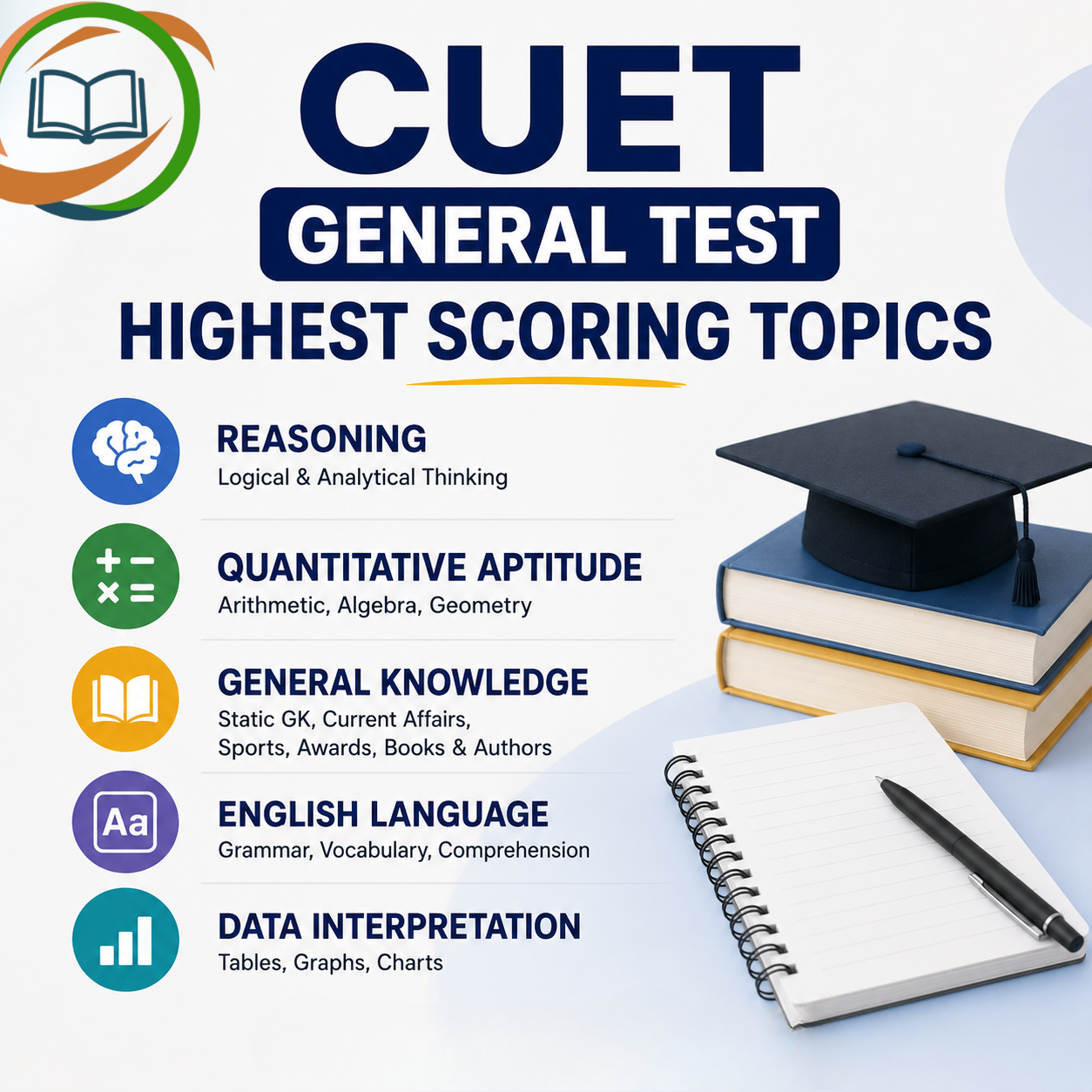
Topic-Wise Scoring Analysis, Section Weightage, Deep-Dive Preparation Strategies, 60-Minute Execution Blueprint & 8-Week Study Plan for CUET General Test 2026
The CUET General Test is one of the most strategically important papers in the entire CUET 2026 examination — and one of the most misunderstood. For students applying to programmes that require the General Test as part of their CUET section, it directly determines merit rank. For students using it as a supplementary paper to strengthen their CSAS aggregate, it can be the difference between a top-preference college allocation and a fallback option. Yet most CUET aspirants approach it with far less structure than their domain subject papers — assuming that ‘general awareness’ is enough, or that no focused preparation is possible because there is no fixed textbook.
Both assumptions are wrong, and this guide from cuet-nta.com corrects them comprehensively. The CUET General Test has a highly consistent question pattern across all years since 2022. Specific topics — Number Series, Analogies, Coding-Decoding, Blood Relations, Percentage, Profit/Loss, Reading Comprehension — appear in every General Test paper with predictable frequency and manageable difficulty. Knowing which topics deliver the highest scores, how to solve them using the most efficient techniques, and how to execute the 60-minute paper with maximum precision is fully achievable through structured preparation. This guide gives you every element of that preparation system.
CUET General Test Highest Scoring Topics 2026: Quick Reference
| Parameter | Details |
| Article Topic | CUET General Test Highest Scoring Topics 2026 |
| Exam | CUET UG 2026 — Common University Entrance Test |
| Paper | Section III — General Test |
| Conducting Body | National Testing Agency (NTA) |
| Total Questions | 60 questions — 50 to be attempted in 60 minutes |
| Marking Scheme | +5 for correct | −1 for incorrect | 0 for unattempted |
| Maximum Score | 250 marks |
| Paper Structure | Quantitative Reasoning, Logical Reasoning, GK/Current Affairs, English, Numerical Ability |
| Highest Scoring Section | Logical Reasoning & Quantitative Reasoning (combined ~40% weightage) |
| Easiest Topics for Quick Wins | Number Series, Analogies, Direction Sense, Blood Relations, Basic Arithmetic |
| Preparation Source | Reasoning workbooks + Class 6–10 NCERT Maths + Daily current affairs reading |
| Official CUET Portal | cuet.nta.nic.in |
| Article Source | cuet-nta.com |
CUET General Test 2026: Structure, Pattern and Marking Scheme
Before identifying the highest scoring topics, every aspirant must have a precise understanding of the General Test’s structure. Unlike domain subject papers, which present 50 questions and require 40 to be attempted in 45 minutes, the CUET General Test presents 60 questions of which 50 must be attempted within 60 minutes. This gives you an average of 72 seconds per question — marginally more than domain papers — but the broader topic coverage and section-switching demands make time management equally important.
Section-Wise Weightage and Scoring Priority
The General Test covers five broad areas, each with distinct question density, difficulty profile, and scoring potential. Understanding this structure allows you to allocate your 60 minutes strategically — spending more time where score return is highest and less where uncertainty risk is greatest:
| Section | Approx. Questions | Max Marks | Avg. Difficulty | Scoring Potential | Priority Level |
| Logical Reasoning | 10–14 | 55–70 | Easy–Moderate | Very High | Priority 1 |
| Quantitative Reasoning | 10–13 | 50–65 | Easy–Moderate | Very High | Priority 1 |
| Numerical Ability | 6–8 | 30–40 | Easy | Very High | Priority 2 |
| English Language | 8–12 | 40–60 | Easy | High | Priority 2 |
| General Knowledge | 8–12 | 40–60 | Moderate | Moderate | Priority 3 |
| Current Affairs | 6–10 | 30–50 | Moderate | Moderate | Priority 3 |
The data is clear: Logical Reasoning and Quantitative Reasoning are jointly your highest-priority sections — not because they are the easiest individually, but because they offer the combination of predictable question types, reliable technique-based solving, low negative-marking risk for prepared students, and the highest total marks potential in the paper. GK and Current Affairs, while important, are lower-priority in pure marks-per-preparation-hour terms due to their factual unpredictability.
Top 20 Highest Scoring Topics in CUET General Test 2026
The following master table ranks the twenty highest-scoring topics in the CUET General Test based on four criteria: question frequency across CUET 2022–2025 papers, average achievable accuracy for adequately prepared students, negative-marking risk per question, and marks contribution to the total score. Green rows represent the highest-scoring, most accessible topics; amber rows indicate moderate difficulty.
| Rank | Topic | Section | Questions (Est.) | Difficulty | Why It Scores High |
| 1 | Number Series & Sequences | Logical Reasoning | 3–5 | Easy | Pattern recognition — no formula needed; very fast to solve once trained |
| 2 | Analogies (Verbal & Non-Verbal) | Logical Reasoning | 2–4 | Easy | Vocabulary + logic combo; high accuracy for prepared students |
| 3 | Coding–Decoding | Logical Reasoning | 2–4 | Easy | Rule-based; once pattern identified, answer is certain — zero negative marking risk |
| 4 | Blood Relations | Logical Reasoning | 2–3 | Easy | Diagram method makes answers definitive; eliminates guessing entirely |
| 5 | Direction Sense | Logical Reasoning | 2–3 | Easy | Diagrammatic approach; fast and accurate with basic practice |
| 6 | Syllogisms | Logical Reasoning | 2–3 | Easy–Moderate | Venn diagram method gives systematic certainty; no memorisation required |
| 7 | Percentage & Ratio | Quantitative Reasoning | 3–5 | Easy–Moderate | Foundation of data interpretation; appears across multiple question types |
| 8 | Profit, Loss & Discount | Quantitative Reasoning | 2–4 | Easy–Moderate | Formula-based; limited concept set; high return on focused practice |
| 9 | Time, Speed & Distance | Quantitative Reasoning | 2–3 | Moderate | Classic formula application; consistent appearance across all CUET years |
| 10 | Simple & Compound Interest | Quantitative Reasoning | 2–3 | Easy | Short formulae; calculation is fast; near-certain correct answer if formula known |
| 11 | Average, Mean & Mixture | Quantitative Reasoning | 2–3 | Easy | Single-step or two-step arithmetic; very high scoring efficiency |
| 12 | Data Interpretation (Tables/Bar) | Quantitative Reasoning | 3–5 | Moderate | High question density per data set; single table yields 3–5 marks |
| 13 | Number System & LCM/HCF | Numerical Ability | 2–3 | Easy | Class 6–8 level arithmetic; completely accessible with basic preparation |
| 14 | Squares, Cubes & Surds | Numerical Ability | 2–3 | Easy | Recall-based; quick retrieval of tables; high accuracy achievable |
| 15 | Reading Comprehension | English Language | 4–6 | Easy | Single passage — 4–6 questions; strong comprehension returns 20–30 marks |
| 16 | Fill in the Blanks (Grammar) | English Language | 3–4 | Easy | Rule-based grammar; NCERT Class 9–10 grammar aligns perfectly |
| 17 | Vocabulary (Synonyms/Antonyms) | English Language | 2–3 | Easy–Moderate | Broad vocabulary base rewards heavily; context elimination works reliably |
| 18 | Sentence Correction | English Language | 2–3 | Easy–Moderate | Grammar rule application; elimination technique very effective |
| 19 | Indian Polity & Constitution | General Knowledge | 2–4 | Moderate | High-frequency factual recall; NCERT Political Science chapters align well |
| 20 | Science & Technology (Current) | Current Affairs | 2–3 | Moderate | Recent tech launches, space missions, health breakthroughs — predictable categories |
Topic frequency estimates are based on analysis of CUET General Test papers from 2022–2025. Actual question distribution in CUET 2026 may vary within the ranges shown. The pattern has been highly consistent across four years — but NTA retains discretion to adjust section weightage annually. Prepare all sections rather than exclusively the top-ranked topics.
Logical Reasoning: Highest Scoring Section — Topic-by-Topic Mastery Guide
Logical Reasoning is the single highest-scoring section of the CUET General Test by marks-per-question efficiency. Questions are almost entirely technique-driven — meaning a student who learns the correct solution method for each question type can answer reliably and quickly without depending on memorised content. This makes Logical Reasoning the section with the highest preparation-to-score conversion rate in the entire General Test.
| Topic | Expected Questions | Difficulty | Key Technique to Master |
| Number Series | 3–5 | Easy | Identify the rule: +n, ×n, alternating, prime, square, cube series. Write differences between consecutive terms first. |
| Analogies | 2–4 | Easy | Ask: what is the relationship between pair 1? Apply identical relationship to pair 2. Works for word, letter, and number analogies. |
| Coding–Decoding | 2–4 | Easy | Write both the original word and its code aligned character by character. The shift pattern becomes immediately visible. |
| Blood Relations | 2–3 | Easy | Draw a family tree diagram for every question — never solve mentally. Diagram prevents ambiguity completely. |
| Direction Sense | 2–3 | Easy | Draw compass direction grid on rough paper. Plot each move physically. Final position from start point gives the answer. |
| Syllogisms | 2–3 | Easy–Moderate | Draw Venn diagrams for all given statements before evaluating conclusions. Never use pure intuition — diagram always. |
| Seating Arrangement | 2–3 | Moderate | Linear: anchor a fixed person and build outward. Circular: fix one and arrange relative positions. Tabulate if complex. |
| Ranking & Order | 1–2 | Easy | Convert the statement into an inequality chain. Read from both ends to extract the asked rank. |
| Statement & Assumption | 1–2 | Moderate | An assumption is unstated but essential for the statement to be true. Test each option: ‘Is this already implied?’ |
| Mirror & Water Image | 1–2 | Easy | Mirror image: flip left-right only. Water image: flip top-bottom only. Quick identification after basic drill practice. |
The Core Principle of Logical Reasoning Mastery
Every Logical Reasoning question type has a definitive solution technique — a systematic method that, when applied correctly, produces the unambiguous correct answer without requiring intuition, guessing, or unusual intelligence. The techniques are: draw family tree diagrams for Blood Relations, draw compass grids for Direction Sense, write difference sequences for Number Series, align code characters for Coding-Decoding, and draw Venn diagrams for Syllogisms. The universal principle is: always use a physical notation method (diagram, table, or sequence) rather than solving mentally. Mental solving under time pressure is the primary source of avoidable errors in Logical Reasoning.
Building Logical Reasoning from zero to CUET-competitive standard requires approximately 3–4 weeks of daily practice: learning the technique for each question type in the first week, applying it to 30–40 questions per topic in the second week, and integrating all types into timed mixed-topic sessions in weeks three and four. Students who follow this progression consistently achieve 80–90% accuracy in Logical Reasoning by the end of the preparation window.
Quantitative Reasoning: Formula Mastery Converts to Guaranteed Marks
Quantitative Reasoning in the CUET General Test draws from arithmetic, basic algebra, and data interpretation — all covered fully in NCERT Mathematics for Classes 6 through 10. No Class 11 or 12 mathematics is required for the General Test’s quantitative component. This is a critical insight: students who are intimidated by the idea of ‘maths questions’ in the General Test are typically imagining Class 12-level complexity that does not exist in this section.
| Topic | Expected Questions | Difficulty | Key Formula / Approach |
| Percentage | 2–3 | Easy | Part/Whole × 100. Learn percentage equivalents of fractions (1/4=25%, 1/8=12.5%). Fraction conversion speeds calculation. |
| Ratio & Proportion | 2–3 | Easy | Cross-multiply for proportions. For ratio problems, assign variable k and solve. Componendo-dividendo for quick division. |
| Profit, Loss & Discount | 2–4 | Easy–Moderate | Profit% = (Profit/CP)×100. Discount% = (Discount/MP)×100. SP = MP × (1−d/100). Memorise both CP and SP forms. |
| Simple & Compound Interest | 2–3 | Easy | SI = P×R×T/100. CI = P[(1+R/100)^T − 1]. For 2 years CI: SI + SI²/100. This shortcut saves significant time. |
| Average | 2–3 | Easy | Average = Sum/Count. For weighted average: (n₁x₁ + n₂x₂)/(n₁+n₂). Alligation diagram works for mixture problems. |
| Time, Speed & Distance | 2–3 | Moderate | D = S×T. Relative speed: same direction = difference; opposite = sum. Train length problems: include both lengths. |
| Time & Work | 2–3 | Moderate | Work rate = 1/days. Combined rate = sum of individual rates. Use LCM method to find total work in complex problems. |
| Data Interpretation | 3–5 | Moderate | Read the table/chart title and units first. Calculate what is asked — do not over-read. Approximate where precision is not needed. |
| Number System | 2–3 | Easy | Divisibility rules for 2–13. Remainder theorem for cyclicity. Even/odd properties in products and sums. |
| LCM & HCF | 1–2 | Easy | HCF: prime factorisation, take minimum powers. LCM: take maximum powers. LCM × HCF = Product of two numbers. |
How to Build Calculation Speed for Quantitative Reasoning
Calculation speed is the determining factor between students who complete the Quantitative Reasoning section within time and those who run out of minutes on what should be accessible questions. Build speed through three specific daily habits: first, memorise multiplication tables up to 20 × 20 until they are instant recall rather than computed recall. Second, learn fraction-to-decimal conversions for all common fractions (1/3, 1/6, 1/7, 1/8, 1/9, 2/3, 3/4) to eliminate the calculation step entirely in percentage problems. Third, practise two-digit multiplication using the vertical method until it takes under 10 seconds per calculation. These three habits, developed over 3–4 weeks of daily drill, produce a measurable and significant reduction in time per quantitative question.
Data Interpretation: The Highest Mark-Density Topic
Data Interpretation questions appear in sets — a single table or chart generates 3–5 questions. This makes DI the highest mark-density topic in the Quantitative Reasoning section: one well-understood data set yields 15–25 marks. The preparation approach is specific: practise reading tables, bar charts, pie charts, and line graphs under 30-second comprehension windows. For each DI set, read the title, column/row headers, and units before reading any actual data values. This orientation step prevents the most common DI error — misunderstanding what the data represents and answering based on a wrong frame. Practise 3 full DI sets daily for two weeks to build the comprehension speed that makes this section reliably high-scoring.
English Language & Numerical Ability: Fast Points for Prepared Students
The English Language and Numerical Ability sections of the CUET General Test are the most immediately accessible for students who have maintained reasonable English reading habits and basic arithmetic proficiency through Class 10. They require the least specialised preparation of any General Test section and deliver reliable marks for students who approach them with the right techniques:
| Topic | Section | Questions | Scoring Strategy |
| Reading Comprehension | English | 4–6 | Read the last question first to know what to look for. Then read the passage actively. Answer inference questions last — spend maximum 8 minutes per passage. |
| Fill in the Blanks | English | 3–4 | Grammar fills: identify the part of speech required (verb/noun/adjective). Context fills: read the sentence both before and after the blank for meaning consistency. |
| Synonyms & Antonyms | English | 2–3 | Use context elimination: a synonym should fit naturally in the original sentence. Build vocabulary from quality reading — The Hindu editorials and NCERT English passages are ideal sources. |
| Sentence Correction | English | 2–3 | Scan for subject-verb agreement first, then tense consistency, then pronoun reference. Read the corrected version aloud mentally — grammatically wrong sentences have an audible awkwardness. |
| Para Jumbles | English | 1–2 | Find the opening sentence first (introduces a new idea, no pronoun reference to earlier sentence). Then find the logical link between consecutive sentences using connector words. |
| Squares & Square Roots | Numerical Ability | 1–2 | Memorise squares 1–25 and cubes 1–15. For square roots of non-perfect squares, use prime factorisation or approximation between nearest perfect squares. |
| Fractions & Decimals | Numerical Ability | 1–2 | Convert between fractions and decimals fluently. For ordering fractions: cross-multiply to compare. Decimal placement errors are the most common careless mistake — write neatly. |
| Simplification (BODMAS) | Numerical Ability | 2–3 | Follow strict BODMAS order: Brackets → Orders → Division → Multiplication → Addition → Subtraction. Nested bracket errors are eliminated by working from the innermost bracket outward. |
| Number Patterns | Numerical Ability | 1–2 | Identify whether the pattern is arithmetic (constant difference), geometric (constant ratio), or mixed. Write first differences between terms to identify the type immediately. |
Building English Proficiency for the General Test
The English component of the CUET General Test tests comprehension, grammar, and vocabulary at a level broadly equivalent to a strong Class 10 standard — not Class 12 advanced literature. The most effective preparation is daily reading of quality English prose: newspaper editorials, NCERT English textbook passages, and short essays from quality publications. This builds both vocabulary (through context exposure) and comprehension speed (through volume of practice) simultaneously. For grammar, NCERT English grammar workbooks for Classes 9 and 10 cover every construction type that appears in CUET General Test grammar questions. Students who complete these workbooks and practise identifying errors in 20 sentences daily for three weeks consistently achieve 80–88% accuracy in the English section.
General Knowledge & Current Affairs: The Strategic Approach
General Knowledge and Current Affairs are the most preparation-intensive sections of the CUET General Test relative to their marks contribution. Unlike Logical Reasoning or Quantitative Reasoning — where a technique learned once applies to all questions of that type — GK and Current Affairs require the ongoing accumulation of specific facts across broad categories. The strategic response is to focus your GK preparation on the highest-yield categories and use time-efficient content curation rather than comprehensive reading:
| GK / Current Affairs Category | Expected Questions | What to Prepare & How |
| Indian Polity & Constitution | 2–4 | Key constitutional articles, landmark amendments (42nd, 44th, 73rd, 74th, 86th, 101st), composition of constitutional bodies, appointment processes. NCERT Political Science Class 9–11 covers this comprehensively. |
| Science & Technology | 2–3 | Space missions (ISRO launches, international missions), AI policy developments, health and medicine breakthroughs, environmental technology. Read science sections of national newspapers monthly. |
| Awards & Honours | 1–3 | Bharat Ratna, Padma awards, Nobel Prizes, National Film Awards, Sahitya Akademi, international sports awards. Compile a single list with name-award-year-reason for the preceding 12 months. |
| National & International Sports | 1–3 | Major tournament results (Asian Games, Commonwealth Games, Olympics, FIFA, ICC), Indian athletes’ records, sports governance appointments. Maintain a sports events tracker from January 2026. |
| Indian History (Static GK) | 1–2 | Freedom movement events and dates, Governors-General and Viceroys, nationalist leaders and their contributions, social reform movements. NCERT History Class 8–10 is the direct source. |
| Indian Geography | 1–2 | Rivers and their origins, national parks and wildlife sanctuaries, highest peaks, major dams and reservoirs, soil types and crop geography. NCERT Geography Class 9–10 is sufficient. |
| Economy & Finance | 1–2 | Union Budget key announcements, RBI policy rates (repo, reverse repo, CRR, SLR), GDP growth figures, major government schemes launched in the past year. Track monthly RBI and Finance Ministry releases. |
| Government Schemes | 1–2 | PM Awas Yojana, Ayushman Bharat, PM Kisan, Digital India, Startup India — know the objective, beneficiary, and launch year of all major central government schemes from the past 3 years. |
| Important Days & Events | 1–2 | UN observance days, national days, major summits (G20, SCO, BRICS) hosted by India or involving India in the past 12 months. Maintain a monthly events log from June 2025 onward. |
| Books, Authors & Reports | 1–2 | Recent books by prominent Indian and international authors, major international reports (Human Development Index, Global Hunger Index, Ease of Doing Business) and India’s rank/performance. Track monthly. |
Building an Efficient Current Affairs System
The most common mistake in current affairs preparation is reading too broadly and retaining too little. Build a focused event log system: every day, record the five most examination-relevant news events in a dedicated notebook or digital document, categorised by topic (Polity, Science, Sports, Economy, International). Review the preceding week’s entries every Sunday. By exam day, you will have a structured, reviewable record of 180+ examination-relevant events rather than a diffuse memory of news you once read and half-remember. This system takes 20–30 minutes daily and produces significantly better GK retention than passive news browsing.
Static GK vs Current Affairs: Getting the Balance Right
Static GK — Indian Constitution, historical events, geography facts, government scheme details — is fully preparable and does not change. Invest in it proportionally because every static GK question you answer correctly is a certain mark that requires no last-minute updating. Current affairs, by contrast, require ongoing maintenance but are less predictable. The optimal preparation balance for most students is 60% preparation time on static GK (preparable thoroughly in advance) and 40% on current affairs (requires sustained daily reading). Within current affairs, prioritise categories that NTA has tested consistently: Science and Technology, Awards, Sports, and Government Policy — in that order.
60-Minute Paper Execution Blueprint for CUET General Test 2026
How you manage the 60-minute General Test window is as consequential as how much you know. The broad topic coverage of the General Test creates section-switching demands that domain papers do not have — you must be able to shift cognitive mode from a Logical Reasoning diagram problem to a Reading Comprehension passage to a GK factual recall question within seconds. The 2-pass blueprint below is designed for this multi-mode paper:
| Time Slot | Duration | Execution Task |
| 0–3 min | 3 min | Full question scan and triage: tag all 60 questions as C (Certain), P (Possible), S (Skip). Prioritise sections in order: Numerical Ability → Logical Reasoning → Quantitative Reasoning → English → GK/Current Affairs. |
| 3–25 min | 22 min | Pass 1 — Attempt all C-tagged questions across every section. Allow maximum 55 seconds per question. If a question takes longer, re-tag as P and move on without hesitation. Complete pass 1 before returning to any question. |
| 25–48 min | 23 min | Pass 2 — Return to all P-tagged questions. Apply full elimination technique. Attempt those where you can eliminate 2+ options confidently. Skip those with fewer than 2 confident eliminations. Never guess on pure instinct. |
| 48–57 min | 9 min | Remaining GK / Current Affairs questions: these carry the highest guess-risk due to factual uncertainty. Attempt only those where you are reasonably certain. Confident wrong GK answers cost more than well-chosen skips. |
| 57–60 min | 3 min | Review buffer: verify that exactly 50 questions are marked. Re-read the options for any answer you felt uncertain about — change only if you can cite a specific fact that supports the change, not from anxiety alone. |
The prioritisation in this blueprint — Numerical Ability first, then Logical Reasoning, then Quantitative, then English, then GK — reflects scoring efficiency under time pressure. Numerical Ability questions are fastest to solve when formula is known. Logical Reasoning technique-based questions are second fastest. English comprehension and GK questions require more cognitive engagement and are better addressed when the faster sections are already secured. Adjust this order based on your personal section strengths — the principle is: highest-certainty sections first.
8-Week CUET General Test Preparation Plan
The CUET General Test can be prepared to a competitive scoring standard within 8 weeks of structured daily work, provided the plan is followed consistently. The following week-by-week framework builds systematically from individual topic mastery through integrated timed practice to final precision refinement:
| Week | Focus Area | Daily Tasks |
| Week 1 | Logical Reasoning — Core Topics | Number Series, Analogies, Coding–Decoding: 30 questions each per day. Learn technique first (15 min), then drill (45 min). Track accuracy daily. Target: 85%+ before moving on. |
| Week 2 | Logical Reasoning — Extended Topics | Blood Relations, Direction Sense, Syllogisms, Seating Arrangement: 25 questions each per day. Use diagram method for every question — no mental solving. Track accuracy. |
| Week 3 | Quantitative Reasoning — Arithmetic Foundation | Percentage, Ratio, Profit/Loss, Simple/Compound Interest, Average: 25 questions per topic. Memorise shortcut formulae. Practise mental calculation for single-step problems. |
| Week 4 | Quantitative Reasoning — Extended + Data Interpretation | Time/Speed/Distance, Time/Work, Number System, LCM/HCF: 20 questions each. Data Interpretation: practise 3 full DI sets daily (table, bar chart, pie chart types). |
| Week 5 | English Language + Numerical Ability | Reading Comprehension: 2 passages daily (timed, 8 min each). Grammar: 20 fill-in-the-blank questions. Numerical Ability: simplification and number pattern drills daily. |
| Week 6 | GK + Current Affairs Foundation | Static GK revision: Indian Polity (1 hr), Geography (1 hr), History (1 hr). Current affairs: read and note 10 events per day from past 6 months. Build category-wise event log. |
| Week 7 | Full Timed Section Tests | Attempt 2 full 60-question General Test mocks per week under strict 60-minute conditions. Detailed post-mock error analysis. Fix all content errors within 24 hours of the test. |
| Week 8 | Precision Refinement | Flashcard review of all weak areas. 1 full mock test mid-week for accuracy maintenance. Final current affairs capsule review. No new topics — only consolidation and confidence building. |
Daily time allocation: 2 hours of General Test-specific preparation per day is sufficient for this 8-week plan, assuming concurrent board exam and domain subject preparation. Students who can dedicate 3 hours daily can compress the plan to 6 weeks by combining Weeks 3 and 4 and Weeks 5 and 6. Never compress Weeks 7 and 8 — the full-length mock test and precision refinement phases are non-negotiable regardless of the total preparation timeline.
Negative Marking Control in the CUET General Test
The CUET General Test’s +5/−1 marking scheme demands the same disciplined negative-marking control as any other CUET paper. However, the General Test presents a unique negative-marking risk profile because of its GK and Current Affairs component — where questions invite plausible-but-wrong guessing more than any technique-based section.
Section-Specific Negative Marking Risk
- Logical Reasoning: Very low risk for technique-trained students. The diagram or algorithmic method for each question type produces a definitive answer. If you cannot complete the diagram due to insufficient information in the question, skip — do not guess.
- Quantitative Reasoning: Low-to-moderate risk. Formula application yields a specific numerical answer that either matches an option exactly or does not. If your calculation produces a value not in the options, re-check once — if still not matching, skip rather than choosing the closest value.
- Numerical Ability: Very low risk. Calculations at Class 6–8 level have clear correct answers. Errors come from careless arithmetic rather than concept uncertainty — write every step neatly to catch them.
- English Language: Low risk for comprehension questions (re-read before final selection), moderate risk for vocabulary questions (use context elimination to reduce to 2 options before attempting).
- GK and Current Affairs: Highest risk section. Attempt only when you are confident or can reduce to 2 options through elimination. Pure guessing on GK questions is the most common source of General Test score deterioration for students who would otherwise perform well.
The 70% Confidence Rule
For the CUET General Test specifically, apply a 70% confidence threshold for all attempts: if you are less than 70% confident in your answer after applying the elimination technique, leave the question unattempted. At 70%+ confidence, the expected value of attempting is positive even accounting for the −1 penalty. Below 70%, the risk is not justified given the availability of other questions where your confidence is higher. This threshold is calibrated to the General Test’s section diversity — where confident Logical Reasoning and Quantitative answers can compensate for conservative GK skipping without sacrificing total score.
Resources for CUET General Test Preparation
For Logical Reasoning
- M.K. Pandey’s Analytical Reasoning — comprehensive coverage of all reasoning question types with technique explanations and graded exercises.
- R.S. Aggarwal’s Verbal and Non-Verbal Reasoning — the most widely used reasoning workbook; covers all CUET General Test reasoning topics with extensive practice sets.
- Previous year CUET General Test papers (2022–2025) — available at cuet-nta.com; the most accurate representation of actual exam question patterns.
For Quantitative Reasoning & Numerical Ability
- NCERT Mathematics textbooks for Classes 6–10 — complete coverage of all arithmetic concepts tested in the General Test quantitative section.
- R.S. Aggarwal’s Quantitative Aptitude — chapter-wise MCQ practice for all arithmetic and data interpretation topics at appropriate difficulty level.
- Shortcut formulae compilation — create a personalised formula card for all topics (Percentage, Profit/Loss, SI/CI, TSD, Time/Work) and review daily during the final 3 weeks.
For English Language
- NCERT English textbooks and grammar workbooks for Classes 9–10 — covers all grammar constructs tested in the General Test.
- Daily editorial reading from national newspapers — builds comprehension speed and contextual vocabulary simultaneously.
- Previous year CUET English Language paper questions — available at cuet-nta.com; the comprehension passage style is consistent between the General Test and the standalone English Language paper.
For GK and Current Affairs
- Monthly current affairs capsules — compiled and categorised summaries available at cuet-nta.com, organised by the topic categories most frequently tested in CUET.
- NCERT Political Science (Classes 9–11) and Geography (Classes 9–10) — best static GK sources for Polity and Geography questions.
- Personal event log — daily 5-event recording in a dedicated notebook, reviewed weekly; the most effective current affairs retention system for competitive exam preparation.
Common Myths About the CUET General Test — Fact Check
| Common Myth | The Fact |
| The General Test has no pattern — you cannot prepare for it | False. Analysis of CUET General Test papers from 2022–2025 reveals highly consistent section-wise question distribution, topic frequency, and difficulty calibration. Number Series, Analogies, Coding-Decoding, Percentage, and Reading Comprehension appear in every paper with near-identical question counts. Preparation based on this pattern-recognition produces measurable and reliable score improvement. |
| Current Affairs is the most important section of the General Test | Misleading. Current Affairs contributes only 6–10 questions out of 50 attempted — approximately 12–20% of the paper. Students who invest disproportionate preparation time in current affairs at the expense of Logical Reasoning and Quantitative Reasoning — which together contribute 40–50% — are misallocating their preparation effort. GK and Current Affairs are important, but they are not the score drivers of the General Test. |
| Science students have a natural advantage in the General Test | Partially true but overstated. Science students may find Quantitative Reasoning and Numerical Ability more accessible due to their mathematics background. However, the General Test also requires English Language proficiency, logical reasoning (not taught as a subject in most boards), and General Knowledge — areas where Humanities and Commerce students often perform equally well or better. Stream background is not a reliable predictor of General Test performance. |
| You do not need to practise for the General Test separately — general intelligence is enough | False. The General Test rewards specifically trained question-solving techniques — the Blood Relations diagram method, the Venn diagram approach for Syllogisms, the DI approximation technique, the two-pass reading strategy for comprehension passages. These techniques are not products of general intelligence alone. They must be learned and drilled until they become automatic. Students who skip structured General Test preparation consistently underperform their potential in this section. |
| Higher difficulty General Test questions are worth attempting for more marks | False. Every CUET General Test question carries identical marks: +5 for correct, −1 for incorrect. A difficult Current Affairs question that you guess on costs the same −1 as an easy question you misread. The optimal strategy is to prioritise easy-to-medium questions (which are far more numerous than difficult ones) and apply negative-marking discipline to borderline-certain questions, regardless of perceived difficulty. |
Final Word
The CUET General Test is not the unpredictable, unpreparable wildcard that many aspirants assume it to be. It has a clear, consistent pattern. Its highest-scoring topics — Number Series, Analogies, Coding-Decoding, Percentage, Profit/Loss, Simple Interest, Average, Data Interpretation, Reading Comprehension, and Fill in the Blanks — are identified, ranked, and strategised in full detail in this guide. Every one of these topics has a specific, learnable technique that converts preparation effort into reliable exam-day marks. The 8-week preparation plan structures that effort into a progression from individual topic mastery through integrated timed practice to final precision refinement.
The General Test rewards a specific kind of preparation intelligence: knowing which topics to prioritise, which techniques to apply, how to execute the 60-minute paper strategically, and how to apply negative-marking discipline across sections with very different risk profiles. Students who bring this preparation intelligence to CUET 2026 will find the General Test to be one of their most consistent and reliable score contributors — not their weakest paper.
Visit cuet-nta.com for full-length CUET General Test mock tests calibrated to the exact 2026 paper pattern, topic-wise question banks for every Logical Reasoning and Quantitative Reasoning category, monthly current affairs capsules organised by examination-relevant categories, NTA notification alerts, and every resource you need to maximise your CUET General Test score in 2026.
Frequently Asked Questions
Data Interpretation gives the highest marks per data set — a single DI set (table or chart) generates 3–5 questions worth 15–25 marks. However, the highest marks per question across all topics go to the easiest Logical Reasoning topics — Number Series, Analogies, and Coding-Decoding — because they combine very high accuracy (90%+ for trained students), fast solving speed (under 60 seconds each), and zero negative marking risk when technique is applied correctly. For maximum total score, focus on mastering easy-to-moderate Logical Reasoning topics and building DI fluency alongside them.
Based on CUET General Test papers from 2022 to 2025, Current Affairs questions appear in the range of 6 to 10 per paper, out of 50 to be attempted. This represents approximately 12–20% of the paper by question count. Current affairs preparation is important but should not dominate your preparation time — Logical Reasoning and Quantitative Reasoning together contribute 40–50% of the paper and have far higher preparation-to-score conversion rates.
The specific questions change every year, but the paper pattern — section-wise topic distribution, question types, and difficulty calibration — has been remarkably consistent across CUET 2022–2025. Number Series, Analogies, Coding-Decoding, Percentage, Profit/Loss, Reading Comprehension, and basic GK appear in every General Test paper. This pattern consistency is what makes structured preparation reliable and effective. However, NTA retains discretion to modify the pattern, so always verify the official syllabus at cuet.nta.nic.in before finalising your preparation plan.
Yes. Scoring 200+ out of 250 in the CUET General Test is achievable for well-prepared students and requires approximately 88–90% accuracy across 50 attempted questions. To achieve this, you need: 90%+ accuracy in Logical Reasoning and Numerical Ability (the most technique-reliable sections), 85%+ accuracy in Quantitative Reasoning and English, and 75%+ accuracy in GK/Current Affairs. This score profile is built through the 8-week preparation plan in this guide combined with consistent mock test practice in the final two weeks.
The General Test is required for students whose target programme specifies it as a mandatory CUET paper. For students whose target programmes do not require it, the General Test is an optional supplementary paper. Many students choose to appear in it voluntarily to strengthen their CSAS aggregate for DU or to hedge across multiple university applications. Whether required or voluntary, the General Test rewards structured preparation in a way that makes appearing without any dedicated preparation — purely on general awareness — a suboptimal strategy that typically underperforms the student's actual potential.
The CUET English Language paper (Section IA) is a standalone language section focused exclusively on English comprehension, grammar, and vocabulary — testing language proficiency in depth. The General Test (Section III) includes an English language component as one of its five sections, but at a shallower depth than the standalone paper. The English component of the General Test typically contributes 8–12 questions out of 60, while the standalone English Language paper tests 50 questions in 45 minutes with more complex passages. Students who prepare thoroughly for the standalone English Language paper will find the General Test's English component highly manageable without additional dedicated preparation.
No Comments yet!