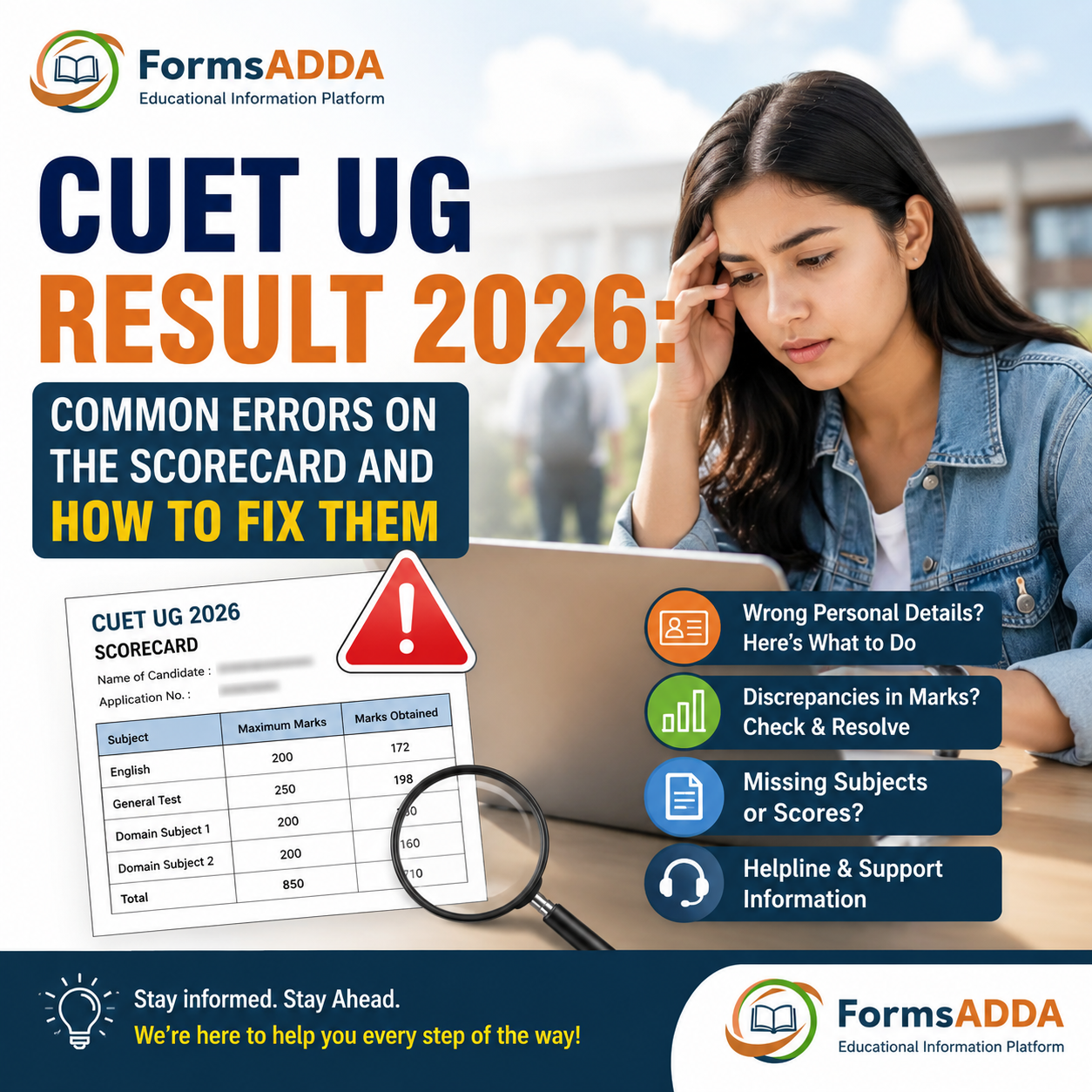
A practical guide to identifying, verifying, and correcting mistakes on your CUET UG 2026 scorecard
Introduction: Why Scorecard Accuracy Matters
The CUET UG 2026 scorecard is the single most important document in your undergraduate admission journey — it is what every university, from Delhi University’s CSAS portal to central universities like BHU and HCU, will use to verify your identity and calculate your merit. While the National Testing Agency (NTA) processes results for lakhs of candidates with considerable accuracy, errors do occasionally appear on individual scorecards, ranging from minor spelling mismatches to more serious issues like an incorrect category or a missing subject score.
Identifying and correcting these errors promptly — before you begin applying to universities — is essential. An uncorrected error can cause complications at document verification, affect your eligibility for reserved-category seats, or in rare cases, lead to outright rejection of an application. This guide on cuet-nta.com explains the most commonly reported scorecard errors, how to verify whether something is genuinely a mistake, and the exact process to get it corrected through NTA’s official channels.
Important: Most CUET UG 2026 scorecards are issued correctly. This guide is intended to help the smaller number of candidates who do encounter a genuine discrepancy, and to clarify which scorecard features (like normalised scores differing from raw scores) are not errors at all.
Common Errors Found on CUET UG 2026 Scorecards
Based on patterns reported in previous CUET cycles, certain types of scorecard errors recur more frequently than others. The table below summarises the most commonly reported issues, their likely causes, and how seriously each should be treated.
| Error Type | Likely Cause | Severity |
| Name spelling mismatch | Typo during registration; mismatch with Class 10 certificate spelling | Critical — must fix before applying |
| Incorrect date of birth | Data entry error during CUET UG 2026 registration | Critical — affects identity verification |
| Wrong category (UR instead of OBC/SC/ST) | Certificate not uploaded correctly or category field misselected | Critical — affects reserved-seat eligibility |
| Missing subject score | Technical sync issue or absent in one exam session despite appearing | Critical — affects programme eligibility |
| Incorrect roll number | Mismatch between admit card and scorecard data | Moderate — verify before relying on it |
| Wrong state of eligibility | Auto-filled incorrectly from registration data | Moderate — affects domicile/state quota |
| Gender field incorrect | Selection error during registration | Moderate — relevant for women-only colleges |
| Normalised score appears unusual | Statistical normalisation across exam sessions (often not an actual error) | Low — usually not an error, verify first |
Note: A normalised score that differs from your raw score is almost always NOT an error — it reflects NTA’s standard cross-session equalisation process. Verify this distinction carefully before assuming there is a mistake (see the dedicated section below).
Name, Date of Birth, and Identity Errors
Errors in your name or date of birth are among the most consequential scorecard mistakes because these fields are used for identity verification at every stage of the admission process — from CSAS registration to physical reporting at your allotted college. A name spelling that does not match your Class 10 certificate, even by a single letter, can create complications during document verification.
These errors typically originate from a data entry mistake during the original CUET UG 2026 registration process, rather than from NTA’s result processing system itself. If you notice a discrepancy, the first step is to confirm exactly what the correct spelling or date should be by referring to your Class 10 certificate, which is treated as the primary source document for name and date of birth across nearly all Indian university admission systems.
Category and Reservation Status Errors
A scorecard showing the wrong category — for example, General/UR listed instead of OBC-NCL, SC, ST, or EWS — is one of the most serious errors a candidate can encounter, because category directly determines which cutoff applies to your application and whether you are eligible for reserved-category seats. This error can occur if the category certificate was not uploaded correctly during registration, or if there was a selection error in the application form.
If your scorecard shows an incorrect category, do not proceed with university applications using that scorecard for reserved-category consideration until the issue is resolved. Universities verify category status against the scorecard and the physical certificate at the time of document checking, and a mismatch between the two can result in your application being processed under the general category instead, significantly affecting your admission chances.
Missing or Incorrect Subject Scores
Occasionally, a candidate who appeared for a particular CUET subject finds that subject missing from their scorecard, or showing a score that does not reflect their actual performance. This is a more technical issue and may relate to data synchronisation between exam centres and NTA’s central database. If you have your admit card confirming that a particular subject exam was scheduled and you attended it, this serves as your primary evidence when raising the issue.
This type of error has serious implications because universities check eligibility against the specific subjects listed on your scorecard. A missing subject score could make you appear ineligible for a programme that requires that subject, even though you did appear for the exam. Report this immediately and provide any documentation you have — including admit card details and, if available, any acknowledgement received at the exam centre.
Normalised Score Looks ‘Wrong’ — Is It Actually an Error?
One of the most frequent sources of confusion is not a genuine scorecard error at all: candidates sometimes see a normalised score that differs from what they calculated based on their own answer review, and assume something has gone wrong. In most cases, this is simply how CUET’s scoring system works, and understanding the mechanism resolves the confusion.
CUET UG is conducted across multiple sessions and dates, and exam difficulty can vary slightly between sessions even when papers are designed to be equivalent. NTA applies a statistical normalisation process to ensure fairness across all candidates, regardless of which session they appeared in. This means your normalised score — the figure used for merit calculation — can be higher or lower than your raw score depending on how your specific session compared to others. A normalised score that is different from a simple correct-minus-incorrect calculation is expected behaviour, not a mistake.
Before filing a grievance about your score, distinguish between an actual data error (wrong subject listed, wrong category, wrong name) and a normalisation outcome (your normalised score differing from your raw score). Only the former requires a correction request to NTA.
How to Fix a Scorecard Error: Step-by-Step Process
If, after careful verification, you confirm a genuine error on your CUET UG 2026 scorecard, follow the structured process below to raise it with NTA through official channels.
| Step | Action | Detail |
| 1 | Identify and document the error | Compare every field on your scorecard against your CUET UG 2026 registration confirmation email, admit card, Class 10 certificate, and category certificate. Write down each discrepancy clearly. |
| 2 | Gather supporting documents | Collect scanned copies of documents that prove the correct information — Class 10 certificate for name/DOB, category certificate for category errors, admit card for roll number verification. |
| 3 | Locate the NTA helpdesk | Visit the official NTA website (nta.ac.in) or the CUET UG portal (exams.nta.ac.in/CUET-UG) to find the helpdesk email address and phone number published after result declaration. |
| 4 | Submit a written complaint | Email NTA’s helpdesk with your full name, application number, roll number, a clear description of the error, and attached scanned copies of supporting documents. |
| 5 | Use the official grievance portal (if available) | If NTA opens a formal online grievance submission window post-result, submit your complaint there for a traceable ticket or acknowledgement number. |
| 6 | Follow up within a few days | If you receive no response within two to three business days, follow up through the same official channel. Keep all correspondence for your records. |
| 7 | Avoid using the erroneous scorecard for major applications | For critical errors (name, DOB, category), wait for written confirmation of correction before applying to universities, especially for reserved-category seats. |
Important: Always use NTA’s official helpdesk and grievance channels published on nta.ac.in or the CUET UG portal. Do not share your application number, password, or personal documents with any unofficial source claiming to expedite corrections.
Documents Required to Support a Correction Request
Every correction request to NTA is processed faster and more reliably when supported by clear documentary evidence. The table below maps each common error type to the specific document you should have ready when submitting your complaint.
| Error Type | Supporting Document Required |
| Name spelling error | Class 10 marksheet/certificate showing the correct spelling; Aadhaar card as secondary proof |
| Date of birth error | Class 10 certificate (primary proof of DOB for most Indian education boards) |
| Category error | Valid SC/ST/OBC-NCL/EWS/PwD certificate issued by competent authority, current and not expired |
| Missing subject score | CUET UG 2026 admit card showing the subject was scheduled; any acknowledgement of having appeared |
| Roll number mismatch | Original admit card with the correct roll number clearly visible |
| State of eligibility error | Class 12 certificate or domicile certificate showing the correct state |
What to Expect After Reporting an Error
NTA’s response time for scorecard correction requests can vary depending on the volume of grievances received during the result season and the complexity of the error. Simple data corrections, such as a name spelling fix backed by clear documentation, are typically processed faster than more complex issues like a missing subject score, which may require cross-checking exam centre records.
- Follow up politely but persistently if you do not receive an initial response within two to three business days.
- Keep a record of every communication, including dates, reference or ticket numbers, and the content of your complaint.
- If a correction affects your eligibility for an imminent university application deadline, mention this clearly and request expedited handling, while also continuing to track the university’s specific deadline.
- Once corrected, download a fresh copy of your scorecard and verify that the correction has been accurately applied before using it for further applications.
Conclusion
Most CUET UG 2026 scorecards are issued accurately, but for the candidates who do encounter a genuine discrepancy, acting quickly and methodically makes all the difference. Verify the issue carefully against your supporting documents, distinguish real errors from expected outcomes like score normalisation, and raise corrections only through NTA’s official helpdesk and grievance channels with clear documentation attached.
Resolving scorecard errors before you begin applying to universities protects your eligibility and prevents complications during document verification later in the admission process. For the latest updates on CUET UG 2026 result issues, official helpdesk links, and complete post-result admission guidance, cuet-nta.com remains your trusted resource throughout the season.
Frequently Asked Questions
Compare the scorecard carefully against your registration confirmation, admit card, and relevant certificates (Class 10 for name/DOB, category certificate for category) to confirm it is a genuine error. Then contact NTA's official helpdesk with a clear written description and supporting documents before using the scorecard for any university application.
Usually not. CUET applies a statistical normalisation process across multiple exam sessions to ensure fairness, since difficulty can vary slightly between sessions. A normalised score that differs from your own raw calculation is standard and expected, not necessarily a mistake. Only contact NTA if you suspect an actual data error, such as a wrong subject or category.
Response times vary based on the volume of grievances and the complexity of the issue. Simple corrections like name spelling are generally resolved faster than issues involving missing subject scores. Follow up within two to three business days if you receive no initial response, and keep all correspondence for reference.
For minor errors that do not affect eligibility (such as a slight formatting difference that still matches your other documents), you may be able to proceed cautiously while carrying supporting documentation. For significant errors involving category, name, date of birth, or missing subjects, it is safer to wait for written confirmation of the correction before applying, particularly for reserved-category seat consideration.
This depends on the error type. For name or date of birth issues, your Class 10 certificate is the primary proof. For category errors, your valid and current category certificate is essential. For missing subject scores, your CUET UG 2026 admit card showing that you were scheduled for that subject is the key supporting document.
NTA publishes helpdesk email addresses and phone numbers on its official website (nta.ac.in) and the CUET UG exam portal (exams.nta.ac.in/CUET-UG), typically updated around the time results are declared. cuet-nta.com will share the verified official contact details as soon as they are published for the 2026 cycle.
No Comments yet!