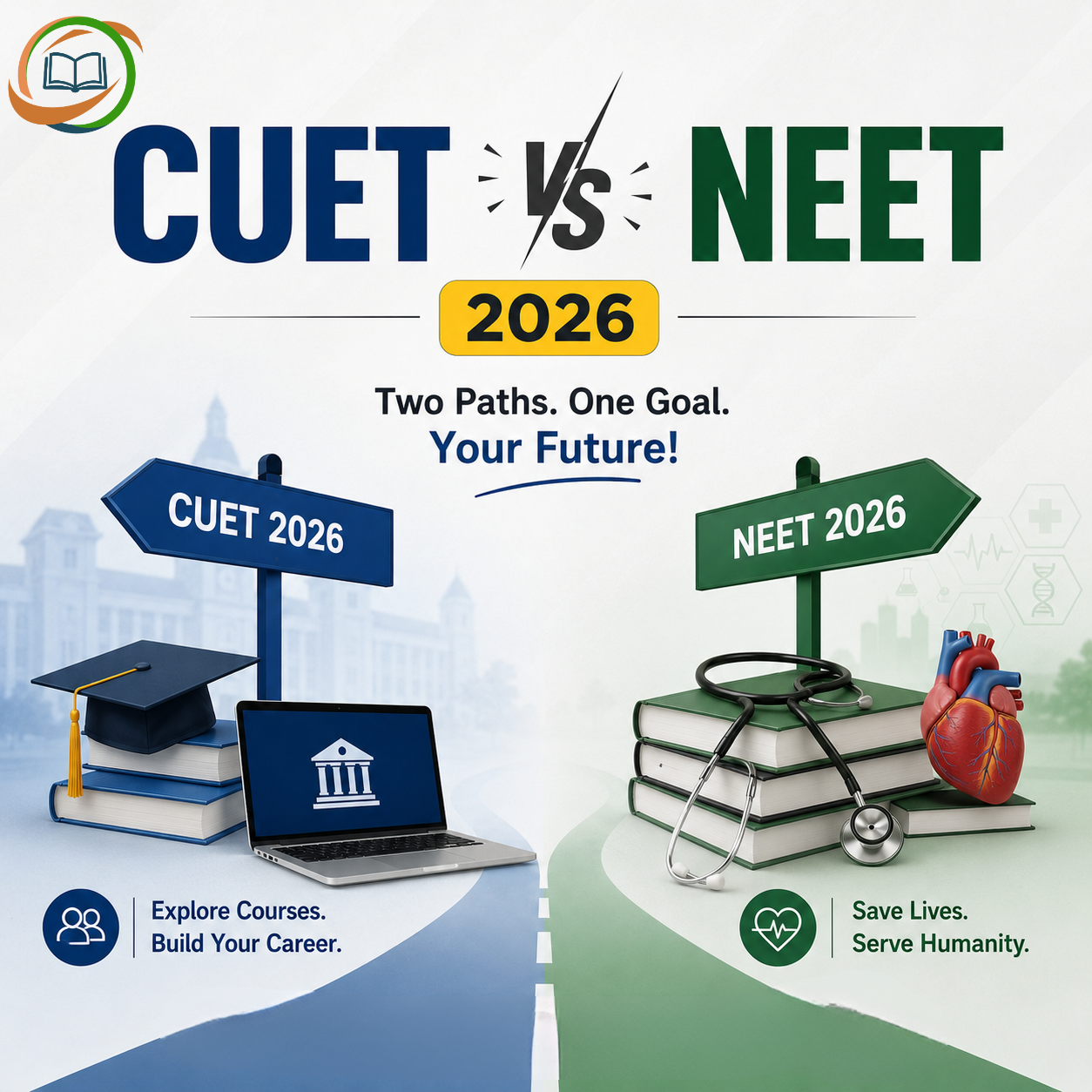
Key Differences, Syllabus, Difficulty, Career Options, Eligibility & Which Exam Is Right for You
Every year, lakhs of Class 12 students across India face one of the most consequential educational decisions of their lives — choosing between CUET UG and NEET. Both examinations are conducted by the National Testing Agency (NTA), both serve as primary gateways to prestigious undergraduate institutions, and both require months of dedicated preparation. Yet they serve completely different academic purposes, attract entirely different student profiles, and open doors to fundamentally divergent career trajectories.
The confusion between CUET and NEET is most acute among PCB (Physics, Chemistry, Biology) students — who are technically eligible for both. This comprehensive guide to CUET vs NEET 2026 breaks down every dimension of comparison — purpose, eligibility, exam pattern, syllabus depth, difficulty level, number of attempts, career scope, top institutions, and the critical question of which exam suits your goals. Whether you are deciding between the two or strategically planning to attempt both, this article gives you the complete picture.
CUET vs NEET 2026: Side-by-Side Quick Comparison
| Parameter | CUET UG 2026 | NEET UG 2026 |
| Full Name | Common University Entrance Test (Undergraduate) | National Eligibility cum Entrance Test (Undergraduate) |
| Conducting Body | National Testing Agency (NTA) | National Testing Agency (NTA) |
| Primary Purpose | Admission to UG programs at 300+ central, state, deemed & private universities | Admission to MBBS, BDS, BAMS, BHMS, BVSc & other medical/health programs |
| Stream Eligible | All streams — Arts, Commerce, Science | Science stream only (PCB mandatory) |
| Subjects Tested | Language + Domain Subjects (23 options) + General Aptitude Test | Physics, Chemistry, Biology (Botany + Zoology) |
| Exam Mode | Computer-Based Test (CBT) | Pen-and-Paper (OMR-based Offline Test) |
| Exam Duration | 60 min per subject paper | 3 hours 20 minutes (single sitting) |
| Total Questions | 50 MCQs per subject paper | 200 questions (180 to be attempted) |
| Marking Scheme | +5 Correct / -1 Wrong / 0 Unattempted | +4 Correct / -1 Wrong / 0 Unattempted |
| Max Total Score | 250 per subject (1,250 for 5 subjects) | 720 marks total |
| Exam Date 2026 | May 11-31, 2026 (Computer Based) | May 4, 2026 (Offline, single day) |
| Frequency Per Year | Once annually | Once annually |
| Attempts Allowed | Unlimited — no cap set by NTA | Unlimited (Supreme Court ruling 2018 onwards) |
| Age Limit (NTA) | No age limit | Minimum 17 years; no upper age limit (court ruling) |
| Difficulty Level | Moderate — Class 12 NCERT based | High to Very High — Class 11+12, deep conceptual depth |
| Syllabus Scope | Class 12 NCERT for domain subjects | Class 11 + Class 12 Physics, Chemistry, Biology (extensive) |
| Approx. Candidates | 14+ lakh (2026) | 24+ lakh (2026 expected) |
| Official Website | cuet.nta.nic.in | neet.nta.nic.in |
1. Purpose and Scope: The Most Critical Difference
CUET UG 2026 — Multi-Disciplinary Gateway
CUET is designed as a broad, inclusive entrance examination that provides a standardized admission pathway across virtually every academic discipline. It serves as the entry point for BA, B.Sc., B.Com, BBA, BCA, B.Tech (at select universities), BA LLB, B.Voc., and dozens of other undergraduate programs. Students from Arts, Commerce, and Science streams are all equally eligible. Over 300 universities — including all 47 central universities — participate, giving CUET one of the widest institutional footprints of any entrance exam in the world.
NEET UG 2026 — Exclusive Medical Gateway
NEET, by contrast, exists for a singular, tightly defined purpose — selecting candidates for admission to medical and healthcare undergraduate programs. These include MBBS, BDS, BAMS (Ayurveda), BHMS (Homeopathy), BUMS (Unani), BVSc (Veterinary Science), and nursing programs at over 700 medical colleges across India. Only Science stream students with Physics, Chemistry, and Biology are eligible. There is no alternative pathway to MBBS or BDS in India — NEET is the sole and mandatory national examination for medical admissions.
Core Distinction: CUET opens multiple academic pathways for all streams. NEET is exclusively the medical pathway — it does not admit students to any non-medical program. If your goal is MBBS or BDS, NEET is mandatory regardless of any other exam you clear. If your goal is anything other than medicine, CUET is the far more relevant examination.
2. Eligibility Criteria: CUET vs NEET 2026
| Eligibility Factor | CUET UG 2026 | NEET UG 2026 |
| Required Stream | Any — Arts, Commerce, Science equally eligible | Science only — Physics, Chemistry, Biology mandatory in Class 12 |
| Class 12 Subjects | No fixed mandatory subjects at NTA level | PCB (Physics, Chemistry, Biology) compulsory with English |
| Min. Marks (NTA) | No minimum marks required by NTA | 50% in PCB aggregate (General); 40% (SC/ST/OBC); 45% (PwBD General) |
| Min. Marks (University) | 50% aggregate (General); 45% (Reserved) | Same NTA threshold applies for all medical college eligibilities |
| Age Limit (NTA) | No age limit — minimum or maximum | Minimum 17 years as of Dec 31 of admission year; no upper limit |
| Number of Attempts | Unlimited — appear every year indefinitely | Unlimited (no cap since Supreme Court ruling 2018) |
| Gap Year Candidates | Fully eligible — no time restriction | Fully eligible — no restriction on number of years since Class 12 |
| Foreign Nationals | Eligible with standard conditions | Eligible (NRIs, OCIs, PIOs) — different fee structure applies |
| Same Year Attempts | Once per year (CUET held annually) | Once per year (NEET held annually, single date) |
3. Exam Pattern: CUET vs NEET 2026
CUET UG 2026 Exam Pattern
| Section | Content | Questions | Duration | Marking |
| Section I | Language Test — 13 languages available | 50 MCQs | 60 min per paper | +5 / -1 / 0 |
| Section II | Domain Subjects — 23 subjects (any stream) | 50 MCQs per subject | 60 min per subject | +5 / -1 / 0 |
| Section III | General Aptitude Test (GAT) — Reasoning, GK, Quant | 50 MCQs | 60 min | +5 / -1 / 0 |
| 2026 Change | All 50 questions compulsory — no optional questions | 50 of 50 | — | All mandatory |
NEET UG 2026 Exam Pattern
| Subject | Questions | Attempt | Marks | Format | Duration |
| Physics | 50 questions (35 MCQ + 15 Assertion-Reason) | 45 of 50 | 180 marks | Offline OMR | 3 hrs 20 min (total) |
| Chemistry | 50 questions (35 MCQ + 15 Assertion-Reason) | 45 of 50 | 180 marks | Offline OMR | Same sitting |
| Botany | 50 questions (35 MCQ + 15 Assertion-Reason) | 45 of 50 | 180 marks | Offline OMR | Same sitting |
| Zoology | 50 questions (35 MCQ + 15 Assertion-Reason) | 45 of 50 | 180 marks | Offline OMR | Same sitting |
| Total | 200 questions | 180 questions | 720 marks | Single offline paper | 3 hrs 20 min |
Key Format Difference: CUET is a Computer-Based Test (CBT) conducted across multiple days and shifts — giving candidates time between different subject papers. NEET is a single-day, single-sitting, pen-and-paper (OMR) test — requiring sustained focus across all four subjects (Physics, Chemistry, Botany, Zoology) in one continuous session without breaks
4. Syllabus Comparison: CUET vs NEET 2026
| Syllabus Feature | CUET UG 2026 | NEET UG 2026 |
| Syllabus Basis | Class 12 NCERT curriculum for domain subjects | Class 11 + Class 12 NCERT (both years equally important) |
| Scope | 23 domain subjects across all streams — breadth-focused | Only Physics, Chemistry, Biology — depth-focused |
| Class 11 Coverage | Minimal — indirect conceptual background only | Extensive — Class 11 contributes 40-45% of NEET questions |
| Biology Depth | Class 12 NCERT — Cell Biology, Genetics, Ecology, Biotechnology | Both Class 11 (Plant Kingdom, Animal Kingdom, Biomolecules) and Class 12 — highest weightage subject in NEET |
| Physics Depth | Class 12 NCERT — Optics, Modern Physics, Electrostatics | Class 11+12 — Mechanics, Thermodynamics, Kinematics, Electrostatics, Optics, Modern Physics |
| Chemistry Depth | Class 12 NCERT — 16 units (includes CBSE-deleted chapters) | Class 11+12 — Physical, Organic, Inorganic Chemistry from both years |
| Language Section | Mandatory for most programs (13 languages) | Not included |
| Reasoning / Aptitude | GAT section available | Not included — pure science subjects only |
| Humanities / Commerce | Fully available — History, Political Sci., Accountancy, etc. | Not included — medicine-focused only |
| Syllabus Flexibility | Candidates choose their subject combination | Fixed — all four sections mandatory |
5. Difficulty Level: CUET vs NEET 2026
| Difficulty Aspect | CUET UG 2026 | NEET UG 2026 |
| Overall Difficulty | Moderate | High to Very High |
| Conceptual Depth | Class 12 level — NCERT direct application | Multi-year depth — analytical understanding of Class 11+12 |
| Biology Requirement | Class 12 NCERT Biology — 50 questions per paper | Botany + Zoology across Class 11+12 — 180 marks combined |
| Problem-Solving | Limited — mostly comprehension and recall based | Extensive — requires deep concept application and data analysis |
| Time Pressure | 72 seconds per question (60 min / 50 questions) | 93 seconds per question (3 hrs 20 min / 180 questions) |
| Competition Intensity | Growing — 14+ lakh candidates in 2026 | Extremely intense — 24+ lakh candidates for limited MBBS seats |
| Seat Availability | Broad — 300+ universities, tens of thousands of seats | Very limited — ~1.12 lakh MBBS seats across all govt. and private colleges |
| Preparation Timeline | 3-6 months with board prep overlap feasible | Typically 1.5-2 years minimum dedicated preparation |
| Self-Study Feasibility | Very high — NCERT + mock tests sufficient for many | Possible but challenging — most successful candidates use coaching |
| Coaching Dependency | Low-Moderate — many crack CUET without coaching | Moderate-High — most AIR top 1000 candidates use some coaching |
The difficulty verdict is unambiguous: NEET is harder than CUET by a significant margin. NEET tests two full years of science content (Class 11 and 12) across three demanding subjects at a depth that requires months of sustained, focused preparation. CUET tests Class 12 content across a flexible subject choice at NCERT conceptual depth — achievable with disciplined board preparation supplemented by CUET-specific practice. This does not mean CUET is easy — the competition at top universities like DU, JNU, and BHU is fierce — but the absolute difficulty of individual questions is considerably lower than NEET.
6. Career Scope: CUET vs NEET 2026
Career Pathways After CUET-Based UG Admission
| Program via CUET | Career Trajectories | Further Competitive Exams |
| BA (Economics / Political Science) | Civil Services (IAS/IPS), Research, Public Policy, Law, International Relations | UPSC CSE, State PCS, CLAT (PG) |
| B.Sc. Life Sciences / Biology | Biotech, Pharma Research, Environmental Science, M.Sc. + CSIR-NET | GATE, CSIR-NET, DBT-JRF |
| B.Sc. Physics / Chemistry | Research (BARC, ISRO, DRDO), Academia, M.Sc. + PhD pathway | GATE, IIT JAM, CSIR-NET |
| B.Com / BBA | CA, MBA, Banking (IBPS/SBI PO), Corporate Finance, Stock Markets | CAT, ICAI CA, ICSI CS |
| BCA / B.Sc. Computer Science | Software Engineering, Data Science, AI/ML, Product Management | GATE, Company-specific coding tests |
| BA LLB (5-year at central univ.) | Advocacy, Judiciary (UPSC Judicial Services), Corporate Law | UPSC Civil Judge, State Bar Exam |
| Mass Communication (via CUET) | Journalism, Broadcasting, PR, Content Strategy | Job placements directly after UG |
| B.Tech via CUET (BHU/select) | Engineering, Technology, Core Sector, Software | GATE (for M.Tech), UPSC ESE |
Career Pathways After NEET-Based Medical Admission
| Program via NEET | Career Trajectories | Further Study / Specialization |
| MBBS | General Physician, Hospital Practice, Medical Officer (Govt.), Research | MD/MS (NEET-PG), Fellowship, DM/MCh (Super-specialization) |
| BDS | Dental Surgeon, Oral Medicine Specialist, Maxillofacial Surgery | MDS (NEET-PG Dental), Private Practice |
| BAMS (Ayurveda) | Ayurvedic Practitioner, Wellness Centers, Pharmaceutical Research | MD (Ayurveda), Ph.D. in Ayurvedic Sciences |
| BHMS (Homeopathy) | Homeopathic Practitioner, Clinical Research, Manufacturing | MD (Homeopathy), Research roles |
| BVSc (Veterinary) | Veterinary Surgeon, Animal Husbandry Officer, Wildlife Research | MVSc, Ph.D., ICAR-NET |
| B.Sc. Nursing | Clinical Nurse, Community Health Officer, Nursing Administration | M.Sc. Nursing, Hospital Management |
| Allied Health Sciences | Medical Imaging, Lab Technology, Physiotherapy, Pharmacy | PG Diploma, M.Sc. Allied Health |
Career Reality: NEET leads to one of India’s most respected and stable career paths — medicine. Government MBBS doctors start at approximately ₹56,000-₹80,000/month and specialist doctors earn ₹1.5-5 lakh/month. CUET careers are more diverse — ranging from IAS officers and judges to data scientists, chartered accountants, and researchers. Neither is superior; the right choice depends entirely on your genuine interests and long-term vision.
7. Top Institutions Accessible Through CUET vs NEET 2026
| Institutions | CUET UG 2026 | NEET UG 2026 |
| Top Central Institutions | DU, BHU, JNU, JMI, AMU, Allahabad University, CURAJ, and 41 other central universities | AIIMS New Delhi, JIPMER Puducherry, Maulana Azad Medical College, AFMC Pune |
| Top State Institutions | Lucknow University, Patna University, Gujarat University, 40+ state universities | Government Medical College Mumbai, Grant Medical College, KGMU Lucknow, MAMC Delhi |
| Private Institutions | Amity, LPU, Chandigarh University, Sharda, Bennett University, 150+ private universities | Kasturba Medical College, St. John’s Medical College, CMC Vellore, Manipal MAHE |
| Total Institutions | 300+ universities across all 28 states and 8 UTs | 700+ medical colleges (Govt. + Private) across India |
| Total UG Seats | Several lakh seats across all programs and institutions | Approx. 1.12 lakh MBBS seats; 27,000+ BDS seats; 50,000+ AYUSH seats |
| Competition Ratio | Varies — from 10:1 to 100:1 for top DU colleges | Extremely high — approximately 22:1 for government MBBS seats (24L candidates for 1.12L seats) |
8. Marking Scheme and Negative Marking: CUET vs NEET
| Feature | CUET UG 2026 | NEET UG 2026 |
| Correct Answer | +5 marks | +4 marks |
| Wrong Answer | -1 mark | -1 mark |
| Unattempted | 0 marks | 0 marks |
| Dropped Question | +5 marks to all candidates | +4 marks to all candidates |
| Max Marks Per Paper | 250 (50 questions x 5 marks) | 180 per subject; 720 total |
| Net Swing Per Question | 6 marks (from wrong to correct) | 5 marks (from wrong to correct) |
| Skip vs Guess Strategy | Skip when below 65% confidence | Skip when below 55% confidence (due to lower reward) |
| Integer-Type Questions | Not applicable — all MCQ format | Some assertion-reason type questions included |
9. Can You Prepare for Both CUET and NEET 2026 Simultaneously?
Yes — and for PCB students, this is actually a strategically sound approach. Here is a clear-eyed assessment of how the two examinations complement and diverge in preparation:
Overlap Between CUET and NEET Preparation
- NEET’s Class 12 Biology, Physics, and Chemistry content fully covers CUET’s domain subject requirements in the same subjects — CUET tests these at NCERT depth, which is a subset of NEET’s deeper treatment
- A student seriously preparing for NEET 2026 automatically covers CUET Biology, Physics, and Chemistry with greater depth than CUET requires — making CUET preparation for these subjects largely unnecessary as a separate activity
- The primary additions for CUET beyond NEET preparation are: the Language Test paper and optionally the General Aptitude Test (GAT) — neither of which requires domain-specific scientific knowledge
What NEET Preparation Does Not Cover for CUET
- NEET does not cover Class 11 syllabus sections that are relevant for CUET’s general aptitude questions — but this matters primarily for the GAT section, which requires separate preparation in reasoning, current affairs, and quantitative ability
- NEET does not cover Arts or Commerce domain subjects — CUET’s broader subject selection is irrelevant for pure NEET aspirants
- NEET is an offline OMR-based test; CUET is CBT. CUET candidates must practice the digital interface separately — NTA’s official mock test portal (nta.ac.in/Quiz) provides this experience
Recommended Strategy for PCB Students
- Primary goal is NEET 2026: Focus 85-90% of preparation on NEET. Register for CUET UG 2026 and select Biology/Biological Sciences + Chemistry + Physics domain papers + one Language paper. Your NEET preparation covers these automatically
- Primary goal is CUET (B.Sc. programs at DU, BHU, JNU): Focus on CUET NCERT-based preparation. Also register for NEET as a stretch goal if genuinely interested in medicine — but do not expect competitive NEET performance from CUET-level preparation alone
- Undecided between medicine and life sciences research: Appear for both. NEET preparation covers CUET science requirements. Add Language paper and targeted GAT practice specifically for CUET. This combination takes 4-6 additional weeks of CUET-specific work beyond NEET preparation
10. Which Exam Is Right for You? Decision Framework
| Your Situation | Recommended Exam | Key Reasoning |
| You want to become a doctor (MBBS/BDS) | NEET — mandatory | No alternative exists — NEET is the only pathway to MBBS/BDS in India |
| You want AYUSH medical degrees (BAMS/BHMS/BUMS) | NEET — mandatory | AYUSH UG programs also require NEET qualification |
| You are from Arts or Commerce stream | CUET only | NEET requires PCB — Arts/Commerce students are ineligible |
| You want B.Sc. Biology / Life Sciences | Both CUET + NEET | CUET opens B.Sc. at DU/BHU/JNU; NEET is backup for BAMS/BVSc if needed |
| You are PCB but undecided on medicine | Both (NEET primary + CUET backup) | Keeps all options open; NEET prep covers CUET science requirements |
| You want careers in research/academics | CUET (B.Sc. route) | Research-focused B.Sc. at premier central universities via CUET |
| You have only 3-4 months to prepare | CUET strongly preferred | NCERT-based CUET preparation is achievable; NEET requires 12-24 months minimum |
| You want highest medical career stability | NEET (Govt. MBBS seat) | Govt. MBBS doctors have exceptional job security and societal respect |
| You want flexibility across career paths | CUET | 280+ universities, all programs, all disciplines — maximum career flexibility |
11. CUET 2026 Preparation Tips (For PCB and Other Students)
Since this is a CUET-focused resource, here are targeted preparation tips for CUET UG 2026 specifically:
- NCERT Class 12 Is Sufficient for Domain Subjects: Unlike NEET (which requires Class 11 and 12 together), CUET domain subjects are based entirely on NCERT Class 12 content. For PCB students, your existing knowledge covers most CUET science paper requirements
- Prioritize Language Paper: The Language Test is compulsory for almost all CUET programs. Practice 2-3 unseen passages daily and revise grammar rules (tenses, voice, narration, articles). This section is often underestimated and easy to score in with consistent practice
- General Aptitude Test (GAT) Requires Separate Preparation: If your target programs require GAT, dedicate 30 minutes daily — 15 minutes for current affairs (last 6 months) and 15 minutes for logical reasoning drills
- Timed Mock Tests Build CBT Comfort: CUET is CBT — practice on the digital interface. Use the official NTA mock test portal at nta.ac.in/Quiz for authentic interface familiarity before exam day
- Negative Marking Discipline: With -1 for wrong answers, skip questions where you cannot confidently eliminate at least 2 of the 4 options. In CUET, an unattempted question (0 marks) is always better than an uncertain guess (-1)
- Focus on Complete Syllabus Coverage: With all 50 questions compulsory in 2026 (no optional questions), you cannot afford blind spots in any chapter — complete topic coverage is non-negotiable
Final Word
The CUET vs NEET 2026 comparison ultimately resolves to a fundamental question about direction, not difficulty. NEET is the singular, irreplaceable gateway to medicine — if becoming a doctor is your calling, NEET is mandatory and non-negotiable. CUET is the gateway to intellectual breadth — giving students from every stream fair, standardized access to hundreds of academic disciplines at India’s finest central and state universities.
For PCB students who are genuinely uncertain, appearing for both is not just possible — it is strategically wise. NEET preparation covers CUET’s science requirements. Adding 4-6 weeks of targeted CUET Language and GAT preparation creates a parallel safety net across both the medical and general education pathways.
If CUET is your chosen path, the exam begins May 11, 2026. Stay connected with cuet-nta.com for the latest CUET UG 2026 updates — city intimation slip, admit card alerts, answer key releases, result dates, and university-wise cutoff analysis.
Frequently Asked Questions
The fundamental difference is purpose. CUET UG 2026 is a broad, multi-disciplinary examination for admission to BA, B.Sc., B.Com, BBA, BCA, B.Tech (select), and other programs at 300+ universities across all academic streams. NEET UG 2026 is exclusively for admission to medical programs — MBBS, BDS, BAMS, BHMS, BVSc — and is open only to Science PCB students. CUET is inclusive of all streams; NEET is exclusively for medical aspiration.
Yes — CUET is considerably less difficult than NEET. CUET tests Class 12 NCERT-level content through moderate MCQs across subjects of the candidate's choice. NEET tests both Class 11 and Class 12 Physics, Chemistry, and Biology at a depth that requires sustained multi-year preparation and strong analytical problem-solving skills. NEET is widely regarded as one of India's toughest undergraduate entrance exams; CUET sits at a significantly lower difficulty level in terms of question complexity and conceptual depth.
Yes — and this is a recommended strategy for PCB students who are not entirely certain about pursuing medicine. NEET 2026 is scheduled for May 4, 2026, and CUET UG 2026 runs from May 11 to May 31 — giving PCB students time to appear for both. NEET preparation at the analytical level naturally covers CUET's PCB domain subject requirements, so the incremental preparation needed for CUET beyond NEET is primarily limited to the Language paper and the GAT section.
NEET is the sole mandatory national entrance examination for MBBS and BDS admissions in India. There is no alternative — not CUET, not any state-level exam. A candidate cannot gain admission to any recognized MBBS or BDS program in India without a valid NEET UG score. CUET does not lead to MBBS or BDS admission at any institution. The two examinations serve entirely different purposes.
CUET UG has no attempt limit — NTA allows candidates to appear indefinitely as long as they meet basic eligibility requirements each year. NEET UG also has no attempt limit as of 2018 — the Supreme Court struck down the earlier three-attempt restriction. Both exams allow unlimited appearances, making them equally accessible for candidates who need multiple attempts to achieve their target score.
Significantly, yes. NEET preparation covers Biology at Class 11 and 12 depth — far exceeding CUET's requirement of Class 12 Biology alone. A student who has prepared Class 12 Biology for NEET will find CUET Biology straightforward. Similarly, NEET Physics and Chemistry preparation at Class 12 level fully satisfies CUET's Physics and Chemistry domain requirements. The reverse is not equally true — CUET-level Biology preparation is insufficient for NEET's extensive Biology coverage spanning both Class 11 and 12.
Neither exam has definitively 'better' career opportunities — they lead to entirely different careers. NEET leads to medicine — one of India's most stable, respected, and well-compensated professions. Government MBBS doctors earn ₹56,000-₹80,000/month starting out, with specialists earning ₹1.5-5 lakh/month. CUET leads to diverse careers across civil services, law, finance, research, technology, journalism, and management — where salaries vary widely from ₹30,000/month for starting government jobs to ₹30 lakh/year and above for data scientists or corporate professionals at top firms. Choose based on your genuine interests, not salary comparisons.
CUET Biology covers Class 12 NCERT Biology only — including Reproduction, Genetics and Evolution, Biology and Human Welfare, Biotechnology, and Ecology. NEET Biology covers both Class 11 and Class 12 in its entirety — adding The Living World, Plant Kingdom, Animal Kingdom, Structural Organisation, Cell Biology, Plant Physiology, Human Physiology, and Biomolecules from Class 11. NEET Biology is approximately twice the volume of CUET Biology and requires significantly deeper conceptual understanding across a much broader topic range.
B.Sc. Nursing admission routes vary by institution. Private nursing colleges and many state institutions admit B.Sc. Nursing students through NEET scores. Some CUET-participating universities (like Jamia Hamdard) offer nursing-adjacent health science programs through CUET. However, NEET qualification is more commonly required for government and premier B.Sc. Nursing programs — particularly at institutions affiliated with medical colleges. Always verify the specific admission route at your target nursing college before registering for any exam.
This is one of the most common dilemmas among PCB students with a passion for Biology. If your interest is in biological research, environmental science, biotechnology, or life sciences academia rather than clinical medicine — CUET is the more appropriate pathway, opening access to B.Sc. Life Sciences, Biotechnology, Biochemistry, and Microbiology programs at DU, BHU, JNU, and other premier central universities. You can then pursue M.Sc., CSIR-NET, and research careers. If you are genuinely drawn to treating patients — NEET and MBBS is the right path. Taking both exams gives you time until results to decide.
No Comments yet!