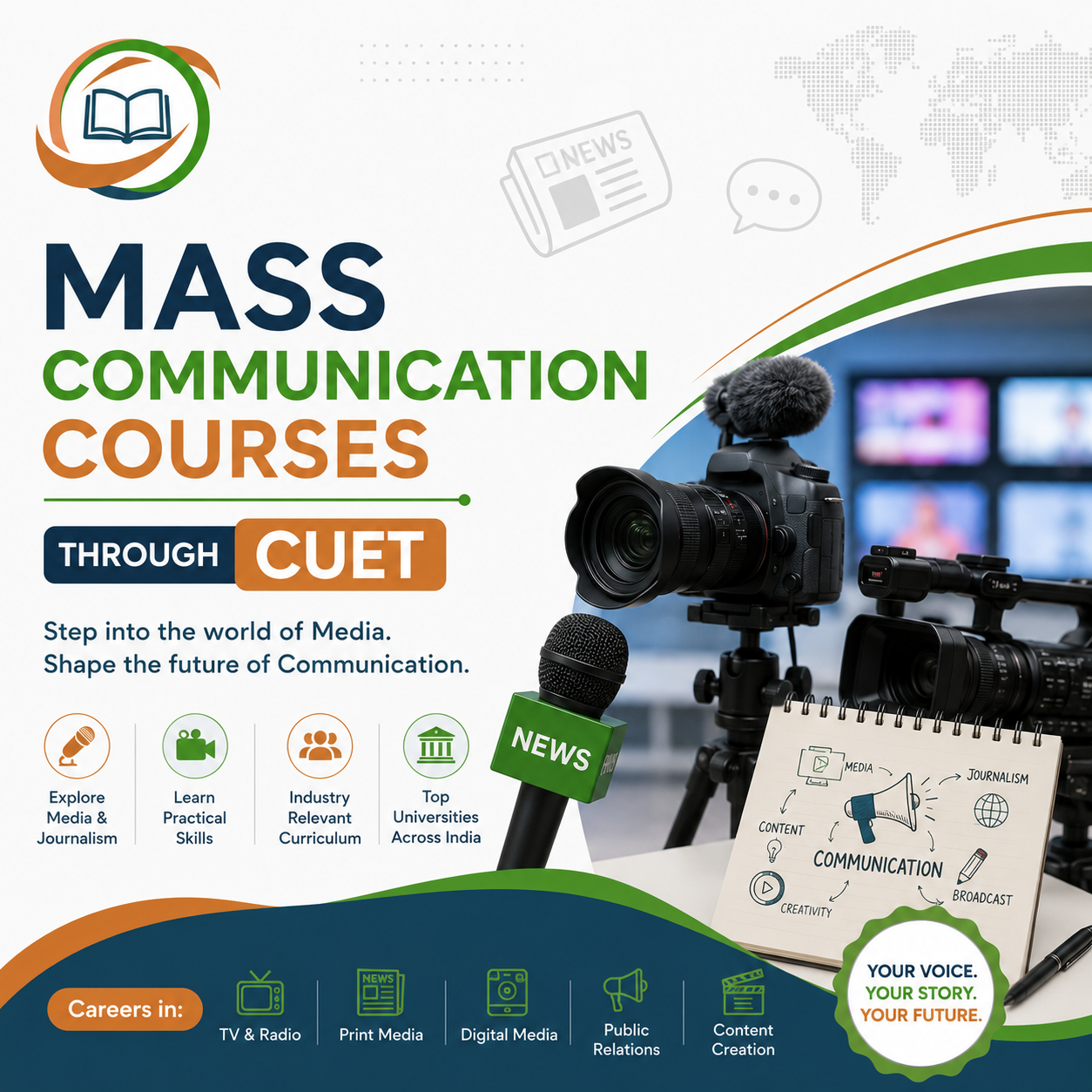
Your Complete Guide to Journalism & Media Studies Admission — Top Universities, Eligibility, Cutoffs, Career Scope & Strategy
Mass Communication has emerged as one of the most dynamic and sought-after undergraduate fields in India, drawing students who are passionate about journalism, digital media, film, public relations, advertising, and content creation. With India’s media landscape expanding rapidly across television, digital platforms, podcasting, and social media, the demand for trained communication professionals has never been higher — and undergraduate Mass Communication programmes have become a direct pathway into this fast-evolving industry.
Since the introduction of CUET as the standardised admission gateway, accessing India’s top Mass Communication and Journalism programmes has become considerably more transparent. A single national-level examination now determines admission to celebrated institutions like Jamia Millia Islamia’s AJK Mass Communication Research Centre, Indraprastha College for Women’s Journalism programme, and numerous central and state university media departments — replacing fragmented entrance tests and unpredictable selection criteria with a unified, merit-based system.
This comprehensive guide by cuet-nta.com covers everything aspiring journalists and media professionals need to know about Mass Communication courses through CUET — from understanding which universities offer the best programmes and what CUET subjects you need, to expected cutoffs, specialisation options, career scope, and the precise admission strategy to secure your seat in this exciting field.
Why Mass Communication Is a Compelling Undergraduate Choice
The Expanding Media and Communication Industry in India
India’s media and entertainment sector has grown into one of the most dynamic segments of the economy, encompassing television news, digital journalism, OTT content platforms, podcasting, social media management, public relations, corporate communications, and advertising. This expansion has created sustained demand for trained Mass Communication graduates who understand both traditional journalistic principles and the rapidly evolving digital media landscape.
Versatility Across Career Paths
Unlike many specialised undergraduate degrees that funnel graduates toward a single career track, Mass Communication offers genuine versatility. Graduates pursue careers as television and print journalists, digital content creators, documentary filmmakers, public relations professionals, advertising copywriters, social media strategists, corporate communications specialists, radio jockeys, podcast producers, and media researchers — among many other paths.
Skills That Transfer Across Industries
Mass Communication programmes build a distinctive combination of skills — storytelling, critical analysis, writing proficiency, visual communication, research methodology, and an understanding of media ethics and law — that are valued well beyond traditional media roles. Many graduates successfully transition into corporate communications, marketing, brand management, and even policy and government communications roles.
CUET Subject and Eligibility Requirements for Mass Communication Courses
Before exploring specific universities, understanding the CUET subject and eligibility requirements for Mass Communication programmes is essential. Requirements vary somewhat by institution, but the following framework applies broadly across most CUET-participating universities offering Mass Communication and Journalism programmes.
General CUET Eligibility for Mass Communication
- Minimum Qualification: Pass in Class 12 (or equivalent) from any recognised board, in any stream (Science, Commerce, or Humanities)
- CUET Domain Subject: Most universities accept English (Language paper) as the primary required domain subject
- Additional Domain Subjects: Universities typically require 2–3 total CUET papers, allowing flexibility in additional subject choice
- General Test: Many universities include the CUET General Test (GT) in the composite score calculation for Mass Communication admission
- Stream Flexibility: Unlike Commerce or Science programmes, Mass Communication generally welcomes candidates from any academic stream
Key Advantage: Mass Communication is one of the most accessible CUET programme categories in terms of subject eligibility. Candidates from Science, Commerce, or Humanities backgrounds can all typically qualify, provided they meet the English language and General Test requirements specified by their target university.
University-wise CUET Subject Requirements
| University / College | Programme | CUET Domain Subjects Required | Composite Score Scale |
| Jamia Millia Islamia (AJK MCRC) | BA Mass Communication | English + General Test (+ specific test/interview at AJK MCRC) | Varies; partial weightage to CUET |
| Jamia Millia Islamia (Main) | BA (Hons) Mass Comm. | English + 2 domain subjects + GT | 800 (4 papers) |
| Indraprastha College for Women | BA (Journalism, Hons) | English + 2 domain subjects + GT | 800 (4 papers) |
| Lady Shri Ram College | BA Journalism (if offered) | English + relevant domain subjects + GT | 800 (4 papers) |
| Central Univ. of Karnataka | BA Mass Communication | English + any 2 domain subjects | 600 (3 papers) |
| Central Univ. of Himachal Pradesh | BA Journalism & Mass Comm. | English + any 2 domain subjects | 600 (3 papers) |
| Pondicherry University | BA Journalism | English + any 2 domain subjects + GT | 800 (4 papers) |
| University of Hyderabad | Integrated Communication | English + relevant domain subjects | 600–800 (varies) |
Important: Some specialised institutions, such as AJK Mass Communication Research Centre at JMI, may use CUET scores as a partial qualifying criterion alongside an institution-specific written test and/or interview. Always verify the exact selection process for your target programme, as Mass Communication admissions sometimes combine CUET with additional evaluation stages.
Top Universities for Mass Communication Courses Through CUET
1. Jamia Millia Islamia (JMI) — India’s Premier Mass Communication Destination
Jamia Millia Islamia stands as India’s most celebrated institution for Mass Communication education, anchored by its renowned A.J.K. Mass Communication Research Centre (AJK MCRC). Established with a mission to produce skilled media professionals, AJK MCRC has built an extraordinary reputation over decades, with alumni occupying senior positions across India’s leading television networks, newspapers, digital media organisations, and film production houses.
JMI offers Mass Communication education through multiple pathways: the highly competitive AJK MCRC (which combines CUET eligibility with its own specialised selection process including written tests and interviews for some programmes), and JMI’s broader BA (Hons) Mass Communication programme through the standard CUET-based admission route. The university’s location in Delhi — India’s media and journalism hub — provides students with exceptional access to internships, industry events, and professional networking opportunities.
| Parameter | Details |
| Location | Jamia Nagar, New Delhi – 110025 |
| Flagship Centre | A.J.K. Mass Communication Research Centre (AJK MCRC) |
| Admission Route | CUET-based (BA Hons Mass Comm.) + specialised selection for AJK MCRC programmes |
| Curriculum Strengths | Television production, documentary filmmaking, print journalism, radio, advertising |
| Industry Connections | Strong ties with NDTV, India Today Group, Doordarshan, leading production houses |
| Notable Alumni | Several prominent journalists, news anchors, and documentary filmmakers across Indian media |
| Infrastructure | Dedicated television studio, radio station, editing labs, photography studio |
| Unique Strength | Most respected name in Indian Mass Communication education; unmatched industry pedigree |
2. Indraprastha College for Women (IPCW), Delhi University
Indraprastha College for Women is one of Delhi University’s most respected institutions for Journalism education, offering a well-regarded BA (Hons) Journalism programme accessible through CUET. As a women’s college on DU’s North Campus, IPCW combines DU’s academic prestige with focused, journalism-specific training, making it one of the most popular CUET destinations for women pursuing media careers.
The Journalism programme at IPCW covers print, broadcast, and digital journalism, alongside media law, ethics, and research methodology. The college’s location within Delhi University provides students access to DU’s broader academic resources, student societies, and a vibrant campus culture, while its dedicated journalism faculty offers specialised mentorship.
| Parameter | Details |
| Location | North Campus, University of Delhi, Delhi – 110054 |
| Type | Women’s college, Affiliated to Delhi University |
| Programme | BA (Hons) Journalism |
| CUET Subjects Required | English + 2 domain subjects + General Test |
| Curriculum Strengths | Print and digital journalism, media writing, broadcast journalism, research methods |
| Campus Culture | Active journalism society, student newspaper, media workshops |
| Unique Strength | DU pedigree combined with focused journalism specialisation in a women-only environment |
3. Lady Shri Ram College for Women (LSR), Delhi University
While primarily known for its Humanities and Social Sciences programmes, Lady Shri Ram College has built strong elective and interdisciplinary offerings in media studies and communication, attracting students interested in combining traditional liberal arts education with media-focused coursework. LSR’s overall academic environment, debate culture, and active student media platforms make it an excellent choice for students interested in journalism as part of a broader social sciences education.
4. Central University of Himachal Pradesh
The Central University of Himachal Pradesh offers a dedicated BA Journalism and Mass Communication programme through CUET, providing an excellent central university option for students seeking quality media education outside the high-competition Delhi ecosystem. With more accessible CUET cutoffs and a growing reputation, this university represents a strong choice for students who want central university credentials combined with focused media training.
5. Pondicherry University
Pondicherry University’s BA Journalism programme is well-regarded among central university media offerings, combining a comprehensive curriculum with the university’s strong overall academic reputation. With comparatively accessible CUET cutoffs, Pondicherry University represents an excellent option for Mass Communication aspirants seeking a central university degree with strong faculty support.
6. University of Hyderabad
University of Hyderabad’s communication studies offerings reflect the university’s broader emphasis on research-oriented education. While historically stronger at the postgraduate level, the university has expanded undergraduate offerings in integrated communication studies, making it a noteworthy option for students seeking a research-driven approach to media education within a prestigious central university environment.
Expected CUET 2026 Cutoffs for Mass Communication Programmes
Mass Communication and Journalism programmes generally have moderate-to-competitive CUET cutoffs compared to flagship Commerce or Humanities programmes at the same institutions, reflecting both genuine demand and somewhat more limited seat availability at top institutions. The following table provides expected cutoff estimates for CUET 2026 based on recent admission trends:
| University / College | Programme | Gen. Cutoff (Approx.) | OBC-NCL (Approx.) | SC (Approx.) |
| Indraprastha College (DU) | BA (Hons) Journalism | 620–680 / 800 | 570–625 / 800 | 510–565 / 800 |
| Jamia Millia Islamia (Main) | BA (Hons) Mass Comm. | 560–630 / 800 | 510–575 / 800 | 455–515 / 800 |
| Lady Shri Ram College (elective) | BA with Media electives | 650–710 / 800 | 595–655 / 800 | 535–590 / 800 |
| Pondicherry University | BA Journalism | 440–510 / 800 | 395–460 / 800 | 345–405 / 800 |
| Central Univ. of Himachal Pradesh | BA Journalism & Mass Comm. | 380–450 / 600 | 340–405 / 600 | 295–355 / 600 |
| Central Univ. of Karnataka | BA Mass Communication | 350–420 / 600 | 310–375 / 600 | 270–330 / 600 |
| University of Hyderabad | Integrated Communication | 470–540 / 800 | 425–490 / 800 | 375–435 / 800 |
Disclaimer: AJK MCRC at JMI typically conducts its own entrance evaluation alongside CUET eligibility for several of its specialised programmes (such as the integrated and diploma-track media courses), so its admission process may not follow a pure CUET-cutoff model. Always verify the exact selection criteria on JMI’s official admission portal.
Specialisations Within Mass Communication: Choosing Your Focus Area
Modern Mass Communication programmes typically offer or lead toward several specialisation tracks. Understanding these specialisations helps you choose a university and programme structure that best matches your specific career interests within the broader field.
| Specialisation | Core Focus | Typical Career Outcomes | Best Suited Universities |
| Print & Digital Journalism | News writing, reporting, editing, investigative journalism | Reporter, Editor, Digital Journalist, Content Writer | JMI, IPCW, Pondicherry University |
| Broadcast Journalism | Television and radio news production, anchoring, field reporting | TV Reporter, News Anchor, Radio Jockey, Field Producer | JMI (AJK MCRC), Central Univ. of HP |
| Documentary & Film | Documentary filmmaking, scriptwriting, video editing, direction | Documentary Filmmaker, Video Editor, Content Producer | JMI (AJK MCRC) |
| Public Relations & Corp. Comm. | Strategic communication, media relations, crisis management | PR Executive, Corporate Communications Manager, Brand Strategist | IPCW, LSR, University of Hyderabad |
| Advertising | Copywriting, brand campaigns, creative strategy, market research | Copywriter, Creative Director, Brand Manager | IPCW, JMI, Central Univ. of Karnataka |
| Digital & Social Media | Content strategy, social media management, SEO, digital analytics | Social Media Manager, Content Strategist, Digital Marketer | All major Mass Comm. programmes |
| Media Research & Academia | Media studies theory, audience research, policy analysis | Media Researcher, Policy Analyst, Academic/Lecturer | University of Hyderabad, JNU (PG pathway) |
Strategy Tip: If you have a specific specialisation interest — such as documentary filmmaking or broadcast journalism — research the specific curriculum, faculty expertise, and infrastructure (studios, editing labs, equipment) at each university before finalising your CSAS or application preferences, since generic ‘Mass Communication’ labels can mask significant curriculum differences between institutions.
Career Scope and Opportunities After Mass Communication Through CUET
One of the strongest arguments for pursuing Mass Communication through CUET is the genuinely diverse and expanding career landscape that awaits graduates. The following overview captures the breadth of opportunities available across traditional and emerging media sectors.
Traditional Media Careers
- Print Journalism: Reporter, sub-editor, feature writer, and editor roles at newspapers and magazines
- Broadcast Journalism: News anchor, field reporter, producer, and editor roles at television news channels
- Radio: RJ (Radio Jockey), producer, and content creator roles across FM and digital radio platforms
- Wire Services: Correspondent and editor roles at news agencies like PTI, ANI, and Reuters India
Digital and Emerging Media Careers
- Digital Journalism: Content writer, digital editor, and multimedia journalist roles at online news platforms
- Social Media Management: Content strategist and community manager roles across brands and media houses
- Podcasting: Producer, host, and content creator roles in India’s rapidly growing podcast industry
- OTT and Streaming Content: Researcher, content development, and production roles at streaming platforms
Corporate and Strategic Communication Careers
- Public Relations: PR executive and account manager roles at PR agencies and corporate communications teams
- Advertising: Copywriter, creative strategist, and account planner roles at advertising agencies
- Corporate Communications: Internal and external communications roles at major corporations
- Brand Management: Brand strategist and marketing communications roles across industries
Film, Documentary, and Production Careers
- Documentary Filmmaking: Director, scriptwriter, and producer roles in documentary and non-fiction content
- Film Production: Assistant director, production coordinator, and post-production roles in film and television
- Video Editing: Editor and motion graphics roles across television, film, and digital content production
| Career Path | Entry-Level Salary Range (Approx.) | Growth Potential | Key Skills Required |
| Print/Digital Journalist | Rs. 3–6 LPA | Strong with experience and specialisation | Writing, research, fact-checking, deadline management |
| TV News Reporter/Anchor | Rs. 4–8 LPA | High visibility career with strong growth | On-camera presence, quick thinking, field reporting |
| PR Executive | Rs. 3.5–6 LPA | Steady growth into management roles | Relationship building, crisis management, writing |
| Copywriter/Creative | Rs. 3.5–7 LPA | Strong growth into creative leadership | Creative writing, brand understanding, ideation |
| Digital Content Strategist | Rs. 4–8 LPA | High demand; rapidly growing field | SEO, analytics, content planning, platform knowledge |
| Documentary Filmmaker | Variable (project-based) | High for award-winning/niche work | Storytelling, technical filmmaking, editing |
CUET Preparation Tips Specifically for Mass Communication Aspirants
Tip 1: Focus Heavily on the English Language Paper
Since English is the primary required domain subject for virtually all Mass Communication programmes through CUET, prioritise thorough preparation for this paper. Practice comprehension passages, vocabulary, grammar, and literary and rhetorical devices extensively, as these consistently appear in CUET English papers and directly impact your composite score for media programmes.
Tip 2: Strengthen General Knowledge and Current Affairs for the General Test
Since the General Test is frequently included in the composite calculation for Mass Communication admissions, and because journalism inherently requires strong general awareness, dedicate consistent time to current affairs, general knowledge, and reasoning sections. This preparation serves dual purposes — boosting your CUET composite and building foundational knowledge valuable for your eventual journalism career.
Tip 3: Choose Complementary Domain Subjects Strategically
Since most Mass Communication programmes require 2–3 domain subjects beyond English, choose complementary subjects strategically. Political Science, Sociology, or Economics can be excellent choices, as they build subject-matter knowledge directly relevant to journalism and media analysis, while also being accessible, NCERT-based subjects that tend to produce strong CUET scores.
Tip 4: Build a Portfolio Alongside CUET Preparation
While not always formally required for CUET-based admission, many top Mass Communication programmes value demonstrated interest and aptitude. Consider building a basic portfolio — blog writing, school newspaper contributions, podcast experiments, or video content — alongside your CUET preparation. This portfolio can be valuable for any supplementary selection processes (like AJK MCRC’s additional evaluation) and for early internship applications.
Tip 5: Research Each University’s Selection Process in Detail
Mass Communication admission processes vary more than many other CUET programmes — some rely purely on CUET composite scores, while others (like certain AJK MCRC programmes) combine CUET eligibility with written tests or interviews. Research the exact selection process for each target programme well in advance so you can prepare appropriately for any additional evaluation stages beyond CUET itself.
Conclusion: Mass Communication Through CUET — A Gateway to India’s Media Future
Mass Communication education through CUET represents a genuinely exciting and accessible pathway into one of India’s most dynamic professional fields. From the unmatched legacy of JMI’s AJK Mass Communication Research Centre to the focused journalism education at Indraprastha College for Women, and the growing strength of central university programmes at Pondicherry University and Central University of Himachal Pradesh, CUET has opened transparent, merit-based access to quality media education across the country.
For aspirants drawn to storytelling, current affairs, creative communication, or the power of media to shape public discourse, this field offers both intellectual stimulation and genuine career versatility. The path forward involves understanding each university’s specific CUET subject requirements, researching expected cutoffs for your target programmes, identifying which specialisation track aligns with your career interests, and preparing strategically for both your CUET examination and any supplementary selection processes your target institutions may require.
At cuet-nta.com, we are committed to supporting Mass Communication aspirants throughout their CUET journey — from understanding programme-specific eligibility to tracking live cutoffs and navigating the admission process at India’s top media education institutions. Bookmark cuet-nta.com for continued guidance as you pursue your path into the world of journalism and mass communication.
Frequently Asked Questions
Jamia Millia Islamia, through its A.J.K. Mass Communication Research Centre (AJK MCRC), is widely regarded as India's premier institution for Mass Communication education, with an exceptional industry reputation and strong placement outcomes. Indraprastha College for Women (DU) is the top choice for students seeking a dedicated Journalism programme within the Delhi University system. Both represent excellent CUET-accessible options depending on your specific programme structure preference.
Yes. Mass Communication is one of the most stream-flexible undergraduate programmes available through CUET. Students from Science, Commerce, or Humanities backgrounds in Class 12 can all apply, provided they meet the specific CUET subject requirements (typically English plus 2–3 additional domain subjects) specified by their target university.
Not entirely. While CUET eligibility is a foundational requirement, AJK MCRC's more specialised and selective programmes often incorporate additional evaluation components such as a written test and/or interview alongside CUET scores. JMI's broader BA (Hons) Mass Communication programme, by contrast, typically follows a more standard CUET composite score-based admission process. Always check the specific programme's official admission notification for the exact selection methodology.
Mass Communication is typically a broader programme covering journalism, public relations, advertising, digital media, and film/broadcast production as integrated components. Journalism, when offered as a distinct programme title (as at Indraprastha College for Women), often places sharper focus specifically on news writing, reporting, and journalistic practice, though it usually still includes broader media studies coursework. Review each university's specific curriculum structure to understand the balance of focus areas.
Mass Communication graduates pursue diverse careers spanning print and broadcast journalism, digital content creation, public relations, advertising and brand management, corporate communications, documentary filmmaking, podcast production, and social media strategy. The field's versatility means graduates are not restricted to a single career path and can pivot across traditional and digital media sectors throughout their careers.
No Comments yet!