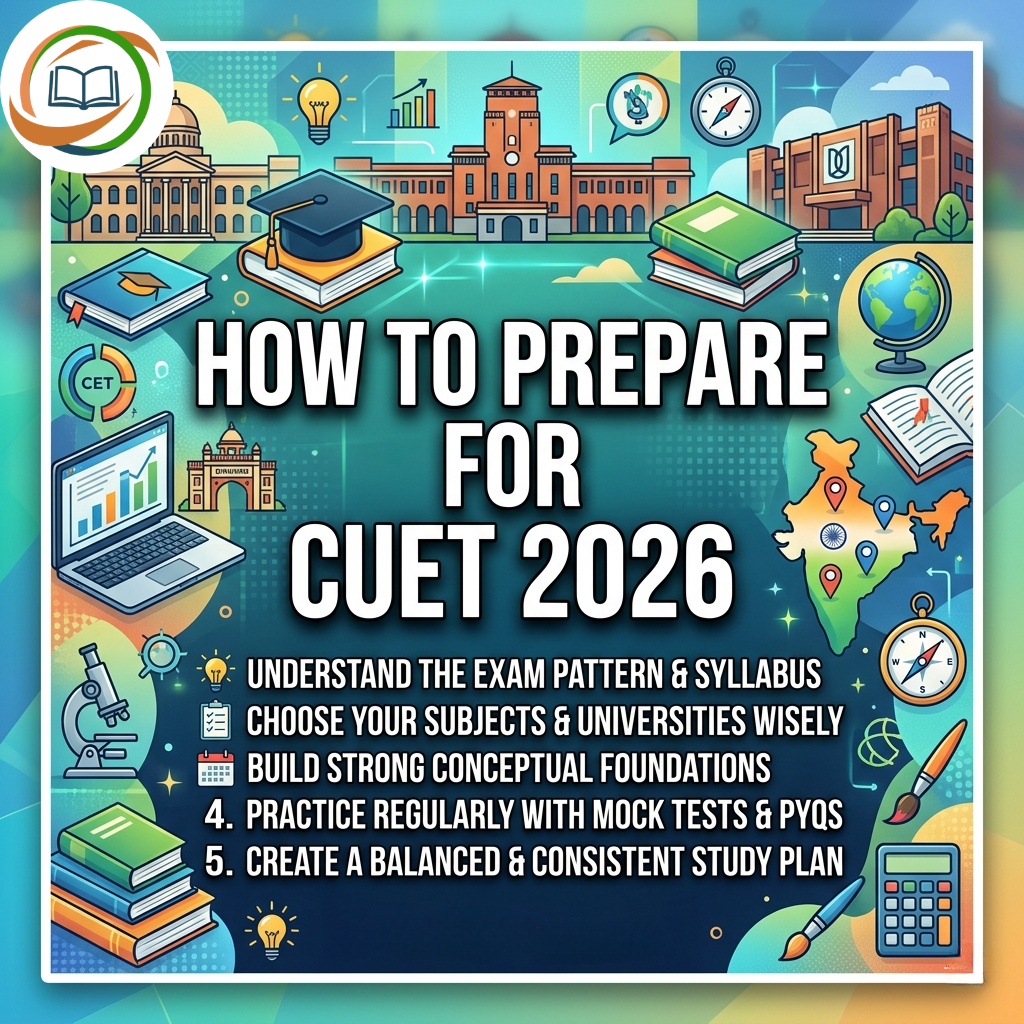
With theCUET UG 2026 exam scheduled from May 11 to May 31, 2026 — just weeks away — the question “How to prepare for CUET 2026?” has never been more urgent. Over 14 lakh candidates are competing for limited seats at 280+ participating universities, including India’s most prestigious central institutions like Delhi University, BHU, JNU, and Jamia Millia Islamia. The students who crack CUET are not always those who studied the longest — they are those who prepared the smartest, most strategically, and most consistently.
This step-by-step guide covers everything you need to know about how to prepare for CUET UG 2026 — from understanding the exam pattern and building a study plan to section-wise preparation strategies, the best books, mock test tactics, and a final-week action plan.
Before You Begin: Three Non-Negotiable First Steps
Step 1 — Understand the CUET 2026 Exam Pattern Thoroughly
You cannot prepare for what you don’t understand. Every minute of your preparation must be aligned with the actual exam structure:
| Feature | CUET UG 2026 Details |
|---|---|
| Sections | Language Test + Domain Subjects + General Aptitude Test |
| Questions Per Subject | 50 MCQs |
| Duration Per Subject | 60 minutes |
| Marking Scheme | +5 Correct / –1 Wrong / 0 Unattempted |
| Max Marks Per Subject | 250 |
| Optional Questions | None — all 50 are compulsory in 2026 |
| Mode | Computer-Based Test (CBT) |
| Exam Window | May 11–31, 2026 |
Key 2026 Change: All 50 questions in every paper are now compulsory. There are no optional questions. This means you cannot selectively answer — complete syllabus coverage is mandatory.
Step 2 — Download the Official NTA Syllabus
The single most important document for CUET preparation is the official NTA CUET UG 2026 syllabus PDF, available free at cuet.nta.nic.in. Download subject-wise PDFs for every paper you are appearing in. Use these as topic-by-topic checklists — check off every topic as you complete it.
Never rely on a third-party “syllabus summary.” The official NTA PDF is the only binding reference.
Step 3 — Know Your Target Score for Each University
Research the expected CUET 2026 cutoffs for your target university and course. For SRCC at DU, aim for 920+ marks across required subjects. For BHU’s competitive programs, target 630–680 per subject. Knowing your destination before starting your journey shapes every preparation decision — which subjects to prioritize, how many mock tests to take, and where to invest your limited study time.
Building Your CUET 2026 Study Plan: Three-Phase Approach
The most effective CUET preparation unfolds across three structured phases:
Phase 1 — Foundation Building (Now to April 30, 2026)
This phase focuses on completing the syllabus for all selected subjects and establishing strong conceptual foundations.
Daily Target: 5–6 hours total (split across subjects)
- 90 minutes: Primary domain subject (new chapter completion)
- 60 minutes: Secondary domain subject
- 45 minutes: Language test practice (passage reading + grammar)
- 30 minutes: GAT — current affairs + reasoning
- 30 minutes: Chapter-wise MCQ practice (just-completed chapters)
Weekly Milestone: Complete 3–4 NCERT chapters per domain subject, solve chapter-wise tests immediately after each chapter, and read current affairs daily using a monthly digest.
Phase 2 — Consolidation & Mock Tests (May 1–10, 2026)
This phase shifts focus from new learning to strengthening, testing, and identifying gaps.
Daily Target: 5–6 hours
- 60–90 minutes: Full-length subject-wise mock test (timed)
- 60 minutes: Detailed post-mock analysis (error review)
- 60 minutes: Weak topic revision based on mock results
- 45 minutes: PYQ (Previous Year Question Paper) practice
- 30 minutes: Current affairs revision and GAT reasoning drills
Weekly Milestone: Complete at least 2–3 full-length mock tests per subject, maintain and review your error log, and finalize your exam-day strategy for each paper.
Phase 3 — Final Revision (May 8–10, 2026 — Last 3 Days Before First Exam)
This is purely a revision and confidence-building phase — no new chapters, no new resources.
- Revise your personal chapter-wise notes only
- Solve 1 short sectional test per subject (20–25 questions) for confidence
- Review your full error log from all previous mocks
- Update current affairs to the latest week
- Download and print admit card; verify exam centre details
- Ensure 7–8 hours of sleep — cognitive performance under exam pressure drops sharply with sleep deficit
Section-Wise: How to Prepare for CUET 2026
Section I — Language Test Preparation
The CUET Language Test is attempted by virtually all candidates and assesses reading comprehension, grammar, vocabulary, and verbal ability. Underperforming here is one of the most common and avoidable reasons for a lower overall score.
Reading Comprehension: CUET passages come in three types — Factual, Narrative, and Literary (including poem-based). The key to scoring here is not just understanding content but answering quickly and accurately under the 72-second-per-question time pressure.
- Read editorials from national newspapers (The Hindu or Indian Express for English; Dainik Bhaskar for Hindi) for 30 minutes daily
- Practice 2–3 unseen passages daily from CUET PYQPs
- Focus on inference and tone-based questions — these are the trickiest and most frequently missed
Grammar and Verbal Ability:
- Cover all core grammar rules: tenses, voice, narration, articles, prepositions, conjunctions
- Practice 20–30 MCQ-format grammar questions daily
- Solve sentence rearrangement and para-jumble sets — these are high-frequency question types in the CUET Language Test
Vocabulary:
- Learn 10–15 new words daily using flashcards or apps
- Focus on contextual usage, synonyms, antonyms, and one-word substitutions
- Reading newspapers naturally builds vocabulary — do not treat it as separate from comprehension practice
Section II — Domain Subject Preparation
Domain subjects are the core of CUET UG 2026 for most candidates. All 23 domain subjects are based entirely on the NCERT Class 12 curriculum.
The Golden Rule: NCERT is Everything — But Read It Differently
Regular board exam reading is passive. CUET preparation requires active NCERT reading:
- Read each chapter twice — once for understanding, once for MCQ sourcing
- Mark every definition, date, formula, diagram caption, and example — these are direct MCQ sources
- Solve all chapter-end exercises as if they were MCQs
- Note all “boxes,” “did you know?” inserts, and in-text examples separately — NTA frequently tests these overlooked sections
Subject-Specific Guidance:
Physics: Understand derivations conceptually — NTA tests application, not rote reproduction. Focus heavily on Electrostatics, Optics, and Semiconductor Electronics. Practice numerical problems daily.
Chemistry (Critical Alert for 2026): The CUET 2026 Chemistry syllabus includes six chapters removed from the CBSE rationalized board syllabus — including Coordination Chemistry, Surface Chemistry, Polymers, and Chemistry in Everyday Life from the old NCERT. If you are only studying the current board edition, you are missing these. Download and study the original (pre-rationalization) NCERT Class 12 Chemistry to cover the full CUET syllabus.
Mathematics: Daily practice of 15–20 MCQs per topic is non-negotiable. Focus on Calculus (Integration expanded in 2026), Probability (Random Variables removed), Vectors, and 3D Geometry.
Biology: Cover all diagrams, life cycles, and process flowcharts thoroughly — CUET Biology tests visual and applied understanding, not just definitions.
Accountancy: Practice journal entries, financial statements, and ratio analysis repeatedly until they become automatic — speed matters within the 60-minute window.
History / Political Science: Create chapter-wise timelines for History. For Political Science, understand the “why” behind events — CUET tests analytical understanding, not just factual recall.
Economics: Master both Micro (consumer theory, production, market forms) and Macro (national income, money and banking, government budget). Practice numerical data interpretation questions from economics newspapers.
High-Weightage Chapter Strategy: Analyze 3–4 years of CUET PYQPs for each subject and count question frequency by chapter. Chapters appearing in 3 or more previous years are your highest-priority targets. Spend proportionally more time mastering these before lower-frequency chapters.
Section III — General Aptitude Test (GAT) Preparation
Many candidates underestimate the GAT and prepare for it last. This is a major strategic mistake — the GAT cannot be crammed in a week. It requires consistent daily practice over weeks.
Current Affairs (10–15 minutes daily):
- Read one national newspaper for 30 minutes every morning
- Maintain a monthly current affairs notebook covering: government schemes, international summits, awards, appointments, science & space, sports, and environment
- Focus on events from the last 6–12 months — this is NTA’s consistent sourcing window for GAT current affairs questions
Logical and Analytical Reasoning (20–25 minutes daily): CUET toppers consistently rank this as the highest-impact GAT preparation habit. Focus topics:
- Seating arrangements (linear and circular) — most frequently tested
- Syllogisms and statement-conclusion
- Blood relations and direction sense
- Coding-decoding and analogy
Solve at least 10–15 reasoning questions daily. Progress from easy to moderate difficulty in the first two weeks, then attempt harder problems in the final week.
Numerical Ability and Quantitative Reasoning (15–20 minutes daily): Review all standard concepts from Class 8–10 Mathematics:
- Percentage, profit & loss, simple and compound interest
- Time and work, time-speed-distance
- Mensuration (area, perimeter, volume)
- Data interpretation (tables, bar graphs, pie charts)
- Averages, ratio and proportion
Practice 15–20 numerical problems daily. Focus on speed and accuracy — the GAT section rewards candidates who can solve moderate arithmetic problems quickly.
How to Use CUET Previous Year Question Papers (PYQPs)
CUET has been conducted since 2022, giving you four full years of actual exam papers available free at cuet.nta.nic.in.
How to Use PYQPs Effectively:
Timing: Do NOT solve PYQPs at the very start of preparation. Wait until you have completed at least 60% of the syllabus for each subject.
Frequency: Solve at least one full PYQP per subject per week during Phases 1 and 2.
Analysis Protocol: After every PYQP, do a detailed review:
Which chapters had the most questions? (update your priority list)
Which question types do you consistently miss? (identify your pattern of errors)
Did you finish within 60 minutes? (time management calibration)
Chapter Frequency Mapping: After solving 3–4 years of PYQPs for a subject, create a chapter-frequency table. High-frequency chapters = highest preparation priority.
Mock Test Strategy: How to Practice and Analyze
According to CUET toppers, taking regular mock tests is one of the top preparation methods — but only if done correctly.
Rules for Effective Mock Test Practice:
Rule 1 — Simulate Real Conditions Every Time Attempt every mock test under strict exam conditions: timer running, no breaks, no phone, no reference material. This conditions your brain to perform under pressure.
Rule 2 — Use the NTA Official Mock Test at Least Once The NTA official mock test at nta.ac.in/Quiz replicates the exact CBT interface — same layout, navigation, question palette, and timer. Attempt it before the actual exam so the interface is completely familiar on exam day.
Rule 3 — Spend More Time Analyzing Than Attempting For every 60-minute mock, spend at least 60–90 minutes on post-test analysis. For each wrong answer, ask: Was it a knowledge gap, a concept error, a reading mistake, or poor time allocation? This categorization drives targeted improvement.
Rule 4 — Maintain an Error Log Keep a dedicated notebook or digital document noting every wrong answer from every mock. Categorize by subject and chapter. Review this log before every subsequent mock test. CUET toppers consistently identify the error log as their most powerful revision tool.
Rule 5 — Track Progress Compare your accuracy and score across mocks over time. If your scores are not improving after 5–6 full-length mocks, it signals that your post-test analysis is not translating to strategy change. Re-examine your preparation approach.
Mastering Negative Marking: The Skill That Separates Good Scores from Great Ones
CUET UG 2026 applies –1 mark for every wrong answer. With +5 for correct answers, one wrong answer costs you the equivalent of what one additional correct answer would have given you, plus a penalty — a net swing of 6 marks per question attempted incorrectly.
The Decision Framework for Every Question:
- Confidence ≥ 70%: Attempt it — the expected value is positive
- Can eliminate 2+ options: Attempt it — narrowed odds are in your favor
- Confidence < 50% and cannot eliminate any option: Skip it — expected value is negative
- Never guess randomly on the last 5 questions to “use up time” — this is one of the most common and costly mistakes in CUET
Practice this decision framework in every mock test until it becomes automatic under time pressure.
Balancing CUET Preparation with Class 12 Board Exams
Many CUET 2026 candidates are simultaneously preparing for Class 12 board exams. Here is the smart way to do both without compromising either:
The Integration Strategy: Since CUET domain subjects are based on NCERT Class 12 content — the same curriculum tested in board exams — both preparations overlap significantly. Study from NCERT for boards, and immediately after each chapter, solve 20–30 CUET-style MCQs. You are not studying twice; you are converting the same content into two formats.
Time Allocation Framework:
- During board exam phase: 70% study time for boards, 30% for CUET (MCQ practice, GAT, language)
- After boards conclude: Immediately shift to 90% CUET focus — full-length mocks, weak topic revision, GAT strengthening
Important Reminder: Board marks carry zero weightage for DU admissions. Your CUET score alone determines merit for DU. However, minimum Class 12 percentages (45–50% for most central universities) must be met for admission eligibility — so do not neglect boards entirely
Best Books for CUET UG 2026 Preparation
| Subject | Recommended Books |
|---|---|
| English (Language) | NCERT Flamingo + Vistas, Wren & Martin Grammar, Arihant CUET English |
| Hindi (Language) | NCERT Textbooks (Class 12), Arihant CUET Hindi |
| Physics | NCERT Class 12 (both parts), Arihant CUET Physics |
| Chemistry | NCERT Class 12 (original — all 16 units), Arihant CUET Chemistry |
| Mathematics | NCERT Class 12 (both parts), Arihant CUET Mathematics |
| Biology | NCERT Class 12, Arihant CUET Biology |
| Accountancy | NCERT Class 12, TS Grewal Double Entry Book Keeping |
| Business Studies | NCERT Class 12, Poonam Gandhi’s Business Studies |
| Economics | NCERT Class 12 (Micro + Macro), TR Jain & VK Ohri |
| History | NCERT Themes in Indian History (Parts I, II, III) |
| Political Science | NCERT Class 12 (both books) |
| Geography | NCERT Class 12 (Human Geography + India People & Economy) |
| General Aptitude Test | Lucent’s GK, RS Aggarwal (Reasoning + QA), Disha CUET GAT, Oswaal CUET GAT |
Book Selection Rule: Pick one primary book per subject and complete it thoroughly. Switching between multiple resources creates confusion and reduces depth. NCERT first, supplemented with one CUET-specific MCQ practice book per subject.
30-Day CUET 2026 Preparation Plan (Final Month)
| Days | Focus | Daily Hours |
|---|---|---|
| Day 1–7 (Apr 22–28) | Complete remaining syllabus gaps; chapter-wise MCQ tests; GAT current affairs | 5–6 hrs |
| Day 8–14 (Apr 29–May 5) | Subject-wise full-length mock tests; deep post-mock analysis; weak topic revision | 5–6 hrs |
| Day 15–19 (May 6–10) | Full-length mock tests (2–3 per subject); error log review; current affairs update; admit card download | 4–5 hrs |
| Day 20+ (Exam Begins May 11) | Short sectional mocks between exam dates; revision of upcoming subjects; adequate rest | 2–3 hrs |
What NOT to Do When Preparing for CUET 2026
Do NOT start new chapters in the last 7 days: The final week is for revision, not new learning. Starting new chapters adds confusion and anxiety without proportional benefit.
Do NOT skip the NTA official mock test: The CBT interface can be unfamiliar for first-timers. Practicing on the official NTA portal eliminates this variable entirely.
Do NOT ignore Chemistry’s extra chapters: CUET 2026 Chemistry includes six CBSE-deleted chapters. Candidates who only prepare the board edition miss these — a costly oversight.
Do NOT over-choose subjects: Choose only the subjects required by your target university. Each extra subject with inadequate preparation increases your negative marking risk and overall fatigue.
Do NOT compare preparation progress with peers: Everyone has different strengths. Focus on your own baseline, your own improvements, and your own target score — not how much someone else has covered.
Do NOT sacrifice sleep: Cognitive performance under exam conditions drops sharply with less than 7 hours of sleep. Consistent sleep is part of your preparation strategy, not a luxury.
Final Word
Knowing how to prepare for CUET 2026 is the first step — but execution is everything. With the exam beginning on May 11, the time for planning has largely passed. What remains is the time for smart, focused action: revising thoroughly from NCERT, taking timed mock tests regularly, analyzing every mistake honestly, and building the mental composure to perform on exam day.
The candidates who succeed in CUET UG 2026 will be those who stayed consistent when it was difficult, analyzed their performance honestly when it was uncomfortable, and walked into the exam hall with a clear strategy rather than hoping for the best.
Stay connected with cuet-nta.com for the latest CUET UG 2026 updates — city intimation slip, admit card download alerts, answer key releases, result notifications, and university-wise cutoff analysis.
Frequently Asked Questions
CUET toppers consistently recommend 5–6 focused hours per day during peak preparation. Quality and consistency matter more than raw hours. A focused 5-hour session with zero distractions outperforms 10 hours of distracted, unfocused study.
For domain subjects, thorough NCERT Class 12 coverage is sufficient for most questions. However, for Chemistry, cover the full original NCERT including six chapters removed from the CBSE board syllabus. Supplement with CUET-specific MCQ practice books to build exam-format familiarity.
Yes. With the official NTA syllabus, NCERT textbooks, free PYQPs from cuet.nta.nic.in, and the NTA's free official mock tests at nta.ac.in/Quiz, self-study is highly effective. Many CUET toppers have prepared without formal coaching. The key is structured planning and consistent daily effort.
Aim for 10–15 full-length mock tests across your selected subjects before the exam. Additionally, solve 30–50 chapter-wise and sectional tests throughout preparation. But remember — analyzing every mock is as important as attempting it.
Ideally, serious CUET-specific preparation should have started in January 2026 alongside board exams. In April, preparation should be in full swing. With the exam from May 11, the focus now is on mock tests, revision, and GAT strengthening — not starting from scratch on new topics.
Dedicate 30–45 minutes daily exclusively to GAT: 15 minutes of current affairs (newspaper + monthly digest), 20 minutes of logical reasoning, and 15 minutes of numerical ability practice. Take 3–4 full-length GAT mock tests in the final month. Consistency over weeks is the only path to a strong GAT score.
With 50 questions in 60 minutes, you have 72 seconds per question. In the first pass, answer all confident questions. Mark uncertain ones for review. In the second pass, apply your elimination skills. Never spend more than 90 seconds on any single question — move on and come back if time permits.
A score above 95th percentile (approximately 180–200 per subject) is generally strong for central universities. For top DU colleges like SRCC, aim for 920+ out of 1,000 across required subjects. A score of 700+ across 4 subjects (175+ per subject) opens doors to strong programs at BHU, Allahabad University, and many other central universities.
No Comments yet!