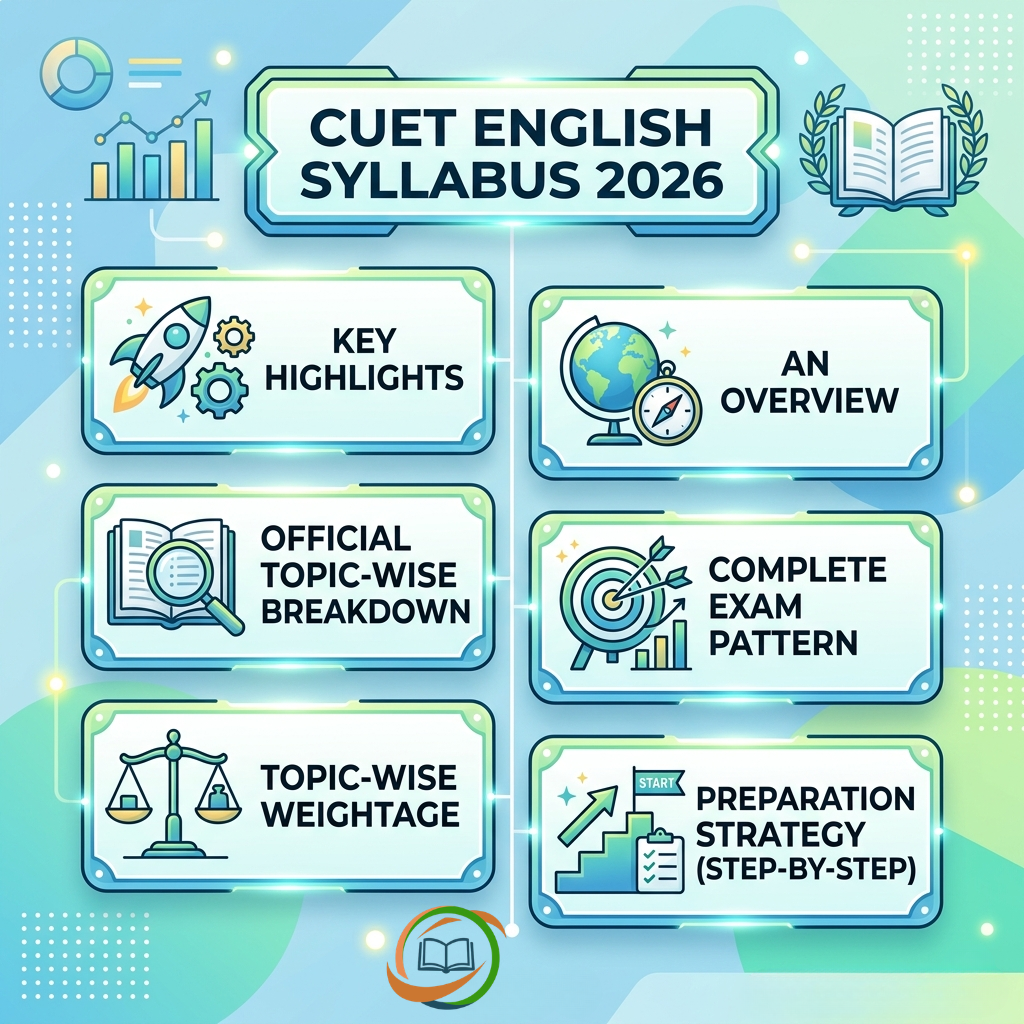
English is the single most popular subject in CUET UG 2026 — with more than 75% of all registered candidates appearing for the English language paper every year. Whether you are aiming for a B.A. (English Honours) at Delhi University, a language program at JNU, or any Arts, Commerce, or Science undergraduate course at a CUET-participating university, English (Subject Code: 101) is almost always a mandatory component of your admission eligibility.
The National Testing Agency (NTA) officially released the CUET English Syllabus 2026 PDF on December 29, 2025, available at cuet.nta.nic.in. This complete guide covers every aspect of the CUET English Syllabus 2026 — official topic-wise breakdown, exam pattern, section-wise weightage, marking scheme, preparation tips, recommended books, and all key details you need to score 250/250 in the English paper.
CUET English Syllabus 2026: Key Highlights
| Feature | Details |
|---|---|
| Subject Name | English |
| Subject Code | 101 |
| Section | Section I — Language Test (Section IA) |
| Total Questions | 50 MCQs |
| Questions to Attempt | All 50 (no optional questions from 2026) |
| Total Marks | 250 |
| Exam Duration | 60 Minutes |
| Marking Scheme | +5 for correct answer, –1 for incorrect answer |
| Medium of Paper | English |
| Syllabus Released On | December 29, 2025 |
| Official Portal | cuet.nta.nic.in |
| CUET Exam Dates | May 11–31, 2026 |
| Difficulty Level | Easy to Moderate |
What is the CUET English Paper? An Overview
The CUET English paper falls under Section I (Language Test) of the CUET UG 2026 exam. Section I covers 13 languages — English, Hindi, Assamese, Bengali, Gujarati, Kannada, Malayalam, Marathi, Odia, Punjabi, Tamil, Telugu, and Urdu — and candidates choose the language paper(s) based on their preferred university’s subject requirements.
English (Section IA) is categorized as a mandatory language paper for the majority of CUET-participating universities across all program streams. It tests a candidate’s reading comprehension ability, verbal proficiency, vocabulary range, and understanding of language usage — skills that are directly relevant to undergraduate academic success.
Important Change for 2026: From CUET UG 2026, there are no optional questions. All 50 questions in the English paper are compulsory, unlike previous years where candidates could choose 40 out of 50. This makes thorough coverage of the full syllabus even more critical this year.
CUET English Syllabus 2026: Official Topic-Wise Breakdown
The official NTA CUET English Syllabus 2026 is structured around two core areas:
- Reading Comprehension
- Verbal Ability
Each of these two pillars covers specific question types and sub-topics. Here is the complete, detailed breakdown:
Area 1: Reading Comprehension
Reading Comprehension is the highest-weightage section of the CUET English paper, accounting for approximately 36–40% of the total marks. This section evaluates a candidate’s ability to read, understand, interpret, and draw conclusions from unseen passages.
The paper includes three passages, each of a maximum of 300–350 words, with approximately 4 questions based on each passage. The three passage types are:
1. Factual Passages These are straightforward, information-based passages presenting facts, data, or descriptions on topics from science, geography, history, current affairs, or everyday subjects. Questions focus on direct retrieval of information, understanding the central idea, and comprehending factual details as presented in the text. This is generally the most accessible passage type for most candidates.
2. Narrative Passages These passages tell a story or describe a sequence of events — typically excerpts from fictional prose, travelogues, autobiographical accounts, or descriptive writing. Questions test understanding of plot, character, cause-and-effect relationships, sequence of events, and inference from context. Narrative passages require stronger reading speed and contextual understanding.
3. Literary Passages This is typically the most challenging passage type. Literary passages may include extracts from poetry, literary prose, dramatic writing, or critical essays. Questions test tone, theme, literary devices, figurative language, mood, and the author’s intent. Candidates preparing for this section should be familiar with Class 12 NCERT English textbooks — Flamingo and Vistas — as the literary style and themes in these passages often reflect similar material.
Key Insight: Reading Comprehension accounts for the largest chunk of the CUET English paper. Candidates who build strong daily reading habits and practice inference-based questions will find a significant advantage here. Aim to solve at least 2–3 unseen passages every day during your preparation.
Area 2: Verbal Ability
Verbal Ability tests a candidate’s command over the English language beyond just reading — it evaluates grammar awareness, logical sequencing, vocabulary depth, and the ability to use English accurately in contextual situations. The major topic types under Verbal Ability are:
1. Para-Jumbles (Rearranging the Parts / Sentence Rearrangement) Jumbled sentences or paragraphs are presented, and candidates must rearrange them into a logically coherent and grammatically correct sequence. This tests understanding of sentence structure, discourse flow, and logical coherence. Para-jumbles consistently appear with 6–7 questions in most CUET English exam shifts and are of easy to moderate difficulty.
2. Choosing the Correct Word Candidates are given a sentence with a blank or an underlined word and must select the most appropriate option from the choices provided. This tests vocabulary precision, word usage in context, and understanding of subtle differences in word meaning. Grammar-related errors like incorrect tense use, wrong prepositions, and subject-verb disagreement also appear in this format.
3. Synonyms and Antonyms Direct vocabulary questions asking candidates to identify a word with the same meaning (synonym) or opposite meaning (antonym) as a given word. These questions test breadth of vocabulary and are generally factual in nature. Vocabulary-related questions — including synonyms, antonyms, idioms, and spelling errors — collectively account for approximately 20–24% of the paper and have appeared in every CUET English exam since 2022.
4. Match the Following Questions where candidates must correctly pair items from two columns — often matching words with their meanings, idioms with their definitions, or phrases with their correct usage. This format tests both vocabulary and logical pairing ability.
5. Idioms and Phrases Understanding the meanings of common idiomatic expressions and fixed phrases as used in context. Candidates should build familiarity with frequently used English idioms from standard Class 12 and general vocabulary resources.
6. One-Word Substitution Given a phrase or a short description, candidates must identify the single word that best captures the meaning. This is a vocabulary and language precision exercise.
7. Spelling and Error Detection Questions requiring candidates to identify spelling mistakes or detect grammatical errors in sentences. These are fewer in number (2–3 questions per paper) but are historically rated as slightly more difficult, with common traps around homophones, commonly misspelled words, and punctuation errors.
CUET English 2026: Complete Exam Pattern
| Parameter | Details |
|---|---|
| Section | Section I — Language Test (IA) |
| Subject Code | 101 |
| Total Questions | 50 |
| Questions to Attempt | 50 (All compulsory — no choice from 2026) |
| Question Type | Multiple Choice Questions (MCQs) |
| Total Marks | 250 (50 questions × 5 marks each) |
| Correct Answer | +5 marks |
| Incorrect Answer | –1 mark |
| Unattempted Question | 0 marks |
| Duration | 60 minutes |
| Mode | Computer-Based Test (CBT) |
| Language of Paper | English |
CUET English 2026: Topic-Wise Weightage
Based on analysis of CUET English papers from 2022 to 2025, the approximate topic-wise weightage distribution is as follows:
| Topic / Area | Approximate Weightage | Approx. Questions |
|---|---|---|
| Reading Comprehension (Factual, Narrative, Literary) | 36–40% | 18–20 |
| Vocabulary (Synonyms, Antonyms, Idioms, Spelling) | 20–24% | 10–12 |
| Grammar-based Questions (via Verbal Ability format) | 20–24% | 10–12 |
| Para-Jumbles / Sentence Rearrangement | 10–12% | 5–7 |
| Verbal Ability — Other (Match the Following, One-Word) | 6–10% | 3–5 |
Note: NTA does not officially publish a fixed question-count breakdown per topic. The above weightage is based on PYQ (Previous Year Question) analysis from CUET English exams conducted between 2022 and 2025. Actual question distribution may vary slightly between exam shifts and years.
What’s New in CUET English Syllabus 2026?
For 2026, the NTA has introduced one significant change that directly affects the English paper:
No Optional Questions: In previous years, candidates could attempt 40 out of 50 questions in the English paper, giving them the flexibility to skip 10 questions. From CUET UG 2026, all 50 questions are compulsory — there is no option to skip. This means candidates must be prepared across all topic types without relying on selective attempts.
The core syllabus structure — Reading Comprehension + Verbal Ability — remains consistent with previous years. The topic types, passage formats, and question styles follow established CUET English exam trends from 2022 onwards.
CUET English 2026: Previous Year Trends at a Glance
Understanding how the English paper has appeared in past exams helps candidates prepare more strategically.
Reading Comprehension (2022–2025): Consistently formed 40–45% of questions. Unseen passages were generally easy to moderate. Inference and author’s viewpoint questions were more frequent than direct factual recall. Literary passages were slightly harder than factual ones.
Vocabulary (2022–2025): 10–14 vocabulary questions appeared per shift. Synonyms and antonyms were the most common format. From 2025 onwards, vocabulary questions increased slightly in proportion, making word knowledge more important.
Para-Jumbles (2022–2025): 6–7 questions per shift at easy to moderate difficulty. One of the most consistently scoreable question types.
Grammar-Linked Questions (2022–2025): Tense corrections, active-passive voice, and error detection appeared regularly within Verbal Ability MCQ formats. Candidates with strong grammar foundations achieved 85–90% accuracy in this zone.
Spelling Questions (2022–2025): 2–3 questions per shift — fewer in number but rated slightly harder, involving homophones and commonly confused spellings.
Recommended Books for CUET English 2026
| Book / Resource | Author / Publisher | Best For |
|---|---|---|
| High School English Grammar and Composition | Wren & Martin | Grammar rules, comprehensive reference |
| Objective General English | S.P. Bakshi (Arihant) | Vocabulary, synonyms, antonyms, verbal ability |
| Lucent’s General English | Lucent Publications | Quick grammar and vocabulary revision |
| NCERT Class 12 English — Flamingo | NCERT | Literary passages, reading comprehension |
| NCERT Class 12 English — Vistas | NCERT | Supplementary literary comprehension |
| CUET English PYQ Papers (2022–2025) | NTA / Various Publishers | Pattern practice, topic familiarization |
| The Hindu / Indian Express (Daily) | Newspaper | Vocabulary, reading speed, comprehension |
CUET English 2026: Preparation Strategy (Step-by-Step)
Step 1 — Download and Study the Official Syllabus Start by downloading the official CUET English Syllabus 2026 PDF from cuet.nta.nic.in. Map every topic type to your current skill level — identify what you are strong in and what needs work.
Step 2 — Build a Daily Reading Habit Spend at least 30–45 minutes daily reading editorials, short stories, essays, and informational articles. Practice all three passage types — factual, narrative, and literary. Focus on inference-based questions rather than just direct information recall.
Step 3 — Expand Vocabulary Systematically Learn 15–20 new words every day with their synonyms, antonyms, and contextual usage. Revise weekly using flashcards. Reading quality newspapers is one of the most effective and free ways to build vocabulary in context.
Step 4 — Master Para-Jumbles Solve 5–10 sentence rearrangement exercises daily during the final preparation weeks. Focus on identifying the opening sentence, logical connectors between sentences, and the concluding sentence — these are the keys to solving para-jumbles quickly.
Step 5 — Reinforce Grammar Through Practice Revise tenses, voice (active/passive), reported speech, and parts of speech using Wren & Martin. Practice error detection and sentence correction MCQs regularly to apply grammar in the exam format.
Step 6 — Solve CUET English PYQs (2022–2025) Solving previous year CUET English papers is non-negotiable. It familiarizes you with exact question styles, difficulty levels, and recurring topics. Analyze every mistake after each paper to close preparation gaps.
Step 7 — Attempt Timed Full Mock Tests In the final 4–6 weeks before the exam, attempt complete 50-question English mocks within 60 minutes. Since all 50 questions are compulsory in 2026, practicing full-paper time management is essential.
Final Word
The CUET English Syllabus 2026 is clearly defined, stable in structure, and entirely achievable for any candidate who prepares with consistency and the right strategy. Reading Comprehension and Verbal Ability together cover the entire paper — and both reward regular reading, a strong vocabulary, and confident language intuition over rote memorization.
The biggest shift for 2026 — all 50 questions being compulsory — means there is no room to leave any area unprepared. Start with the official NTA syllabus PDF, assess your gaps honestly, and build a daily routine that touches every topic type well before the May 11–31, 2026 exam window.
Stay connected with cuet-nta.com for mock tests, previous year papers, topic-wise study notes, cutoff analysis, and all CUET English 2026 updates.
Frequently Asked Questions
The CUET UG 2026 subject code for English is 101, falling under Section I — Language Test (Section IA) of the exam.
There are 50 MCQs in the paper. From 2026, all 50 are compulsory with no optional skipping. Each correct answer carries +5 marks, each incorrect answer results in –1 mark, and unattempted questions carry 0 marks. Total marks: 250.
The syllabus covers two core areas: (1) Reading Comprehension — Factual, Narrative, and Literary passages (300–350 words each), and (2) Verbal Ability — Para-Jumbles, Choosing the Correct Word, Synonyms and Antonyms, Match the Following, Idioms and Phrases, One-Word Substitution, and Spelling/Error Detection.
Grammar is not listed as a standalone section in the official NTA syllabus. However, grammar concepts — tenses, active/passive voice, error detection, and sentence correction — regularly appear within the Verbal Ability question formats. Basic grammar preparation is still strongly recommended
The CUET English paper has a duration of 60 minutes. PwBD candidates are entitled to 20 additional minutes of compensatory time per hour.
Class 12 NCERT English textbooks — Flamingo (Main Textbook) and Vistas (Supplementary) — are directly relevant, especially for literary passage comprehension and understanding literary writing styles.
English consistently records the highest registrations among all CUET subjects. Over 800,000 candidates appeared for the CUET English paper in 2025, representing approximately 75% of all CUET UG 2025 registrations.
The official CUET English Syllabus 2026 PDF is available for free at the NTA's official portal: cuet.nta.nic.in. Navigate to the Syllabus section and download the Language Section PDF (Subject Code 101).
No Comments yet!