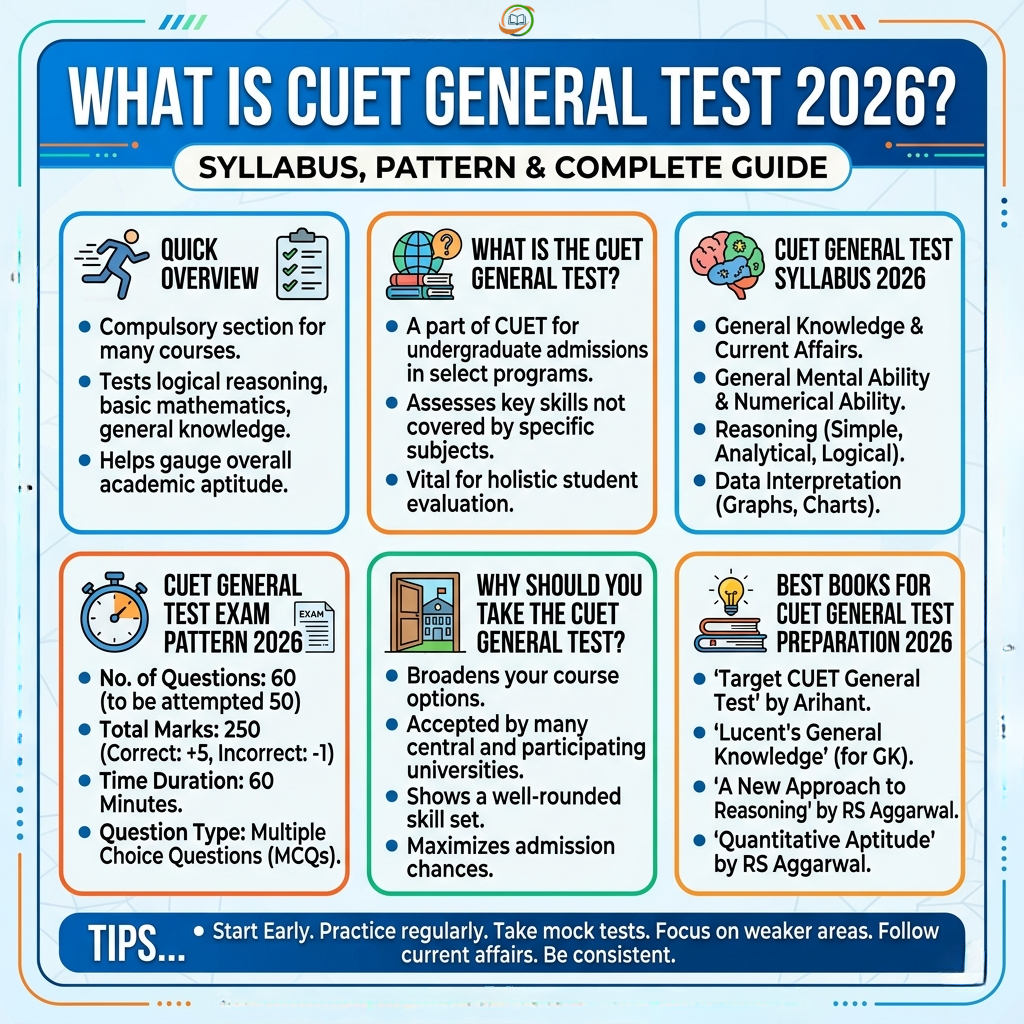
If you are preparing for CUET UG 2026 and wondering what the General Test is all about — whether you need to take it, what topics it covers, and how to score well — this guide is for you.
The CUET General Test (also known as the General Aptitude Test or GAT) is one of the three core components of the CUET UG exam. While it is technically optional, it plays a crucial role for lakhs of students applying to popular undergraduate programmes like BBA, B.A. (Hons.), and various vocational and cross-stream courses.
Let us break it all down for you in simple terms.
CUET General Test — Quick Overview
Parameter | Details |
|---|---|
| Section | Section III of CUET UG 2026 |
| Also Known As | General Aptitude Test (GAT) |
| Total Questions | 50 (all compulsory) |
| Marks Per Question | +5 |
| Total Marks | 250 |
| Negative Marking | –1 per wrong answer |
| Duration | 60 Minutes |
| Mode | Computer-Based Test (CBT) |
| Languages Available | 13 |
| Mandatory? | Optional (course/university-dependent) |
What is the CUET General Test?
The CUET General Test is Section III of the Common University Entrance Test (CUET UG 2026), conducted by the National Testing Agency (NTA). Unlike Section I (Languages) and Section II (Domain-Specific Subjects), the General Test does not test your knowledge of a specific school subject. Instead, it evaluates your overall aptitude, reasoning ability, general awareness, and basic mathematical skills.
In simple terms, think of it as an all-rounder test designed to assess how well you think, analyse, and apply knowledge — not just what you have memorised from textbooks.
The General Test was earlier a choice-based section, but under the revised CUET 2026 exam pattern, all 50 questions in this section are compulsory — there are no optional questions. This change makes it even more important for candidates to prepare every topic in the syllabus thoroughly.
Is the CUET General Test Compulsory?
No — the General Test is not compulsory for all candidates. However, it becomes mandatory depending on the university and course you are applying for. You need to check the specific admission criteria of each university you are targeting.
Here is when you will typically need to appear for the CUET General Test:
- BBA, BMS, and Management programmes at most central and private universities
- B.A. (Hons.) programmes in social sciences and humanities at several universities
- Vocational and open-eligibility courses that do not have a specific domain subject
- Cross-stream admissions — for example, a Science student applying for a B.A. programme
- Programmes where domain subjects have been discontinued — NTA has discontinued domain papers for Entrepreneurship, Teaching Aptitude, Fashion Studies, Tourism, Legal Studies, and Engineering Graphics. For these programmes, admissions are now made based on the General Aptitude Test.
Important: Always check the official admission prospectus of your target university to confirm whether the General Test is required for your chosen course.
CUET General Test Syllabus 2026
The CUET General Test syllabus is broad but well-defined. It covers the following major areas:
1. General Knowledge & Current Affairs
This section tests your awareness of the world around you. It includes:
- Static GK — Indian history, geography, polity, science, books and authors, awards, sports records
- Current Affairs — Recent national and international events, government schemes, summits, sports developments, and important appointments
Expected number of questions: 12–14
2. General Mental Ability
This section assesses your reasoning and thinking skills through:
- Series completion
- Analogy
- Odd one out
- Coding-decoding
- Blood relations
- Direction sense
Expected number of questions: 10–12
3. Numerical Ability & Quantitative Reasoning
This section is based on simple mathematical concepts taught up to Class 8 — so do not worry about advanced mathematics. Topics include:
- Arithmetic (percentage, ratio, profit & loss, average, speed-time-distance)
- Basic algebra
- Geometry and mensuration
- Statistics
- Data interpretation
Expected number of questions: 10–20
4. Logical & Analytical Reasoning
This section evaluates your ability to think logically and solve puzzles:
- Statement and conclusions
- Syllogism
- Seating arrangements
- Puzzles and grids
- Critical reasoning
Expected number of questions: 10–12
5. General Science & Environmental Literacy
This area covers basic science and environment awareness:
- Everyday science concepts
- Environmental issues, climate change, sustainability
- Basic biology, physics, and chemistry at foundational level
- Important scientific discoveries and inventions
Expected number of questions: 6–8
CUET General Test Exam Pattern 2026
Here is a detailed look at the exam pattern for the CUET General Test:
Feature | Details |
|---|---|
| Total Questions | 50 |
| All Questions Compulsory | Yes (no internal choice) |
| Question Type | MCQ (Multiple Choice Questions) |
| Marks for Correct Answer | +5 |
| Marks for Wrong Answer | –1 |
| Marks for Unattempted | 0 |
| Duration | 60 Minutes |
| Maximum Score | 250 Marks |
| Mode | Online (CBT) |
Marking Scheme — Explained
- Every correct answer earns you +5 marks.
- Every incorrect answer leads to a deduction of –1 mark.
- Questions left unanswered carry no penalty.
- If a question is found incorrect or dropped by NTA, all candidates who attempted it receive +5 marks automatically.
Important: Always check the official admission prospectus of your target university to confirm whether the General Test is required for your chosen course.
Topic-Wise Expected Weightage
Based on previous years’ CUET General Test papers, here is the approximate topic-wise distribution:
| Topic | Expected Questions |
|---|---|
| General Knowledge & Current Affairs | 12–14 |
| Numerical Ability & Quantitative Reasoning | 10–20 |
| Logical & Analytical Reasoning | 10–12 |
| General Mental Ability | 8–10 |
| General Science & Environment | 6–8 |
Why Should You Take the CUET General Test?
Even if the General Test is not strictly required for your course, here are some compelling reasons to consider it:
- Boosts overall score: A good score in the General Test can significantly improve your overall CUET performance alongside domain and language sections.
- Widens university options: Several universities and courses specifically require or prefer the General Test score, opening up more choices for you.
- No subject-specific preparation needed: The General Test does not require mastery of any Class 12 subject. With smart preparation, it can be one of the highest-scoring sections.
- Useful for management programmes: BBA and BMS admissions at top universities like Delhi University, Banaras Hindu University, and Jamia Millia Islamia require the General Test, making it essential for aspiring management students.
Best Books for CUET General Test Preparation 2026
Here are some of the most recommended study resources:
| Book | Author/Publisher |
|---|---|
| Lucent’s General Knowledge | Dr. Binay Karna |
| Quantitative Aptitude for Competitive Exams | R.S. Aggarwal |
| A Modern Approach to Logical Reasoning | R.S. Aggarwal |
| Analytical Reasoning | M.K. Pandey |
| Current Affairs Monthly Magazine | Any reputed publisher (Pratiyogita Darpan, etc.) |
| CUET General Test Previous Year Papers | NTA / Various publishers |
CUET General Test Preparation Tips 2026
1. Start with the Syllabus
Download the official CUET 2026 syllabus from cuet.nta.nic.in and go through the General Test topics carefully. Mark the areas you are weak in and plan accordingly.
2. Focus on High-Weightage Topics
Numerical Ability and GK/Current Affairs together account for the largest chunk of questions. Prioritise these areas early in your preparation.
3. Read the News Every Day
Spend 20–30 minutes daily reading a newspaper or a current affairs app. Focus on national/international events, government schemes, important appointments, and sports updates from the past 6–12 months.
4. Practise Previous Year Papers
Solving CUET General Test papers from previous years gives you a clear idea of the question style, difficulty level, and time management required.
5. Take Regular Mock Tests
Attempt full-length mock tests under timed conditions. This helps you build speed and accuracy — both critical for the 60-minute General Test.
6. Revise NCERT Class 6–8 for Math
For the Numerical Ability section, revising basic NCERT concepts from Classes 6 to 8 is more than sufficient. Avoid over-preparing advanced topics not in the syllabus.
7. Avoid Blind Guessing
While educated guessing can help, randomly marking answers can cost you marks due to negative marking. Attempt a question only if you are reasonably confident.
Frequently Asked Questions
The CUET General Test (Section III) is an optional aptitude-based paper in CUET UG 2026 that tests General Knowledge, Reasoning, Numerical Ability, and General Science. It carries 250 marks and consists of 50 compulsory MCQs.
No, it is not compulsory for all candidates. Its requirement depends on the university and UG programme you are applying to. Programmes like BBA, social science courses, and those with discontinued domain subjects typically require the General Test.
There are 50 questions in the General Test, and all are compulsory. There are no optional questions in the revised 2026 pattern.
The total marks for the CUET General Test is 250. Each correct answer gives +5 marks and each wrong answer leads to a –1 mark deduction.
The CUET General Test duration is 60 minutes.
Many top universities including Banaras Hindu University (BHU), Jamia Millia Islamia (JMI), Aligarh Muslim University (AMU), and several private universities require the General Test for select programmes. Always verify with individual university prospectuses.
The CUET General Test can be attempted in 13 languages, as available in Section I of CUET UG 2026
The syllabus covers: General Knowledge & Current Affairs, General Mental Ability, Numerical Ability & Quantitative Reasoning, Logical & Analytical Reasoning, and General Science & Environmental Literacy.
No Comments yet!