Last Updated: April 22, 2026 | Source: cuet.nta.nic.in
The CUET UG 2026 (Common University Entrance Test – Undergraduate) is one of India’s largest and most competitive national-level entrance examinations. Conducted by the National Testing Agency(NTA), it offers a single, standardized platform for students seeking undergraduate admission across central universities, state universities, deemed universities, and private universities in India. Whether you are aiming for Delhi University (DU), Banaras Hindu University (BHU), Jawaharlal Nehru University (JNU), or any of the 280+ participating institutions, CUET UG 2026 is your gateway to higher education.
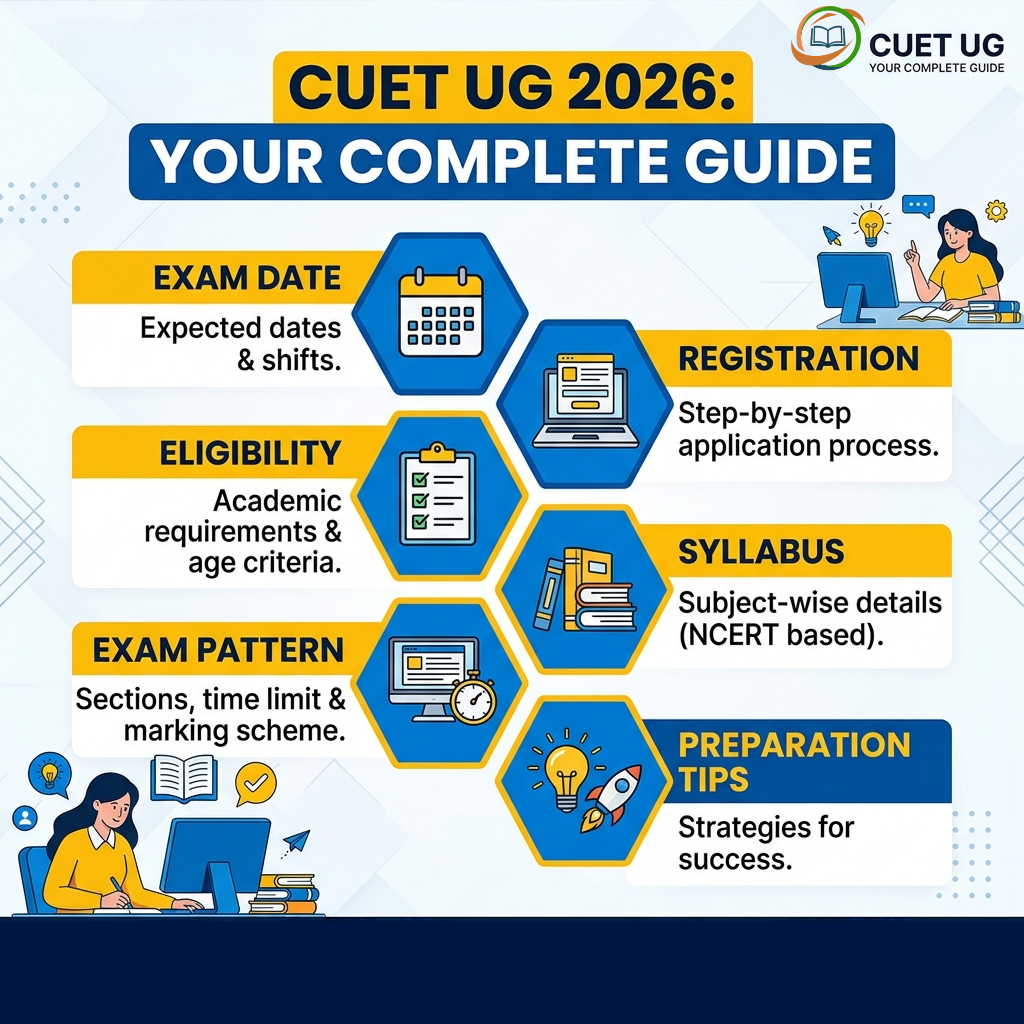
This comprehensive guide covers everything from important dates and eligibility criteria to exam pattern, syllabus, application fees, and preparation strategy — all in one place.
CUET UG 2026: Key Highlights at a Glance
| Detail | Information |
|---|---|
| Information | Common University Entrance Test (Undergraduate) |
| Conducting Body | National Testing Agency (NTA) |
| Official Website | cuet.nta.nic.in |
| Notification Released | January 3, 2026 |
| Registration Period | January 3 – February 26, 2026 (Reopened) |
| Exam Mode | Exam Mode |
| Exam Dates | May 11 – May 31, 2026 (Tentative) |
| Subjects Offered | 13 Languages + 23 Domain Subjects + General Test |
| Marking Scheme | +5 Correct, –1 Wrong, 0 Unattempted |
| Max Subjects Allowed | Up to 5 |
| Participating Universities | 280+ (Central, State, Deemed & Private) |
| City Intimation Slip | 4th week of April 2026 (Expected) |
| Admit Card | 1st week of May 2026 (Expected) |
| Result | June 2026 (Expected) |
What is CUET UG 2026?
Introduced in 2022 by the University Grants Commission (UGC) and administered by NTA, CUET UG has transformed undergraduate admissions in India. It replaced the individual university entrance tests and removed the over-reliance on Class 12 board marks for securing seats at premier institutions.
CUET UG 2026 is conducted in Computer-Based Test (CBT) mode across more than 500 cities within India and select international locations. The exam is offered in 13 languages, making it accessible to students from all linguistic backgrounds. Today, over 280 universities — including all 45 Central Universities — mandatorily accept CUET UG scores for undergraduate admissions, making it one of the most significant entrance exams in the country.
CUET UG 2026 Important Dates
| Event | Date |
|---|---|
| Official Notification Released | January 3, 2026 |
| Registration Start Date | January 3, 2026 |
| Registration Last Date (Extended) | February 4, 2026 |
| Fee Payment Last Date | February 7, 2026 |
| Registration Reopened | February 23 – 26, 2026 |
| Subject Correction Window | Opened (Closed April 19, 2026) |
| Exam City Intimation Slip | 4th week of April 2026 (Expected) |
| Admit Card Release | 1st week of May 2026 (Expected) |
| CUET UG 2026 Exam Dates | May 11 – May 31, 2026 (Tentative) |
| Result Declaration | June 2026 (Expected) |
| Counselling Begins | Counselling Begins |
Note: Dates marked as tentative are based on official NTA patterns and may be revised. Always check cuet.nta.nic.in for the latest updates.
CUET UG 2026 Eligibility Criteria
Before applying for CUET UG 2026, every candidate must meet the following eligibility requirements set by NTA:
Academic Qualification: Candidates must have passed or be appearing in Class 12 (10+2) from a recognized board in 2026. The minimum aggregate required is 45% for General category candidates and 40% for SC/ST/OBC reserved category candidates.
Age Limit: There is no upper age limit for appearing in CUET UG 2026. However, individual universities may have their own age-related criteria for specific programs, which candidates should verify separately.
Nationality: Indian nationals are eligible to apply. Foreign nationals, NRI, and OCI candidates may also apply as per NTA rules.
Subject Freedom (New in 2026): The UGC has introduced a key change — candidates can now choose any subject for CUET UG, regardless of their Class 12 subjects. This gives students greater flexibility in selecting programs they wish to pursue.Important: Meeting CUET eligibility does not guarantee university admission. Each participating university has its own course-specific eligibility criteria, which candidates must check independently.
CUET UG 2026 Exam Pattern
Understanding the exam pattern is crucial for effective preparation. The CUET UG 2026 follows an MCQ-based format divided into three main sections:
Section I – Language Test (Section 1A and 1B)
- Tests reading comprehension and language proficiency
- Section 1A: 13 languages (including Hindi, English, Tamil, Telugu, etc.)
- Section 1B: Additional language options (regional languages)
- Each paper: 50 MCQs to be attempted in 45 minute
Section II – Domain-Specific Subjects
- 23 domain subjects available (based on Class 12 NCERT curriculum)
- Candidates can select up to 6 domain subjects based on their target university requirements
- Each paper: 50 MCQs in 45 minutes
- 6 subjects discontinued in 2026: Entrepreneurship, Teaching Aptitude, Fashion Studies, Tourism, Legal Studies, and Engineering Graphics
Section III – General Test (GAT)
- Tests general knowledge, current affairs, quantitative reasoning, logical reasoning, and analytical skills
- 60 MCQs in 60 minutes
- Primarily required for B.Com, BBA, BMS, and management-related programs
Marking Scheme
| Response | Marks |
|---|---|
| Correct Answer | +5 |
| Incorrect Answer | –1 |
| Unattempted / Marked for Review | 0 |
Maximum marks per subject: 250 (50 questions × 5 marks) Maximum total marks (5 subjects): 1,250
Strategy Tip: Since negative marking applies, avoid random guessing. Only attempt a question if you are at least 70% confident of the answer.
CUET UG 2026 Syllabus
The CUET UG 2026 syllabus is primarily based on the NCERT Class 12 curriculum for domain subjects. Here is a section-wise breakdown:
Language Sections (1A/1B): Reading comprehension, vocabulary, grammar, and verbal ability. For Hindi, topics include sandhi, samas, muhavare, alankar, and ras. Equivalent grammar concepts apply for other regional languages.
Domain Subjects: The syllabus closely mirrors the Class 12 NCERT textbooks for subjects such as Physics, Chemistry, Mathematics, Biology, History, Geography, Political Science, Economics, Accountancy, Business Studies, and 13 more. Students already preparing for board exams are at an advantage.
The CUET UG 2026 syllabus is primarily based on the NCERT Class 12 curriculum for domain subjects. Here is a section-wise breakdown:
Language Sections (1A/1B): Reading comprehension, vocabulary, grammar, and verbal ability. For Hindi, topics include sandhi, samas, muhavare, alankar, and ras. Equivalent grammar concepts apply for other regional languages.
Domain Subjects: The syllabus closely mirrors the Class 12 NCERT textbooks for subjects such as Physics, Chemistry, Mathematics, Biology, History, Geography, Political Science, Economics, Accountancy, Business Studies, and 13 more. Students already preparing for board exams are at an advantage.
- General Knowledge and Current Affairs (last 6 months)
- Logical and Analytical Reasoning
- Quantitative Reasoning (basic Mathematics up to Class 8)
- General Mental Ability
CUET UG 2026 Application Fee Structure
The CUET registration fee varies by candidate category and the number of subjects selected:
| Category | Fee for 1 Subject | Fee per Additional Subject |
|---|---|---|
| General (UR) | ₹1,000 | ₹400 |
| OBC-NCL / EWS | ₹900 | ₹375 |
| SC / ST / PwD / Third Gender | 800 | ₹350 |
| Centres Outside India | ₹4,500 (up to 3 subjects) | Extra charges apply |
Payment Methods: Net Banking, Debit Card, Credit Card, or UPI (online only — no offline payments accepted).
How to Register for CUET UG 2026
Since the 2026 registration window is now closed, here are the steps for reference for future applicants:
- Visit the official website: cuet.nta.nic.in
- Register with your name, date of birth, mobile number, and email ID to generate an Application Number
- Fill the Application Form — enter personal, academic, and exam preference details
- Select Subjects — choose up to 5 subjects (languages, domain subjects, or General Test) aligned with your target university courses
- Upload Documents — photograph (white background, 80% face visible), signature, and other required documents in prescribed format
- Pay the Fee online using your preferred payment method
- Download the Confirmation Page — save and print it for future reference
Note: The confirmation page is proof of successful registration. If not generated after payment, contact the bank or NTA helpdesk immediately.
CUET UG 2026 Participating Universities
As of 2026, over 280 universities accept CUET UG scores, a significant expansion from the 44 Central Universities that originally piloted the exam in 2022. Key participating institutions include:
Central Universities (Mandatory): Delhi University (DU), Banaras Hindu University (BHU), Jawaharlal Nehru University (JNU), Jamia Millia Islamia,Aligarh Muslim University (AMU),Hyderabad University, and all 45 Central Universities across India.
State Universities: Lucknow University, Gujarat University, Osmania University, Vikram University, Mahatma Gandhi Kashi Vidyapith, and many more state government universities.
Deemed & Private Universities: Amity University,Lovely Professional University (LPU), Chandigarh University, SRM University, and select other private institutions that accept CUET scores alongside or in lieu of their own entrance tests
Important Note: Since Delhi University (DU) admits students exclusively through CUET scores, board exam percentages are not considered for DU admissions in any undergraduate program — including top colleges like SRCC, Hindu, St. Stephen’s, Hansraj, Miranda House, and Lady Shri Ram.
What’s New in CUET UG 2026?
The UGC and NTA have introduced several significant changes for CUET UG 2026 that aspirants must be aware of:
1. Subject Freedom: Students can now opt for any subject regardless of what they studied in Class 12. This opens up more program options for students from diverse academic backgrounds.
2. Six Domain Subjects Discontinued: Entrepreneurship, Teaching Aptitude, Fashion Studies, Tourism, Legal Studies, and Engineering Graphics have been dropped from CUET UG 2026 due to low registration numbers. Candidates who registered for these in previous years should note this change.
3. No Optional Questions: All 50 questions in each subject paper are now mandatory — there are no optional questions. This change demands better overall preparation across the entire syllabus.
4. APAAR ID Integration: Students using an APAAR (Academic Bank of Credits) ID benefit from automatic integration of their CUET scores into their permanent academic records.
CUET UG 2026: Admit Card & City Intimation Slip
City Intimation Slip (Expected: 4th week of April 2026): Released before the admit card, it notifies candidates about their exam city. Use this to plan travel and accommodation in advance.
Admit Card (Expected: 1st week of May 2026): Released 2–4 days before the exam date, the hall ticket is available only on cuet.nta.nic.in. It contains the full exam centre address, shift timing, date, and exam-day instructions. Without the printed admit card, entry to the exam hall is not permitted.
CUET UG 2026 Result & Counselling
Result: The NTA is expected to announce CUET UG 2026 results in June 2026. Candidates can check their scorecards by logging in with their application number and date of birth on the official website.
Counselling: CUET UG does not have a centralized national counselling process. Each participating university manages its own admission procedure. For example, Delhi University uses the Common Seat Allocation System (CSAS) portal. Candidates must register separately on their preferred university’s admission portal after the results are declared. Counselling is generally expected to begin in the last week of July 2026
CUET UG 2026 Preparation Tips
1. Start with NCERT Books Since the domain subject syllabus is directly based on Class 12 NCERT textbooks, thorough revision of these books forms the strongest foundation for CUET preparation.
2. Practice with Previous Year Papers Solving past CUET question papers helps you understand the difficulty level, question format, and time management requirements for each section.
3. Attempt Mock Tests Regularly NTA releases official sample papers and mock tests on the portal. Taking these under exam conditions helps build speed, accuracy, and confidence.
4. Work on the General Test Separately The General Test requires consistent reading of current affairs (last 6 months), practice in logical reasoning, and revision of basic quantitative concepts. Dedicate separate study time to this section.
5. Do Not Over-Choose Subjects Select only the subjects required by your target university programs. Opting for extra subjects without preparation can result in negative marking that pulls your overall rank down.
6. Manage Negative Marking Wisely Incorrect answers cost you 1 mark each. Develop the habit of leaving questions blank when unsure rather than guessing — zero marks for an unattempted question is better than a −1 for a wrong one.
Final Word
CUET UG 2026 is more than just an entrance exam — it is the key to undergraduate admission at India’s most prestigious universities. With over 280 participating institutions and a fair, standardized format, it truly represents the vision of “One Nation, One Entrance Test.” Whether you are aiming for a seat at Delhi University, BHU, or any top private university, your CUET UG score is what counts.
Stay ahead of the competition by preparing smart, staying updated, and checking cuet-nta.com regularly for the latest CUET UG 2026 news, notifications, admit card updates, answer keys, and results.
Disclaimer: All information in this article is sourced from official NTA notifications and trusted academic platforms. Dates mentioned are tentative and subject to revision. Candidates are advised to verify all details at the official website: cuet.nta.nic.in.
Frequently Asked Questions
CUET UG 2026 is a national-level undergraduate entrance exam conducted by NTA for admission to 280+ universities across India, including all 45 Central Universities.
The exam is tentatively scheduled from May 11 to May 31, 2026, in CBT mode.
Candidates must have passed or be appearing in Class 12 from a recognized board. General category students need a minimum of 45%, while reserved categories require 40%. There is no age limit.
Candidates can choose up to 5 subjects from languages, domain subjects, and the General Test.
Yes. DU admits all undergraduate students exclusively through CUET scores. Board exam marks are not considered.
+5 for a correct answer, −1 for a wrong answer, and 0 for unattempted questions.
The result is expected in June 2026, announced on cuet.nta.nic.in.
No. Each participating university conducts its own admissions. DU uses the CSAS portal, while other universities have their individual processes.
Entrepreneurship, Teaching Aptitude, Fashion Studies, Tourism, Legal Studies, and Engineering Graphics have been removed.
The official website is cuet.nta.nic.in.
No Comments yet!