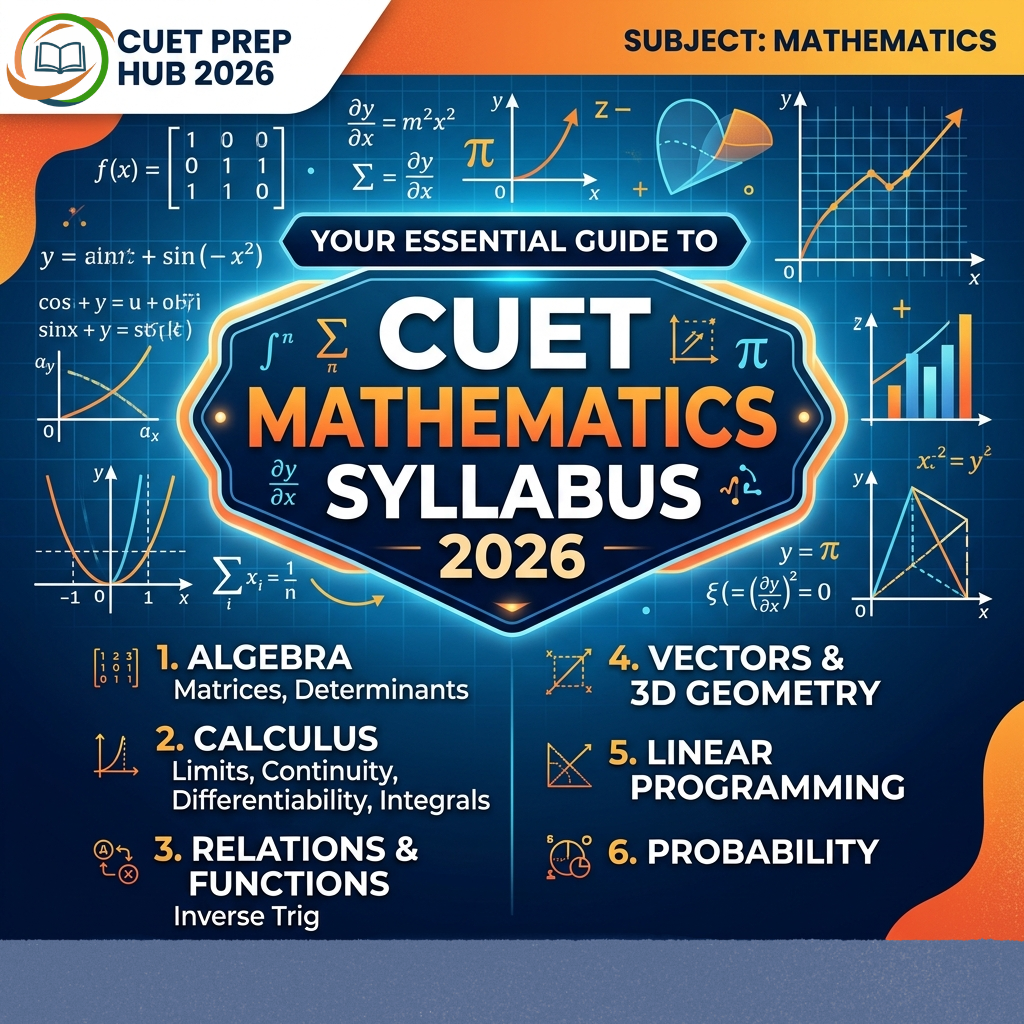
The complete, revised CUET UG 2026 Mathematics syllabus — section-wise breakdown of Section A, B1 (Mathematics) & B2 (Applied Mathematics), key NTA updates, high-weightage topics, and expert tips to ace the exam.
What is CUET Mathematics Syllabus 2026?
The CUET Mathematics Syllabus 2026 is the officially prescribed set of topics and chapters that the National Testing Agency (NTA) will test in the CUET UG 2026 Mathematics exam (Subject Code: 319). It is primarily based on the Class 12 NCERT Mathematics curriculum, making it closely aligned with what students prepare for their board examinations.
However, it is equally important to understand that the CUET Mathematics syllabus is not identical to the Class 12 board syllabus. NTA has retained certain chapters that were removed from the CBSE rationalized curriculum, and has also introduced updates to specific units — particularly in Calculus and Probability — for the 2026 cycle. Therefore, students who rely solely on their board preparation may find gaps in their CUET readiness.
📌 Key Fact: Mathematics and Applied Mathematics are among the top three most-selected domain subjects in CUET UG, making the exam highly competitive. A clear understanding of the revised CUET 2026 Mathematics syllabus is the single most important step in building a targeted, high-scoring preparation strategy.
Furthermore, the CUET Mathematics paper is divided into three sections — Section A (common compulsory topics), Section B1 (Mathematics), and Section B2 (Applied Mathematics) — and understanding how each section works is essential before diving into the topic-by-topic breakdown.
CUET 2026 Mathematics Exam Pattern
Before exploring the detailed syllabus, it is equally important to understand the exam structure. The CUET UG 2026 Mathematics paper follows a specific section-wise pattern that directly determines how you should allocate your preparation time.
| Section | Content | Total Questions | Questions to Attempt | Marks |
|---|---|---|---|---|
| Section A | Common Mathematics Topics | 15 | 15 (All Compulsory) | 75 |
| Section B1 | Mathematics (Standard) | 35 | 25 (Any 25) | 125 |
| Section B2 | Applied Mathematics | 35 | 25 (Any 25) | 125 |
| Total | — | 85 | 50 (A + B1 or B2) | 250 |
| Parameter | Details |
|---|---|
| Marking Scheme | +5 for each correct answer |
| Negative Marking | –1 for each incorrect answer |
| Question Type | MCQs (Objective Type) |
| Exam Mode | Computer Based Test (CBT) |
| Duration per Section | 60 minutes |
| Language of Paper | English & Hindi (bilingual) |
| Exam Window | May 11–31, 2026 |
⚠️ Important: Candidates must attempt Section A (all 15 questions) and then choose either Section B1 (Mathematics) or Section B2 (Applied Mathematics) — not both. Choose the section that matches the undergraduate course requirements of your target universities. Science and engineering-bound students typically opt for B1, while commerce and economics students often prefer B2.
Key Changes in CUET Maths Syllabus 2026
NTA has introduced notable revisions to the CUET Mathematics Syllabus 2026 compared to the previous cycle. Consequently, students who prepared for CUET 2025 must review these changes carefully to avoid studying outdated content or missing newly added areas.
| Unit / Topic | Change | Impact |
|---|---|---|
| Integrals (Calculus) | NEW / EXPANDED | Addition of integrals and square roots of quadratic equations under the Integral unit — expands problem-solving scope in Calculus significantly |
| Random Variables (Probability) | REMOVED | Random Variables topic has been removed from the Probability section — focus now shifts to core probability distributions and theorems |
| Probability (Core) | STREAMLINED | Probability section significantly reduced overall — candidates should no longer spend time on Random Variable sub-topics |
| Integration Applications | EXPANDED | Broader integration application questions are now expected — NCERT Class 12 exercise problems must be practised thoroughly |
| Non-Board Chapters | RETAINED | Certain chapters removed from CBSE rationalized syllabus continue to appear in CUET — board preparation alone is not sufficient |
✅ Takeaway: If you are transitioning from Class 12 board preparation to CUET 2026, focus your additional effort on Calculus (especially Integration) which has been expanded, and remove Random Variables from your revision schedule since it has been dropped. These targeted adjustments can meaningfully improve your score.
Section A – Common Compulsory Topics
Section A of the CUET Mathematics paper is compulsory for all candidates, regardless of whether they attempt Section B1 or B2. It contains 15 questions drawn from core Class 12 Mathematics topics that form the conceptual backbone of both Mathematics and Applied Mathematics.
Since all 15 questions in Section A are compulsory, performing well in this section is absolutely non-negotiable. Moreover, these topics frequently overlap with high-weightage areas in Section B1 and B2, making thorough preparation here doubly beneficial.
| # | Topic | Key Sub-Topics |
|---|---|---|
| 1 | Relations and Functions | Types of relations (reflexive, symmetric, transitive, equivalence); one-to-one and onto functions |
| 2 | Inverse Trigonometric Functions | Definition, range, domain, principal value branches; graphs of inverse trigonometric functions |
| 3 | Matrices | Types, operations (addition, multiplication, scalar multiplication); symmetric & skew symmetric matrices; transpose |
| 4 | Determinants | Determinants up to 3×3; minors, cofactors; invertibility of matrices; solving systems using matrix inverses |
| 5 | Continuity & Differentiability | Chain rule; derivatives of inverse trig, exponential and log functions; parametric differentiation; second-order derivatives |
| 6 | Applications of Derivatives | Rate of change; equations of tangents and normals; increasing/decreasing functions; maxima and minima; practical problem-solving |
Section B1 – Mathematics (Standard) Topics
Section B1 is intended for students who have studied standard Mathematics in Class 12 and are targeting courses such as B.Sc. Mathematics, B.Sc. Statistics, B.Tech (at CUET-participating universities), and similar programs. Out of 35 questions in this section, candidates must attempt any 25.
The topics in Section B1 are more advanced and proof-based compared to Section B2. As a result, students opting for B1 should ensure strong conceptual clarity in all units, particularly Algebra, Calculus, and Vectors, which together form the bulk of the question set.
📐 Relations & Functions
- Types: reflexive, symmetric, transitive, equivalence
- One-to-one and onto functions
- Composite functions and invertibility
- Binary operations
🔢 Algebra (Matrices & Determinants)
- Matrix operations and properties
- Symmetric & skew-symmetric matrices
- Determinants, minors, cofactors
- Solving linear equations using matrix method
∫ Calculus – Integrals
- Integration as inverse of differentiation
- Methods: substitution, partial fractions, by parts
- Definite integrals and properties
- Area under curves (applications) Expanded
📉 Differential Equations
- Order and degree of DEs
- General and particular solutions
- Variable separable method
- Linear differential equations
➡️ Vectors & 3D Geometry
- Vector addition, multiplication (dot & cross)
- Direction cosines and ratios
- Equation of lines and planes in 3D
- Angle between lines/planes; distance formulas
🎲 Probability
- Conditional probability; multiplication theorem
- Independent events; Bayes’ theorem
- Probability distributions (Binomial)
- Random Variables removed Removed
| Unit | Key Topics | Expected No. of Questions |
|---|---|---|
| Relations & Functions | Equivalence relations, composite functions, binary operations | 3–4 |
| Algebra | Matrices, determinants, solving systems of equations | 5–6 |
| Calculus | Continuity, differentiation, integration, differential equations, applications | 10–12 |
| Vectors & 3D Geometry | Vectors, direction cosines, equations of lines/planes | 5–6 |
| Linear Programming | Formulation, graphical method, optimal solutions | 2–3 |
| Probability | Conditional probability, Bayes’ theorem, Binomial distribution | 3–4 |
Section B2 – Applied Mathematics Topics
Section B2 covers Applied Mathematics, which is designed for students who have studied the Applied Mathematics elective at the Class 12 level. This section is particularly popular among students targeting commerce, economics, and management-related undergraduate programs such as B.Com, BBA, and B.Sc. Economics.
While Section B2 shares some conceptual overlap with B1, it places a stronger emphasis on real-world applications of mathematical concepts — including financial mathematics, index numbers, and business-oriented statistics. In addition, it tests topics like Linear Programming and Probability from a more applied perspective.
| Unit | Topics Covered |
|---|---|
| Numbers, Quantification & Numerical Applications | Modular arithmetic, alligation and mixtures, boats and streams, partnership, pipes and cisterns, races, clock-related problems |
| Algebra | Matrices and types of matrices; equality, transpose, symmetric and skew-symmetric matrices; algebra of matrices; determinants up to 3×3 |
| Calculus | Higher order derivatives; marginal cost and marginal revenue; maxima and minima applications in business; integration and its applications Expanded |
| Probability Distributions | Probability distribution of a random variable; mathematical expectation; variance; Binomial distribution |
| Index Numbers & Time-Based Data | Index numbers (Laspeyre, Paasche, Fisher); time series analysis; trend analysis; seasonality; business forecasting |
| Financial Mathematics | Perpetuity, sinking funds, valuation of bonds; calculation of EMI; linear depreciation; net present value |
| Linear Programming | Introduction; feasibility; graphical method; types of problems; manufacturing, transportation, and diet problems |
📌 B1 vs B2 — Which Should You Choose? If you are targeting B.Sc. Mathematics, B.Sc. Statistics, or science UG programs, choose Section B1. If you are aiming for B.Com (Hons), BBA, B.Sc. Economics, or management programs — and you studied Applied Mathematics in Class 12 — Section B2 is the better fit. Always cross-check with the subject requirements of your target university.
High-Weightage Chapters for CUET Maths 2026
Not all chapters carry equal weight in the CUET Mathematics exam. Based on analysis of previous years’ question papers and the revised 2026 syllabus structure, the following chapters are considered the highest priority. Accordingly, students should allocate the most preparation time to these areas.
- Calculus (Integrals + Differentiation + DEs)Very High
- Algebra (Matrices & Determinants)High
- Vectors & 3D GeometryHigh
- Relations & FunctionsMedium-High
- ProbabilityMedium
- Linear ProgrammingMedium
- Financial Mathematics (B2 only)Medium
- Index Numbers & Time Series (B2 only)Moderate
✅ Strategy Tip: Since Calculus alone accounts for roughly 40–45% of the total question set in Section B1, mastering Integration, Differentiation, and Differential Equations should be your top priority. Similarly, Matrices and Determinants in Algebra are consistently high-scoring because the question types are predictable and formula-driven.
Preparation Tips for CUET Mathematics 2026
Knowing the CUET Mathematics syllabus 2026 is the starting point — but equally important is knowing how to prepare efficiently within the available time. The following expert-backed strategies will help you maximize your score systematically.
📚 Start with NCERT Class 12
The CUET Mathematics exam is built almost entirely on NCERT Class 12 concepts. Read every chapter line-by-line, understand all solved examples, and complete all exercise questions before moving to additional resources.
🎯 Prioritize Calculus First
Since Calculus carries the highest weightage — especially Integration, which has been expanded in 2026 — begin your preparation with this unit. Build strong fundamentals in differentiation before tackling integration.
📝 Build a Formula Sheet
Create a dedicated formula sheet for each chapter — integration formulas, determinant properties, vector identities, and probability theorems. Revising this sheet daily during the final 3 weeks dramatically improves recall speed in the exam.
🧪 Solve Chapter-wise MCQs
After completing each NCERT chapter, immediately practice MCQs from that unit. CUET questions are objective, so practicing the MCQ format builds the instincts needed to solve questions quickly within the 60-minute window.
📊 Analyse Previous Year Papers
Solving CUET 2023, 2024, and 2025 Mathematics papers reveals recurring question types, topic frequency patterns, and difficulty level. This analysis allows you to fine-tune your focus areas more accurately than the syllabus alone.
⏱️ Practice Full Mock Tests
Attempt at least 4–5 full-length CUET Mathematics mock tests in timed conditions. Since you must choose 25 questions from Section B (35 available), practice deciding quickly which 25 to attempt based on your strengths during the test.
🔁 Revise Removed Topics
Do not waste time on Random Variables (removed from Probability in 2026) or other dropped sub-topics. Redirect that time to the expanded Integration unit and 3D Geometry, where more marks are now available.
🗓️ Follow a Structured Plan
Divide your preparation into three phases: Phase 1 (Learning, 6 weeks) → Phase 2 (Chapter-wise Practice, 4 weeks) → Phase 3 (Mock Tests + Revision, 3 weeks). Allocate at least 2–3 hours daily to Mathematics throughout all three phases.
Best Books for CUET Mathematics 2026
Choosing the right study material is just as important as understanding the syllabus. While NCERT Class 12 Mathematics remains the primary and most essential resource, the following additional books are widely recommended by CUET toppers and coaching experts for deeper practice and MCQ preparation.
| Book Title | Author / Publisher | Best For |
|---|---|---|
| NCERT Mathematics Class 12 (Part I & II) | NCERT | Primary syllabus — mandatory for all |
| CUET UG Mathematics Chapter-wise MCQs | Arihant Publications | MCQ practice, topic-wise question bank |
| Mathematics for CUET UG | MTG Learning Media | Comprehensive topic coverage + mock tests |
| RD Sharma – Mathematics Class 12 | Dhanpat Rai Publications | Deep practice for Calculus and Algebra |
| NTA CUET UG Official Practice Papers | NTA / cuet.nta.nic.in | Authentic exam pattern practice — free |
| Applied Mathematics Class 12 NCERT | NCERT | Section B2 candidates — primary resource |
Conclusion
The CUET Mathematics Syllabus 2026 is a well-structured, NCERT-aligned framework that tests core mathematical concepts across Relations & Functions, Algebra, Calculus, Vectors, Probability, and more. However, given the key 2026 revisions — particularly the expanded Calculus unit and the removal of Random Variables — a targeted and updated preparation approach is essential for maximizing your score.
To summarize, start with a thorough reading of NCERT Class 12 Mathematics, focus your greatest effort on high-weightage chapters like Calculus and Algebra, use the chapter-wise MCQ practice to build speed, and consistently revise using a formula sheet. Equally important is deciding early whether Section B1 or B2 aligns with your target university requirements.
Stay updated with the latest CUET 2026 notifications, syllabus PDFs, mock tests, and cutoff data at cuet-nta.com — your complete CUET preparation resource.
Frequently Asked Questions
Yes, NTA has introduced key changes. The most notable updates are the expansion of the Calculus unit (especially Integrals) with new topic additions like square roots of quadratic equations, and the removal of Random Variables from the Probability section. These changes require candidates to revise their preparation strategy accordingly.
The CUET UG Mathematics syllabus is primarily based on the Class 12 NCERT curriculum. However, certain topics and foundational concepts from Class 11 may be referenced for conceptual clarity. For the purpose of CUET 2026, focus your primary preparation on Class 12 NCERT Mathematics.
Section B1 covers standard Mathematics (proof-based, theoretical) and is suited for students targeting B.Sc. Mathematics or science programs. Section B2 covers Applied Mathematics (real-world applications, financial mathematics, statistics) and is ideal for commerce and economics students. You can only choose one — not both.
The CUET Mathematics paper contains a total of 85 questions — 15 in Section A (all compulsory) and 35 each in Section B1 and B2 (attempt any 25 from the chosen section). Candidates attempt a total of 50 questions out of 85, for a maximum of 250 marks.
Yes. The marking scheme is +5 marks for each correct answer and –1 mark for each incorrect answer. Unattempted questions carry no penalty. Therefore, avoid blind guessing and skip questions you are uncertain about — a wrong answer costs you 6 marks relative to a correct one.
Based on previous year trends and the 2026 syllabus structure, the highest-priority chapters are Calculus (Integration, Differentiation, Differential Equations), Algebra (Matrices and Determinants), and Vectors & 3D Geometry. Together, these units typically account for over 55–60% of the total question set.
The official CUET UG 2026 Mathematics Syllabus PDF (Subject Code: 319) can be downloaded directly from the NTA website at cuet.nta.nic.in under the "Syllabus" section. Always download from the official NTA website to ensure you have the most current and accurate syllabus.
No Comments yet!