Introduction
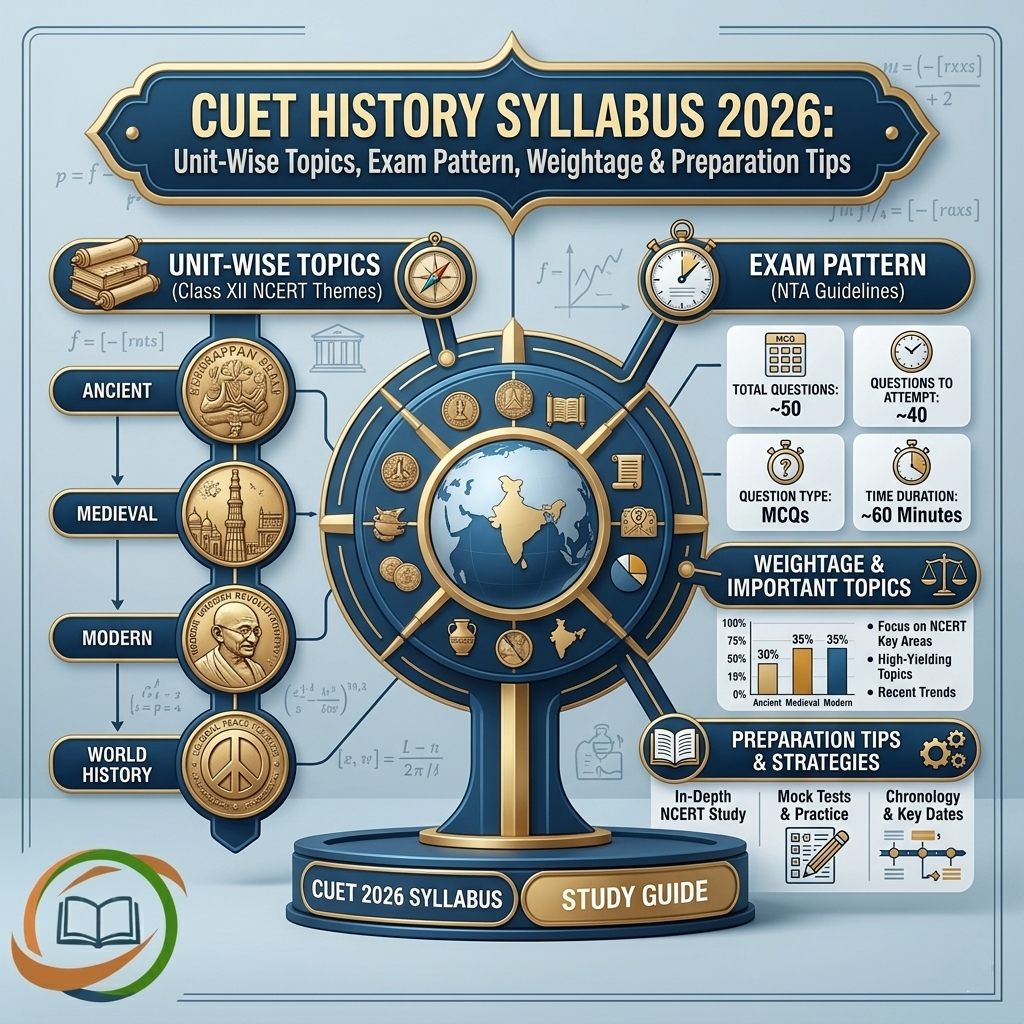
If you are planning to appear forCUET UG 2026 with History as your domain subject, the very first step is to get completely familiar with the CUET History Syllabus 2026. The National Testing Agency (NTA) has officially released the updated syllabus, and it comes with a notable revision — the History syllabus now comprises 12 units instead of the earlier 15, making it more focused and streamlined for aspirants.
History is one of the most popular domain subjects in CUET, selected by thousands of students aspiring for courses like B.A. History (Hons), B.A. Political Science, B.A. Sociology, B.A. Archaeology, and more at top universities such as Delhi University, BHU, JNU, and Jamia Millia Islamia.
In this article, you will find the complete CUET History Syllabus 2026 with unit-wise topics, exam pattern, expected chapter-wise weightage, recommended books, and smart preparation tips — everything in one place.
CUET History Syllabus 2026: Quick Overview
Before diving into the detailed syllabus, here is a snapshot of key information every History aspirant should know:
| Parameter | Details |
|---|---|
| Conducting Body | National Testing Agency (NTA) |
| Subject Code | History – Domain Subject (Section II) |
| Exam Dates | May 11 – May 31, 2026 |
| Total Units | 12 Units (Revised from 15) |
| Based On | Class 12 NCERT – Themes in Indian History (Parts I, II & III) |
| Total Questions | 50 MCQs (All Compulsory) |
| Total Marks | 250 |
| Time Duration | 60 Minutes |
| Marking Scheme | +5 for Correct, -1 for Incorrect |
| Syllabus PDF | Available on cuet.nta.nic.in |
Theme 1: Themes in Indian History – Part I (Ancient India)
This section covers prehistoric and ancient Indian history. It focuses on archaeological evidence, early political systems, social structures, and religious developments.
Unit 1 – Harappan Archaeology (Indus Valley Civilisation)
- Early urban centres and their planning
- Major excavation sites: Mohenjo-Daro, Harappa, Lothal, Dholavira
- Tools, crafts, trade, and social organisation
- Decline of the Harappan civilisation
Unit 2 – Political and Economic Systems in Early States
- Inscriptional evidence from Mauryan to Gupta periods
- Administrative systems: monarchy, oligarchy, Mahajanapadas
- Economic structures: land revenue, trade routes, guilds
- Ashokan edicts and their significance
Unit 3 – Social Histories Using the Mahabharata
- Caste system, class hierarchy, and gender roles in ancient India
- Family structures and social norms depicted in the epic
- The Mahabharata as a historical source
Unit 4 – History of Buddhism and Architecture (Sanchi Stupa)
- Origins and spread of Buddhism and Jainism
- Life of Gautama Buddha and core Buddhist teachings
- Sanchi Stupa: significance, structure, and sculptural art
- Vedic religion vs. heterodox movements
Theme 2: Themes in Indian History – Part II (Medieval India)
This section covers medieval Indian history with a focus on society, religion, architecture, and empire.
Unit 5 – Medieval Society Through Travellers’ Accounts
- Accounts of Al-Biruni, Ibn Battuta, and Francois Bernier
- Social and cultural life in medieval India through foreign eyes
- Trade, economy, and urban life in medieval period
Unit 6 – Religious History: Bhakti-Sufi Traditions
- Bhakti movement: key saint-poets (Kabir, Mirabai, Tukaram, Ramananda)
- Sufi orders and their teachings
- Impact of Bhakti-Sufi traditions on Indian society and culture
- Spiritual literature and devotional poetry
Unit 7 – Architecture and Empire: Hampi (Vijayanagara Empire)
- Rise and fall of the Vijayanagara Empire
- Temples, fortifications, and urban planning at Hampi
- Art and architecture as reflections of imperial power
- Significance of Hampi as a UNESCO World Heritage Site
Unit 8 – The Mughal Empire and Agrarian Society
- Ain-i-Akbari by Abu Fazl: structure and significance
- Akbar’s administrative reforms and religious policies
- Agrarian relations, zamindars, and peasant life under Mughals
- Revenue systems during the Mughal period
Theme 3: Themes in Indian History – Part III (Modern India)
This section is the most heavily weighted in CUET History and covers the colonial period, the freedom struggle, and post-independence India.
Unit 9 – Colonialism and Rural Society
- Impact of British colonialism on Indian agriculture
- Land revenue systems: Permanent Settlement, Ryotwari, Mahalwari
- Role of zamindars, money-lenders, and artisans under colonial rule
- Changes in rural economy and peasant distress
- Causes of the 1857 Revolt: political, economic, social, and military
- Key centres and leaders: Mangal Pandey, Rani Lakshmibai, Bahadur Shah Zafar
- Nature of the revolt: sepoy mutiny or war of independence?
- British response and aftermath
Unit 11 – Mahatma Gandhi and the National Movement
- Gandhi’s philosophy: Satyagraha, non-violence, and civil disobedience
- Major movements: Non-Cooperation Movement (1920), Salt March (1930), Quit India Movement (1942)
- Role of mass participation in India’s freedom struggle
- Gandhi’s vision of independent India
Unit 12 – Making of the Indian Constitution
- The Constituent Assembly: composition and debates
- Key themes in constitutional debates: rights, federalism, minority rights
- B.R. Ambedkar’s role as chief architect of the Constitution
- Fundamental Rights, Directive Principles, and Preamble
CUET History Exam Pattern 2026
Understanding the exam pattern is as important as knowing the syllabus. Here is the complete CUET History exam structure for 2026:
| Parameter | Details |
|---|---|
| Exam Mode | Computer-Based Test (CBT) |
| Question Type | Multiple Choice Questions (MCQs) |
| Total Questions | 50 |
| Questions to Attempt | All 50 (No internal choice) |
| Total Marks | 250 |
| Duration | 60 Minutes |
| Correct Answer | +5 marks |
| Wrong Answer | -1 mark |
| Unattempted | 0 marks |
Important Note: Unlike some other CUET subjects, the History paper requires candidates to attempt all 50 questions with no option to skip. This makes time management and accuracy both critically important.
CUET History 2026: Chapter-Wise Expected Weightage
While NTA does not officially publish chapter-wise marks distribution, the following expected weightage is based on trends from CUET 2022, 2023, 2024, and 2025 question papers:
| Unit / Topic | Expected Questions |
|---|---|
| Harappan Archaeology | 3–4 |
| Political & Economic History (Inscriptions) | 4–5 |
| Social History – Mahabharata | 3–4 |
| Buddhism & Sanchi Stupa | 3–4 |
| Medieval Travellers’ Accounts | 3 |
| Bhakti-Sufi Traditions | 4 |
| Hampi – Vijayanagara Architecture | 3 |
| Mughal Empire & Ain-i-Akbari | 4 |
| Colonialism & Rural Society | 4 |
| Revolt of 1857 | 4–5 |
| Gandhi & National Movement | 5–6 |
| Making of the Indian Constitution | 3–4 |
| Total | 50 |
High-Priority Units: Gandhi & National Movement, Revolt of 1857, and Making of the Indian Constitution carry the highest expected weightage. Prioritise these during revision.
Best Books for CUET History 2026 Preparation
| Book | Why It’s Useful |
|---|---|
| Themes in Indian History – Part I (NCERT Class 12) | Covers Units 1–4; primary source for ancient history |
| Themes in Indian History – Part II (NCERT Class 12) | Covers Units 5–8; essential for medieval history |
| Themes in Indian History – Part III (NCERT Class 12) | Covers Units 9–12; most important for modern India |
| CUET History Previous Year Papers | Best for understanding question trends and difficulty |
| Arihant CUET History Guide | Good for practice MCQs and quick revision |
Golden Rule: For CUET History 2026, NCERT Class 12 Themes in Indian History (Parts I, II & III) are your primary and most sufficient resource. Do not over-rely on reference books.
How to Download CUET History Syllabus 2026 PDF
Follow these simple steps to download the official CUET History Syllabus 2026 PDF from the NTA website:
- Visit the official NTA CUET website: cuet.nta.nic.in
- Click on the “Syllabus” section from the main menu
- Select “Domain Subjects” from the syllabus page
- Locate History from the subject list
- Click the PDF link to download and save it
You can also directly access the syllabus from the official CUET information bulletin, which is available free of cost — no registration required.
Smart Preparation Tips for CUET History 2026
1. Start with the NCERT Books Since the entire CUET History syllabus is drawn from Class 12 NCERT Themes in Indian History (Parts I, II & III), start by reading each chapter carefully. Understand the context, not just the dates and names.
2. Make Unit-Wise Notes After reading each unit, prepare short summary notes with key events, names, dates, and causes. These notes are invaluable for quick revision in the final weeks before the exam.
3. Focus on High-Weightage Units First Units 10 (Revolt of 1857), Unit 11 (Gandhi & National Movement), and Unit 12 (Making of the Constitution) have the highest expected question count. Cover these units thoroughly before moving to others.
4. Solve Previous Year Question Papers Practicing CUET History PYQs from 2022 to 2025 will give you a clear idea of the question style, difficulty level, and recurring themes. Most CUET History questions follow predictable patterns.
5. Attempt Mock Tests Regularly Take full-length History mock tests in CBT mode to simulate actual exam conditions. This helps you manage 50 questions in 60 minutes without panicking.
6. Be Careful with Negative Marking With -1 for each wrong answer, avoid guessing randomly. If you are not at least 65–70% confident about an answer, it is safer to leave it blank.
7. Create a Revision Timetable Divide the 12 units across weeks. Allocate 2–3 days per unit for reading, 1 day for note-making, and 1 day for MCQ practice. Revise each unit at least twice before the exam.
8. Use Visual Aids For History, timelines, maps, and flowcharts work exceptionally well. Create a visual timeline of major events from Harappan civilisation to the making of the Constitution for a quick bird’s-eye view.
Courses That Require CUET History 2026
Selecting History as a domain subject opens the door to a wide range of undergraduate programmes. Here are some popular UG courses for which History is a required or preferred subject:
| Course | Top Universities |
|---|---|
| B.A. History (Hons) | Delhi University, BHU, JNU, Hyderabad University |
| B.A. Political Science (Hons) | DU, JNU, Jamia Millia Islamia |
| B.A. Sociology | DU, Jadavpur University, BHU |
| B.A. Archaeology | BHU, Deccan College |
| B.A. Geography | DU, Osmania University |
| B.A. (General) – Humanities | Most central and state universities |
| BSW (Bachelor of Social Work) | Various CUET-participating universities |
Conclusion
The CUET History Syllabus 2026 is well-structured, NCERT-aligned, and perfectly manageable for any student who puts in consistent effort. With 12 focused units spanning Ancient, Medieval, and Modern Indian History, the syllabus rewards thorough understanding over rote memorisation.
Start early, follow the NCERT books diligently, practice MCQs regularly, and pay extra attention to high-weightage units like the Revolt of 1857, Gandhi’s National Movement, and the Making of the Indian Constitution.
For the latest updates on CUET UG 2026 syllabus, admit card, exam dates, result, and cut-offs, stay connected with cuet-nta.com — your most trusted CUET preparation resource.
Frequently Asked Questions
Yes. NTA has revised the CUET History Syllabus 2026 — it now contains 12 units instead of the previous 15, making it more streamlined and focused.
You need all three volumes: Themes in Indian History – Part I, Part II, and Part III (Class 12 NCERT). These three books collectively cover the entire CUET History syllabus.
The CUET History paper consists of 50 MCQs, all compulsory, to be completed in 60 minutes.
You receive +5 marks for a correct answer and -1 mark for an incorrect answer. Unattempted questions carry zero marks.
Based on previous year trends, Unit 11 (Gandhi & National Movement) consistently carries the highest number of questions (5–6), followed by Unit 10 (Revolt of 1857) and Unit 12 (Making of the Constitution).
CUET History is considered moderate in difficulty. The questions are primarily memory-based and NCERT-aligned. However, the 60-minute time limit for 50 questions demands quick recall and time discipline.
Absolutely. CUET History is highly self-study friendly. With thorough NCERT reading, regular mock tests, and previous year paper practice, self-study students regularly achieve excellent scores.
No Comments yet!