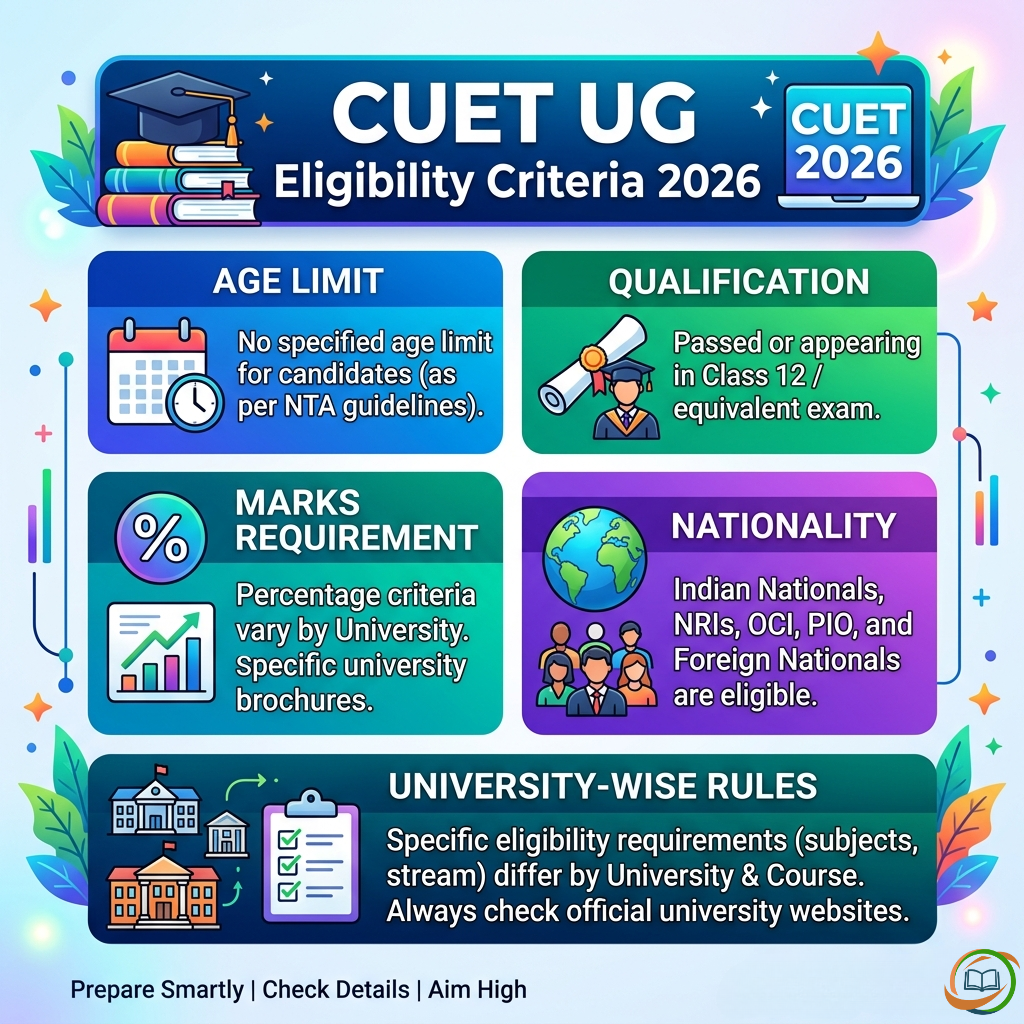
Before filling the application form or beginning your preparation, every aspiring candidate must thoroughly understand the CUET UG Eligibility Criteria 2026. Issued by the National Testing Agency (NTA) along with the official CUET UG 2026 Information Bulletin on January 3, 2026, the eligibility criteria define the minimum requirements a candidate must meet to appear in the Common University Entrance Test and secure undergraduate admission at any of the 280+ participating universities across India.
Understanding CUET eligibility is not just about whether you can appear in the exam — it is also about whether you can secure admission at your target university after qualifying. Both levels of eligibility are equally important, and this article covers both in complete detail.
CUET UG Eligibility Criteria 2026: Quick Snapshot
| Eligibility Parameter | NTA’s Requirement |
|---|---|
| Educational Qualification | Passed or Appearing in Class 12 (10+2) |
| Stream Restriction | None — Any stream (Science / Commerce / Arts) |
| Minimum Marks (NTA) | No minimum percentage required by NTA to appear |
| Minimum Marks (Universities) | 50% for General; 45% for SC/ST/OBC (set by universities) |
| Age Limit (NTA) | No upper or lower age limit prescribed by NTA |
| Age Limit (Universities) | Varies — check each university separately |
| Nationality | Indian nationals + select foreign nationals eligible |
| Number of Attempts | Unlimited (no attempt cap set by NTA) |
| Subject Restrictions | None — any CUET subject can be chosen (new in 2026) |
| Exam Mode | Computer-Based Test (CBT) |
| Official Website | Official Website |
Two Levels of CUET UG Eligibility: What You Must Know
One of the most important things to understand about CUET UG 2026 eligibility is that it operates at two distinct levels:
Level 1 — NTA’s Eligibility to Appear in CUET UG 2026: This is the basic eligibility prescribed by NTA for a candidate to register and appear in the CUET UG 2026 exam. NTA’s requirements are minimal and inclusive — almost any student who has completed or is appearing for Class 12 can sit for the exam.
Level 2 — University/Programme-Specific Eligibility for Admission: Even if you qualify CUET UG 2026, you may not be eligible for admission to a specific program at a specific university unless you also satisfy that university’s individual eligibility requirements — which may include minimum Class 12 marks, subject combinations, age limits, and other course-specific conditions.
Critical Reminder: Appearing in CUET or scoring a high CUET score does NOT automatically guarantee admission. Always verify the program-specific eligibility of your target university at its official website before making CUET subject selections.
1. Educational Qualification for CUET UG 2026
Candidates must have passed or be appearing in Class 12 (10+2) or an equivalent examination from a recognized board. This is the primary and most fundamental eligibility requirement set by NTA.
Accepted Boards and Qualifications:
- CBSE (Central Board of Secondary Education)
- CISCE / ISC Board
- All State Boards (UP Board, Maharashtra Board, Rajasthan Board, Bihar Board, etc.)
- NIOS (National Institute of Open Schooling)
- Any other board recognized by the Association of Indian Universities (AIU)
- Equivalent international qualifications from boards recognized by the Government of India
For “Appearing” Students: Students who are currently in Class 12 and have not yet received their final marksheet are also eligible to register for CUET UG 2026 by selecting the “Appearing” status. However, they must produce their Class 12 passing certificate and marksheet at the time of counselling or document verification. Failure to clear the Class 12 board exam or meet the university’s minimum marks requirement will result in disqualification from admission, even after qualifying CUET.
Important Rule: Candidates who have failed in one or more subjects in their Class 12 board exam are NOT eligible to appear in CUET UG 2026. Eligibility requires either passing the Class 12 exam or currently appearing for it in 2026.
Stream Restriction: None
CUET UG 2026 has no stream restriction for appearing in the exam. Students from Science, Commerce, Arts, and Vocational streams are equally eligible. However, individual universities and programs may require specific subjects studied at the Class 12 level — which is a university-level eligibility condition, not an NTA exam eligibility rule.
2. Minimum Marks Required for CUET UG 2026
NTA’s Position: No Minimum Percentage
NTA does not prescribe any minimum percentage in Class 12 for a candidate to appear in CUET UG 2026. This means you can register for and attempt the CUET exam regardless of your Class 12 score.
University-Prescribed Minimum Marks
However, almost all participating universities — especially Central Universities — have their own minimum Class 12 mark requirements for admission, regardless of your CUET score:
| Category | Minimum Class 12 Marks (Typically Required by Universities) |
|---|---|
| General / Unreserved (UR) | 50% aggregate in Class 12 |
| OBC-NCL | 45% aggregate in Class 12 |
| SC / ST | 45% aggregate in Class 12 |
| EWS | 50% aggregate in Class 12 |
| PwBD | 5% relaxation from the applicable category’s requirement |
| BTech Programs | 45% for General; 40% for SC/ST/Reserved |
University-Specific Examples:
- Delhi University (DU): Minimum 45% in Class 12 for General category; 40% for SC/ST/OBC for most programs
- Banaras Hindu University (BHU): Minimum 50% for General; 45% for OBC; 40% for SC/ST
- JNU (Jawaharlal Nehru University): Minimum 45% for General; 40% for SC/ST/OBC for most programs
- Jamia Millia Islamia (JMI): 50% for General; 45% for reserved categories
Key Insight: The minimum marks specified above are admission thresholds set by universities — they are not NTA exam eligibility requirements. A candidate with less than 50% in Class 12 can still appear in CUET UG 2026, but would not be eligible for admission at universities requiring 50% minimum.
3. Age Limit for CUET UG 2026
NTA’s Position: No Age Limit
This is one of the most important and frequently misunderstood aspects of CUET UG eligibility. NTA has NOT prescribed any minimum or maximum age limit for appearing in CUET UG 2026.
- Candidates of any age can register and appear in CUET UG 2026
- Gap year students, older candidates, and mature learners are equally eligible
- There is no upper age bar imposed by NTA
University-Specific Age Limits
While NTA imposes no age limit, individual universities may have their own age criteria for specific programs. Some notable examples:
| University / Course | Age Condition |
|---|---|
| Delhi University (most UG programs) | No age limit |
| BHU — Most UG Programs | Maximum 22 years as of July 1, 2026 |
| Maximum 22 years as of July 1, 2026 | Maximum 25 years as of July 1, 2026 |
| BHU — BPA (Performing Arts) | Maximum 35 years as of July 1, 2026 |
| Jamia Millia Islamia (select programs) | Course-specific — check JMI bulletin |
| Allahabad University (select programs) | Course-specific — check AU bulletin |
Advice for Older Candidates and Gap-Year Students: You are fully eligible to appear in CUET UG 2026, as NTA places no restrictions. However, verify age requirements directly on the official website of each university you plan to apply to, particularly for BHU and institutions with course-specific age caps.
4. Nationality Criteria for CUET UG 2026
CUET UG 2026 is open to a wide range of nationalities, as specified in the NTA Information Bulletin:
Eligible Nationalities:
- Indian nationals (all categories — General, SC, ST, OBC-NCL, EWS, PwBD)
- Citizens of Nepal and Bhutan
- Tibetan refugees who migrated to India before January 1, 1962, with the intention of permanent settlement
- Individuals of Indian origin who have migrated from countries including Pakistan, Myanmar (Burma), Sri Lanka, Kenya, Uganda, Tanzania, Zambia, Malawi, Zaire (Democratic Republic of Congo), Ethiopia, and Vietnam with the intent of permanent settlement in India.
- NRI (Non-Resident Indian), OCI (Overseas Citizen of India), and PIO (Persons of Indian Origin) candidates — eligible as per NTA rules, subject to university-specific NRI/OCI policies
Note on Foreign Nationals: Individual universities have their own separate admission policies for international students. NTA’s nationality eligibility for the CUET exam does not override a university’s own rules for foreign national admissions. Always verify at the respective university’s international admissions portal.
5. Subject Eligibility: The Major New Rule for 2026
One of the biggest changes in CUET UG 2026 eligibility is the removal of subject restrictions. Under the new UGC rule:
- Candidates can now choose any CUET subject for their exam, regardless of what subjects they studied in Class 12
- A Science student can choose Commerce domain papers; an Arts student can choose Science domain papers
- This flexibility is at the CUET exam level only
However — University-Level Subject Matching Still Applies: Universities continue to enforce specific subject combination requirements for admission to their individual programs. For example:
- BHU still requires Physics, Chemistry, and Mathematics/Biology combination for BSc (Hons) programs
- DU enforces specific subject-course mapping for program eligibility under CSAS
- Most universities require at least one language paper in the candidate’s preferred medium
Strategy Tip: While you technically have the freedom to choose any CUET subject under the new 2026 rule, always align your subject selection with the requirements of your target university’s course. Choosing mismatched subjects can lead to ineligibility at the admission stage, even with a high CUET score.
6. Number of Attempts: Unlimited
Unlike many competitive entrance exams such as JEE or NEET, CUET UG has no limit on the number of attempts. Candidates can appear for CUET UG as many times as they wish, provided they meet the eligibility requirements in the year they are applying.
This means:
- If you are not satisfied with your 2026 CUET score, you can appear again in 2027
- There is no “used up attempts” concept in CUET
- Each year’s CUET score is valid only for that year’s admission cycle — scores from previous years cannot be used for a later year’s admission
7. PwBD (Persons with Benchmark Disability) Eligibility
Candidates with disabilities can apply for CUET UG 2026 under the PwBD category with specific provisions:
Eligibility: Minimum 40% disability (Benchmark Disability) is required to claim PwBD reservation benefits.
Certificate Required: A valid UDID (Unique Disability Identification) Certificate issued by a notified medical authority must be uploaded during registration and produced at document verification during university counselling.
Special Note for Dyslexia Category: Candidates claiming reservation under Dyslexia must ensure their disability certificate specifically mentions “Severe” under the Dyslexia category.
Reservation: PwBD candidates are entitled to 5% horizontal reservation across all categories at all participating Central Universities, as per Government of India norms.
Exam Accommodations: PwBD candidates are entitled to a scribe, extra time (20 minutes per hour), and other accommodations as per NTA’s guidelines — details of which must be selected at the time of registration.
8. CUET UG 2026 Reservation Policy
Seat reservations in all participating Central Universities follow Government of India norms:
| Category | Percentage of Seats Reserved |
|---|---|
| SC (Scheduled Caste) | 15% |
| ST (Scheduled Tribe) | 7.5% |
| OBC-NCL (Non-Creamy Layer) | 27% |
| EWS (Economically Weaker Sections) | 10% |
| PwBD (Horizontal Reservation) | 5% |
Points to Remember for Reservation:
- Category certificates must be issued on or after January 1, 2026 to be valid for CUET UG 2026 reservation benefits
- If a candidate fails to upload a valid certificate during registration or counselling, they will be treated as a General category candidate
- Candidates claiming OBC-NCL must ensure their certificate is from the Non-Creamy Layer — plain OBC certificates without NCL status are not accepted
- No change of category is permitted after the registration deadline
- State governments and private universities may have additional reservation policies beyond the central norms — verify with each institution
9. University-Wise CUET Eligibility Highlights
Since university-level eligibility is as important as NTA’s exam-level eligibility, here is a quick comparison of key university requirements:
Delhi University (DU)
- Must appear in CUET UG 2026 (mandatory for all regular programs)
- Subject mapping between Class 12 subjects and CUET papers is enforced during CSAS counselling
- Minimum 45% in Class 12 for General category (40% for SC/ST/OBC for most programs)
- No age limit imposed by DU
- Class 12 marks used only as tie-breaker when CUET scores are identical
Banaras Hindu University (BHU)
- CUET UG 2026 score is mandatory
- Minimum 50% in Class 12 for General category; 45% for OBC; 40% for SC/ST
- Maximum age of 22 years for most UG programs (as of July 1, 2026)
- BHU-specific subject combinations required for different programs
- CUET not accepted for MBBS, BDS — only NEET UG applies
Jawaharlal Nehru University (JNU)
- CUET UG 2026 scores are used for admission
- Each program specifies which CUET sections are considered and their weightage
- Minimum 45% in Class 12 for General category; 40% for reserved categories
- Candidates must check JNU’s individual program brochure for course-specific subject requirements
Jamia Millia Islamia (JMI)
- Admission is based on specific CUET subject scores
- Minimum 50% for General; 45% for reserved categories in Class 12
- Some JMI courses have additional admission tests or interview components alongside CUET scores
Common Eligibility-Related Mistakes to Avoid
1. Confusing NTA’s Exam Eligibility with University Admission Eligibility Many students assume that meeting NTA’s basic eligibility is enough to secure admission. It is not. University-level eligibility — including minimum marks, subject combinations, and age limits — is a separate, additional requirement. Both must be satisfied simultaneously.
2. Choosing CUET Subjects Without Checking University Requirements The new 2026 freedom to choose any CUET subject does not mean you should ignore what your target university requires. Always map your CUET subject choices to the specific subject combinations your desired program mandates.
3. Not Verifying Age Requirements of Target Universities Since NTA has no age limit but BHU and several other universities do, older candidates and those above 22 years must carefully verify age eligibility for specific programs before registration.
4. Submitting Outdated Category Certificates Category certificates must be issued on or after January 1, 2026. Older certificates will be rejected, and the candidate will be treated as a General category applicant. Get updated certificates well before the counselling stage.
5. Assuming a High CUET Score Guarantees Admission Scoring in the 99th percentile is impressive, but if you have not met the minimum Class 12 marks, age limit, or subject combination requirements of your target university, admission will still be denied. Eligibility must be checked holistically — not just based on the CUET score.
Final Word
Understanding the CUET UG Eligibility Criteria 2026 in full detail — not just at the NTA exam level but also at the university admission level — is the first and most essential step in your CUET journey. The good news is that NTA’s own requirements are highly inclusive: no age bar, no minimum marks, no stream restriction, and no attempt limit. This makes CUET accessible to the widest possible pool of students.
What determines your actual success, however, is satisfying the eligibility requirements of your target university and course — making it essential to research each institution carefully, select the right CUET subjects, and ensure your Class 12 credentials meet their standards.
Stay connected with cuet-nta.com for the latest updates on CUET UG 2026 eligibility, admit card, exam dates, results, and university-wise admission schedules.
Frequently Asked Questions
Candidates must have passed or be currently appearing in Class 12 (10+2) or equivalent from a recognized board. There are no stream restrictions — students from Science, Commerce, and Arts are all eligible.
No. NTA has not prescribed any minimum or maximum age limit for CUET UG 2026. However, individual universities may have their own age requirements for specific programs — such as BHU, which caps most UG programs at 22 years.
NTA does not require any minimum percentage to appear in CUET UG 2026. However, participating universities typically require 50% for General category and 45% for SC/ST/OBC-NCL for admission. Verify the exact percentage requirement at each university you plan to apply to.
Yes. CUET UG 2026 has no stream restriction. Students from Science, Commerce, and Arts backgrounds can all register and appear. However, specific courses at specific universities may require certain subjects studied in Class 12.
Yes. NTA has no age limit or attempt restriction. Gap-year students who have already passed Class 12 are fully eligible to apply. Verify age eligibility of individual target universities separately.
There is no limit on the number of attempts. You can appear for CUET UG every year as long as you meet the eligibility criteria for that year. Note that each year's score is valid only for that year's admission cycle.
Yes. NRI, OCI, and PIO candidates are eligible to appear for CUET UG 2026. However, individual universities have their own policies for NRI/OCI admissions, which may include separate seat quotas and fee structures.
No. Candidates must have either passed Class 12 completely or be currently appearing for it in 2026. Students who have failed in one or more subjects are not eligible.
No. Under the new 2026 UGC rule, candidates can choose any CUET subject regardless of what they studied in Class 12. However, this flexibility is at the exam level only — universities still enforce subject-program matching at the admission stage.
A minimum of 40% disability (Benchmark Disability) is required to claim PwBD reservation benefits. A valid UDID Certificate from a notified medical authority must be uploaded during registration.
No Comments yet!