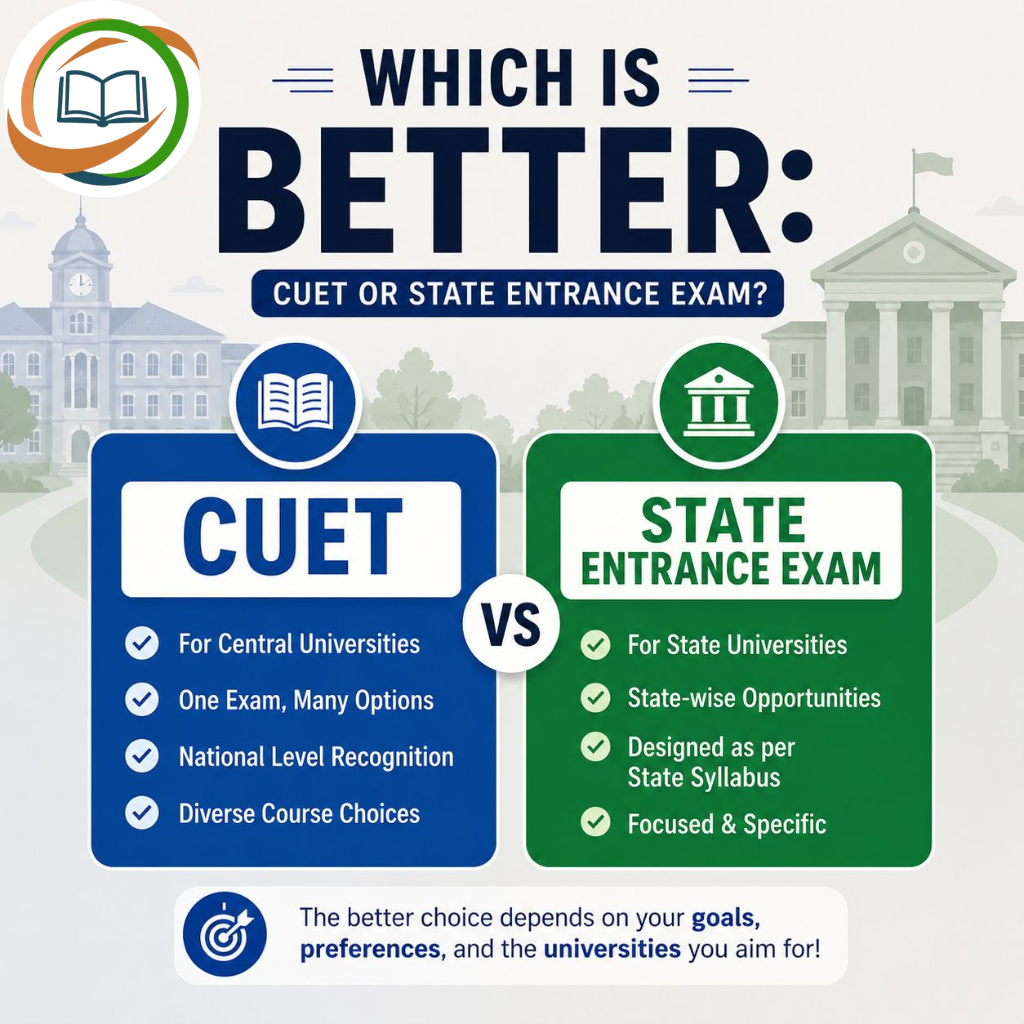
A Complete 2026 Comparison of National vs State-Level Undergraduate Entrance Exams in India
Every year, millions of Class 12 students across India face one of the most consequential decisions of their academic life — should they focus on CUET 2026, prepare for their state’s own entrance exam, or pursue both simultaneously? The question of which is better, CUET or State Entrance Exam, does not have a single universal answer. It depends on your academic stream, career aspirations, target universities, home state, and the kind of campus experience you are seeking.
This in-depth comparison guide covers every dimension of the debate — exam structure, accessibility, university scope, difficulty level, career outcomes, cost, and admission strategy — so you can make a fully informed, personalised decision in 2026. Whether you are a student from Rajasthan, Maharashtra, Tamil Nadu, Uttar Pradesh, West Bengal, or any other state, this guide has the answers you need.
CUET vs State Entrance Exam 2026: Quick Comparison
| Parameter | CUET 2026 | State Entrance Exams 2026 |
| Conducting Body | NTA (National Testing Agency) | State Government / State Agency |
| Scope | National — 250+ universities across India | State-specific institutions only |
| Streams Covered | All streams (Arts, Commerce, Science) | Usually stream-specific |
| Eligibility | Class 12 pass / appearing (all boards) | Varies by state and exam |
| Number of Attempts | Once per year | Once per year (most states) |
| Difficulty Level | Moderate (NCERT Class 12 based) | Varies: Moderate to High |
| Exam Medium | 13 languages | State language + English (mostly) |
| University Reach | Central, Deemed, Private (250+ institutions) | Limited to state universities/colleges |
| Reservation Benefits | Central Govt. quota + university norms | State quota reservations apply |
| Preparation Overlap | High — aligned with board exam syllabus | Moderate — may have extra topics |
| Fee Structure | Single application fee for multiple universities | Separate fee per exam / state |
| Official Portal | cuet.nta.nic.in | Respective state admission portals |
Understanding CUET 2026: The National Gateway
The Common University Entrance Test (CUET) is India’s centralised undergraduate entrance examination, conducted by the National Testing Agency (NTA) on behalf of participating universities. Launched in 2022, CUET has grown rapidly to include over 250 participating institutions — encompassing all 45 Central Universities, dozens of Deemed Universities, and an increasing number of State and Private Universities.
CUET 2026 is a Computer-Based Test (CBT) that assesses candidates in three sections: a Language Test, Domain-Specific Subjects (directly aligned with NCERT Class 12 curriculum), and an optional General Test. The exam is available in 13 languages, making it accessible to students from all linguistic backgrounds across India. A single CUET application and score can be used to apply to multiple universities simultaneously — eliminating the burden of separate entrance tests for each institution.
Who Should Prioritise CUET 2026?
- Students targeting Central Universities such as Delhi University, JNU, BHU, AMU, or Hyderabad University
- Students from any stream — Arts, Humanities, Commerce, or Science — seeking broad university options
- Aspirants who want to explore admissions across multiple states from a single examination
- Students from CBSE, ICSE, or smaller state boards who want a level national playing field
- Students aiming for programs like B.A., B.Sc., B.Com, BBA, BCA, B.Ed., or B.A. LL.B. at top institutions
Understanding State Entrance Exams 2026: The Regional Pathway
State Entrance Exams are undergraduate admission tests conducted by individual state governments or state-level agencies for admission to colleges and universities within that particular state. Unlike CUET, state exams are not centralised at the national level — each state designs its own examination based on its local curriculum, language, and admission requirements.
India has a diverse ecosystem of state-level undergraduate entrance exams across different streams. Some focus exclusively on science and engineering, while others cover arts, commerce, law, education, and management programs. Clearing a state exam typically grants access to state government colleges, state universities, and affiliated colleges — institutions that often offer state domicile quota reservations providing significant seat advantages to local students.
Major State Entrance Exams for UG Admissions in 2026
| # | Exam Name | State | Programs / Scope |
| 1 | MHT CET | Maharashtra | Engineering, Pharmacy, Agriculture (PCM/PCB) |
| 2 | KCET | Karnataka | Engineering, Pharmacy, Agriculture, Architecture |
| 3 | AP EAPCET | Andhra Pradesh | Engineering, Agriculture, Pharmacy (PCM/PCB) |
| 4 | TS EAPCET | Telangana | Engineering, Agriculture, Pharmacy (PCM/PCB) |
| 5 | WBJEE | West Bengal | Engineering, Technology, Pharmacy, Architecture |
| 6 | OJEE | Odisha | Engineering, Pharmacy, MCA, MBA, Lateral Entry |
| 7 | KEAM | Kerala | Engineering, Architecture, Pharmacy |
| 8 | GUJCET | Gujarat | Engineering, Pharmacy (PCM/PCB stream) |
| 9 | HP CET | Himachal Pradesh | Engineering, Pharmacy, B.Sc. Nursing |
| 10 | RPET / REAP | Rajasthan | Engineering, Pharmacy admission (state colleges) |
| 11 | CUET (for states) | Pan-India | Arts, Commerce, Science at state univ. joining CUET |
| 12 | DU JAT | Delhi University | BMS, BBA, BBE at Delhi University colleges |
| 13 | IPU CET | Delhi (IP Univ.) | Engineering, Law, Management, Nursing |
| 14 | Odisha +2 Science | Odisha | Science stream UG admissions |
| 15 | TANCET | Tamil Nadu | PG programs; TNEA for UG Engineering |
Who Should Prioritise State Entrance Exams?
- Students who want to study in their home state and leverage domicile-based reservation benefits
- Science (PCM/PCB) students targeting engineering, pharmacy, or agriculture programs at state technical institutions
- Students whose primary goal is admission to well-established state government colleges with affordable fee structures
- Students from states where the top institutions (like IIT Bombay for Maharashtra via MHT CET or IISc for Karnataka via KCET) require state exam scores
- Students who have studied under the state board curriculum and find state exam syllabus more aligned with their preparation
CUET vs State Entrance Exam: Detailed Parameter-by-Parameter Analysis
1. Exam Scope and University Reach
This is the single most significant differentiator between CUET and state entrance exams. CUET 2026 is a pan-India examination whose score is accepted by 250+ universities spread across every region of the country. A student from Bihar can use a strong CUET score to gain admission to Delhi University, Hyderabad University, or Pondicherry University with equal standing as a local student.
State entrance exams, in contrast, are geographically bounded. A strong MHT CET score benefits Maharashtra college admissions but carries no weight in Tamil Nadu or West Bengal. This makes CUET a significantly more versatile and high-reach credential for students willing to relocate for quality education, while state exams remain the more direct route for students committed to staying within their home state.
Scope verdict: If your career goal demands the best possible institution regardless of geography — think DU, JNU, BHU, or CURAJ — CUET 2026 is the more powerful credential. If your priority is a specific state’s top government engineering or science college, the relevant state exam is your primary focus.
2. Syllabus and Preparation Alignment
CUET 2026 domain subjects are directly based on the NCERT Class 11 and 12 syllabus — the same content students prepare for board exams. This means that for most CUET aspirants, board exam preparation and CUET preparation are mutually reinforcing rather than separate endeavours. Students following CBSE or NCERT-based state boards experience the strongest natural alignment.
State entrance exams vary significantly in their syllabus alignment. Engineering-focused state exams like MHT CET, KCET, and WBJEE draw from Class 11 and 12 Physics, Chemistry, and Mathematics — similar to JEE preparation. Some state exams include topics beyond the standard board curriculum or use state board-specific textbooks, requiring additional focused preparation beyond what board exams demand.
| Syllabus Factor | CUET 2026 | State Exams (avg.) |
| Base Syllabus | NCERT Class 12 (all subjects) | State Board / NCERT Class 11+12 |
| Board Alignment | Very High — mirrors board prep | Moderate to High (varies by state) |
| Extra Preparation Needed | Low — NCERT revision sufficient | Moderate — state-specific topics |
| Subject Flexibility | Multi-subject across all streams | Usually stream-specific (PCM/PCB) |
| Language of Exam | 13 languages including regional ones | State language + English |
| Typical Duration | 3.5 hours (multi-section) | 2–3 hours (exam-specific) |
3. Difficulty Level
CUET 2026 is widely considered to be of moderate difficulty, primarily testing factual recall, conceptual understanding, and reading comprehension based on NCERT Class 12 content. Questions are not designed to test extreme analytical depth or problem-solving under time pressure — unlike JEE or NEET. Students who have completed a thorough NCERT revision with regular mock test practice can score competitive percentiles in CUET.
State entrance exam difficulty levels vary significantly across states and streams. Engineering-focused exams like WBJEE and MHT CET are considerably more challenging than CUET — requiring advanced problem-solving in Mathematics, Physics, and Chemistry at a level comparable to JEE preparation. General arts and commerce-stream state exams tend to be more moderate, though some include state-specific content not covered in NCERT.
| Difficulty Factor | CUET 2026 | State Exams |
| Overall Difficulty | Moderate | Moderate to High (stream-specific) |
| Question Type | MCQ — fact-based and conceptual | MCQ — often more analytical |
| Mathematics Level | NCERT Class 12 standard | Higher in engineering state exams |
| Time Pressure | Moderate — manageable with practice | High in technical state exams |
| Preparation Timeline | 3–6 months alongside board prep | 6–12+ months for technical exams |
| Coaching Dependency | Low to Moderate | High for engineering state exams |
4. Reservation and Domicile Benefits
Reservation policy is one of the most practically significant factors when comparing CUET and state entrance exams — and it is one that many students overlook until the admission season.
CUET-based admissions at Central Universities follow central government reservation norms: 27% for OBC (non-creamy layer), 15% for SC, 7.5% for ST, 10% for EWS, and 5% horizontal reservation for PwD candidates across all categories. These benefits apply uniformly regardless of which state you come from, as long as you hold a valid central government category certificate.
State entrance exams, on the other hand, activate state-specific reservation structures that often include domicile-based quotas — seats reserved exclusively for permanent residents of that state. In many states, 85–95% of government college seats are reserved under state quota, accessible only to domicile holders. For students who are state domicile holders in their home state, this represents a massive advantage in terms of both seat availability and cutoff requirements.
Reservation strategy: If you belong to a reserved category (OBC/SC/ST/EWS) and your home state has strong government colleges in your chosen field, the state exam’s domicile quota can give you a significant seat advantage. Central University admissions via CUET offer the same central reservation benefits but without domicile-based quotas — competition is open to all states equally.
5. Fee Structure and Cost of Preparation
From a financial planning perspective, CUET 2026 offers a clear efficiency advantage: a single application fee covers your access to all 250+ participating universities. Instead of paying separate application fees for five or ten different state exams and university portals, one CUET application creates a single credential with multi-institution reach.
State exams each have their own application fee, exam schedule, and counselling process. A student applying to multiple state exams simultaneously faces cumulative application costs, multiple preparation timelines, and several separate document verification processes. However, if a student’s target is exclusively within one state, the cost of a single state exam remains lower than CUET plus multiple university applications.
| Cost Factor | CUET 2026 | State Entrance Exams |
| Application Fee | Single fee; covers multiple universities | Separate fee per exam |
| Coaching Cost | Lower — NCERT-based is self-study-friendly | Higher for technical exams |
| Study Material Cost | Low — NCERT books sufficient as base | Moderate to High (reference books) |
| Multiple Applications | One score, multiple universities | One score, one state (mostly) |
| Central Univ. Fees (UG) | Rs. 15,000–40,000 per year (low) | State college fees: Rs. 5,000–30,000 |
| Private Univ. via CUET | Rs. 80,000–1,80,000 per year | Varies by state private college |
6. Career Scope and Brand Value of Institutions
The brand value and career outcomes of the institution you graduate from matter enormously — and this is where the CUET vs State Entrance Exam debate becomes deeply personal.
Central Universities accessible through CUET — Delhi University, JNU, BHU, Hyderabad University, AMU, JMI, and others — carry strong national and in some cases international recognition. DU graduates are sought after in civil services, media, academia, business, and law. JNU has produced some of India’s most distinguished researchers, diplomats, and policy-makers. BHU’s alumni network spans virtually every field of Indian professional life.
State universities and colleges accessible through state exams also produce highly successful professionals, and in some cases — particularly in engineering, medicine, and agriculture — state institutions are genuinely among India’s best. Anna University in Tamil Nadu, Jadavpur University in West Bengal, and COEP Technological University in Maharashtra are state-affiliated institutions with exceptional academic reputations that rival many central universities. The quality of your chosen institution matters far more than whether you reached it through CUET or a state exam.
CUET vs State Exam: State-Wise Decision Scenarios
The right choice between CUET and a state entrance exam often depends on your specific home state, the quality of institutions available locally, and whether your field of study has strong state-level options. Here is a state-wise scenario analysis to help guide your decision:
| State | Key State Exam | CUET vs State Exam Recommendation |
| Maharashtra | MHT CET | Science students targeting engineering: MHT CET is primary. Arts/Commerce students targeting quality UG: CUET opens DU, BHU, CURAJ options unavailable via state routes. |
| Karnataka | KCET | Engineering and agriculture: KCET for RV, BMS, DSCE colleges. Humanities/Commerce: CUET unlocks Central University access not available through KCET. |
| West Bengal | WBJEE | Engineering: WBJEE for Jadavpur, IIEST Shibpur. Arts/Commerce/Science: CUET opens DU, JNU, BHU — significantly expanding your options. |
| Rajasthan | REAP | Engineering: REAP for Rajasthan state colleges. All other streams: CUET is strongly recommended — CURAJ, Uniraj, MLSU, JNVU all participate. |
| Tamil Nadu | TNEA | Engineering: TNEA for Anna University affiliates. Humanities/Commerce: CUET opens national options far beyond Tamil Nadu state college scope. |
| Andhra Pradesh | AP EAPCET | Engineering/Agriculture: AP EAPCET. Non-technical UG: CUET provides access to Central Universities across India. |
| Uttar Pradesh | State exams | UP students benefit greatly from CUET — BHU, AMU, and multiple Central Universities are accessible, all highly competitive for UP students. |
| Delhi NCR | IPU CET | CUET strongly recommended for DU colleges. IPU CET for IP University-specific programs (BMS, BBA, Engineering, Nursing). |
Can You Prepare for Both CUET 2026 and State Entrance Exams Simultaneously?
For many students — particularly those in the Science stream — the answer is yes, with strategic planning. The degree of overlap between CUET and state exam preparation depends significantly on which state exam you are targeting:
High Overlap Scenarios (Prepare for Both Efficiently)
- CUET + MHT CET / KCET / WBJEE: These engineering state exams cover PCM from Class 11 and 12 — the same base as CUET’s Mathematics and Science domain subjects. With disciplined preparation, covering both is achievable, though state engineering exams demand greater analytical depth
- CUET + Commerce State Exams: Students targeting both Central Universities and state commerce colleges can align CUET Commerce preparation (Accountancy, Business Studies, Economics) with most state commerce admission requirements
- CUET + Humanities State Exams: Arts and Humanities students often find the highest overlap — NCERT-based CUET preparation covers most state exam requirements for non-technical programs
Lower Overlap Scenarios (Requires Separate Focused Preparation)
- CUET + NEET: Medical aspirants must treat NEET and CUET as fully separate preparations. NEET demands Biology at a depth significantly beyond CUET Science domain requirements
- CUET + JEE: Engineering aspirants targeting IITs via JEE must prioritise JEE preparation, which covers Mathematics and Physics at a level far above CUET requirements. CUET preparation can be layered in as secondary
- CUET + Technical State Exams: AP EAPCET, TS EAPCET, and KEAM include agriculture and technical components not covered in CUET — requiring dedicated additional preparation time
Dual-exam strategy: Build your foundation in NCERT Class 12 content thoroughly — this serves both CUET and most state exam base requirements. Then add state-exam-specific topics as a targeted layer. Prioritise based on your primary target institution: if a Central University is your dream destination, weight CUET preparation more heavily. If a specific state institution is non-negotiable, weight that state exam accordingly.
CUET 2026 vs State Entrance Exam: Advantages and Disadvantages
CUET 2026 — Advantages
- Single exam score unlocks 250+ universities across all regions of India
- Preparation strongly aligned with Class 12 NCERT board syllabus — minimal additional effort
- Access to India’s most prestigious Central Universities including DU, JNU, BHU, and AMU
- Available in 13 languages — genuinely accessible to students from all linguistic backgrounds
- Moderate difficulty level makes competitive scores achievable with focused NCERT preparation
- Central government reservation benefits apply uniformly across all CUET-based admissions
CUET 2026 — Disadvantages
- Does not cover engineering or medical admissions — JEE and NEET remain separate
- No domicile quota — competition is pan-India, which can be more intense for top DU colleges
- Some state universities still conduct parallel admission processes alongside CUET
- Conducted only once per year — limited re-attempt opportunity unlike JEE’s two sessions
State Entrance Exams — Advantages
- Domicile-based reservation provides significant seat advantages for home state students
- Direct pathway to quality state government colleges with very affordable fee structures
- State-specific institutions like Jadavpur University (WBJEE) and Anna University (TNEA) have national reputations
- More familiar exam environment for students who studied under the state board curriculum
- Engineering and pharmacy programs accessible through state exams have strong placement ecosystems
State Entrance Exams — Disadvantages
- Geographic limitation — score valid only within that state’s institution ecosystem
- Multiple separate applications, fees, and counselling processes if targeting more than one state
- Technical state exams (MHT CET, WBJEE, KCET) require significantly more preparation time than CUET
- No access to Central Universities — missing out on DU, JNU, BHU, AMU without CUET
- State exam syllabus may differ from NCERT, creating additional preparation burden for CBSE students
The Verdict: Which is Better — CUET or State Entrance Exam?
There is no single correct answer — and anyone who claims otherwise is oversimplifying India’s enormously diverse higher education landscape. The better choice depends entirely on your individual profile. Here is a simple decision matrix to guide you:
| Your Situation | Better Choice |
| You want admission to DU, JNU, BHU, AMU, or any Central University | CUET 2026 is mandatory — no state exam grants access to these |
| You are a Science (PCM) student targeting IITs | JEE is your primary exam; CUET as a backup for non-engineering programs |
| You are targeting engineering at state institutions (MHT CET, KCET, WBJEE) | State exam is your primary focus; CUET optional for non-engineering options |
| You are from Arts or Commerce and want the best possible university | CUET 2026 strongly recommended — opens far more premier options nationally |
| You want to stay in your home state and leverage domicile quota | State exam is more strategically advantageous for reserved seat access |
| You want to keep maximum options open with minimum exam load | CUET 2026 — one exam, 250+ universities, all streams covered |
| You are a Science student wanting both engineering and UG options | Appear in both — state exam for engineering, CUET for science/arts UG programs |
| You have a CBSE / NCERT background | CUET 2026 — your board prep is your CUET prep with minimal extra effort |
Preparation Tips for CUET 2026 and State Entrance Exams
If You Are Focusing Primarily on CUET 2026
- NCERT Mastery First: Complete NCERT Class 12 textbooks for all chosen domain subjects before any other resource — this is the single most impactful preparation step for CUET
- Previous Year CUET Papers: Solve CUET 2022, 2023, 2024, and 2025 papers to understand question format, topic frequency, and time management requirements
- Language Section Practice: Dedicate regular daily sessions to reading comprehension and grammar — the language section is underestimated but can meaningfully boost your overall percentile
- Mock Tests on cuet-nta.com: Attempt full-length timed mock tests to build exam speed and section-wise accuracy under simulated conditions
- University Research Runs Parallel: While preparing, simultaneously research target universities, their CUET subject requirements, and admission schedules to avoid last-minute confusion
If You Are Targeting State Entrance Exams
- Know Your State Exam Syllabus: Download the official state exam syllabus and compare it carefully with your board syllabus — identify additional topics and prioritise them
- State-Specific Mock Tests: Use official previous year state exam papers and approved mock test series — question style varies significantly between states
- Focus on Speed and Accuracy: Most technical state exams are time-pressured; regular timed practice is essential to manage the exam within the allotted duration
- Track State Counselling Schedules: State admission counselling happens quickly after results — prepare all documents (domicile certificate, category certificate, marksheets) in advance
Final Word
The question of which is better — CUET or State Entrance Exam — ultimately resolves to a question of your priorities, your profile, and your vision for the next three to five years of your academic life. CUET 2026 is the superior choice if you want to access India’s finest Central Universities, explore programs across all streams without geographic limitations, and build your undergraduate foundation at an institution with genuine national recognition. State entrance exams are the superior choice if your goals are tied to specific state institutions, domicile reservation benefits are strategically important for you, or you are pursuing engineering and technical programs for which state exams are the primary admission pathway.
For the majority of Arts, Commerce, and general Science students, appearing in CUET 2026 is not just advisable — it is essential. For Science students with dual engineering and non-engineering aspirations, combining a relevant state exam with CUET 2026 offers the most comprehensive safety net. For pure engineering aspirants, JEE remains the primary focus with state exams as the secondary route.
Stay informed, prepare strategically, and visit cuet-nta.com for CUET 2026 mock tests, university comparison tools, state-wise admission guides, official NTA notifications, and all the resources you need to make the right choice and secure your dream university seat in 2026.
Frequently Asked Questions
Yes, absolutely. There is no restriction on appearing in both CUET 2026 and one or more state entrance exams in the same academic year. In fact, most career counsellors recommend appearing in both to maximise your admission options. Since CUET aligns strongly with NCERT Class 12 content, your board exam preparation naturally supports CUET readiness alongside state exam preparation.
No. CUET does not replace state entrance exams. CUET is the admission gateway for Central Universities and other CUET-participating institutions. State exams remain the primary route for state government colleges, state technical universities, and institutions that have not joined the CUET framework. Both systems co-exist and serve different institutional ecosystems.
This depends on your score relative to the competition. CUET 2026 has approximately 14–15 lakh applicants for seats across 250+ universities — competition is national. State exams have a smaller applicant pool competing primarily for state institutions, and domicile reservation further improves local students’ odds. In absolute terms, CUET offers more total seats across a wider range of institutions, while state exams offer domicile advantages that can improve your admission probability at specific state colleges.
For non-engineering programs, CUET is generally considered easier than most technical state entrance exams like MHT CET, WBJEE, KCET, and AP EAPCET. These engineering-focused state exams require deep analytical problem-solving at a level closer to JEE preparation. For arts and commerce-stream programs, CUET and state exam difficulty levels are broadly comparable, with CUET’s NCERT alignment being a significant advantage for CBSE-board students.
It depends on whether the state university has joined the CUET framework. An increasing number of state universities are adopting CUET scores for admission to their campus programs. However, affiliated colleges within state university systems generally continue with their own merit-based admissions. Always check whether your specific target state university or college is a CUET-participating institution before making your exam strategy decision.
For most Arts and Humanities students, CUET 2026 is significantly more advantageous. CUET opens access to premier Central Universities like Delhi University, JNU, BHU, AMU, and Hyderabad University — institutions with exceptional academic reputations for social sciences, languages, history, political science, and literature. Most state-level arts admissions rely on direct board merit rather than competitive entrance exams, making CUET the primary differentiator for Arts students seeking the best possible university outcomes.
For CUET 2026 counselling at Central Universities: CUET 2026 scorecard, Class 10 and 12 marksheets, migration certificate, community / category certificate (if applicable), domicile certificate (for some universities), passport-size photographs, and Aadhaar or government ID. State exam counselling additionally requires a domicile / residence certificate from the relevant state as proof of eligibility for state quota seats, along with all standard academic documents.
No Comments yet!