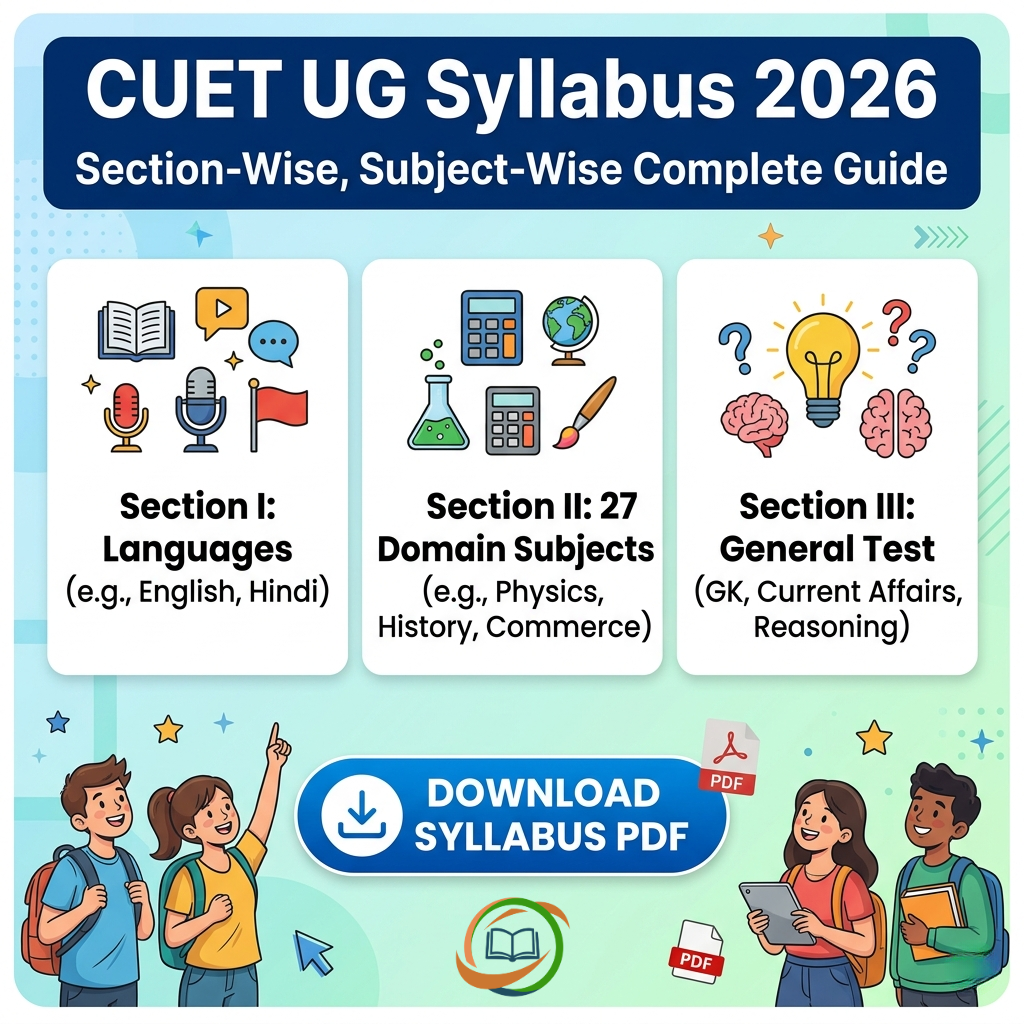
The CUET UG Syllabus 2026 has been officially released by the National Testing Agency
(NTA) on its official portal cuet.nta.nic.in. Every student preparing for the Common University
Entrance Test must understand the complete, updated syllabus before building their study plan
— because knowing what to study is just as important as knowing how to study.
The CUET UG 2026 syllabus is structured across three broad sections: Language Tests
(Section I), Domain-Specific Subjects (Section II), and the General Aptitude Test (Section III).
Together, these sections cover 37 subjects — 13 languages, 23 domain subjects, and 1
General Aptitude Test — from which candidates can choose a maximum of 5 subjects. With the
exam scheduled from May 11 to May 31, 2026, now is the time to align your preparation with
the official syllabus.
This article provides a complete section-wise and subject-wise breakdown of the CUET UG
2026 syllabus, including new changes for 2026, key topics, exam pattern, and actionable
preparation tips.
CUET UG Syllabus 2026: Quick Overview
| Feature | Details |
|---|---|
| Conducting Body | National Testing Agency (NTA) |
| Official Website | cuet.nta.nic.in |
| Total Subjects Available | 37 (13 Languages + 23 Domain Subjects + 1 GAT) |
| Maximum Subjects a Candidate Can Choose | 5 |
| Exam Mode | Computer-Based Test (CBT) |
| Questions per Subject | 50 MCQs |
| Duration per Subject | 60 Minutes |
| Marking Scheme | +5 Correct, –1 Wrong, 0 Unattempted |
| Domain Syllabus Based On | NCERT Class 12 Curriculum |
| Exam Dates | May 11–31, 2026 |
What’s New in CUET UG Syllabus 2026?
Before diving into the section-wise breakdown, it is important to understand the key changes
NTA has introduced in the CUET UG 2026 syllabus compared to the previous year.
- Total Subjects Reduced from 63 to 37: NTA has significantly streamlined the subject
offerings. The total number of test papers has been reduced from 63 to 37, removing 26
subjects that had low registration numbers or were deemed redundant. - Six Domain Subjects Discontinued:The following domain-specific subjects have been
permanently removed from CUET UG 2026: Entrepreneurship, Teaching Aptitude, Fashion
Studies, Tourism, Legal Studies, and Engineering Graphics. Admissions to courses previously
linked to these subjects will now be based on theGeneral Aptitude Test (GAT) score. - Language Sections Reduced from 33 to 13:CUET UG 2026 now offers only 13 languages
instead of 33. The 13 available languages are: English, Hindi, Assamese, Bengali, Gujarati,
Kannada, Malayalam, Marathi, Odia, Punjabi, Tamil, Telugu, and Urdu. - No Optional Questions:: A significant structural change for 2026 — all 50 questions in every
subject paper are nowcompulsory. There are no optional questions anymore, making
complete syllabus coverage essential. - Chemistry Syllabus Expanded:The Chemistry syllabus retains a 16-unit structure, which is
broader than the rationalized CBSE Class 12 board syllabus. Six chapters removed from the
CBSE curriculum are still part of the CUET UG 2026 Chemistry syllabus — requiring extra
preparation beyond board-level study. - Mathematics Syllabus Revised: The Probability section has been reduced (Random
Variables removed), while the Calculus section — particularly Integration — has been expanded
in scope for 2026. - No Subject Restrictions (New UGC Rule): Students can now chooseany domain subject
regardless of their Class 12 stream or subjects studied. This flexibility opens new program
options across universities.
CUET UG Syllabus 2026: Section-Wise Breakdown
SECTION I — Language Test (Section 1A & 1B)
The Language section assesses a candidate’s reading comprehension, grammar,
vocabulary, and verbal ability in their chosen language. This section is broadly the same
across all 13 available languages.
13 Available Languages: English, Hindi, Assamese, Bengali, Gujarati, Kannada, Malayalam,
Marathi, Odia, Punjabi, Tamil, Telugu, and Urdu.
Key Topics in the Language Section:
- Reading Comprehension: Three types of passages are included — Factual, Narrative, and
Literary — each with a maximum length of 300–350 words. Questions test understanding,
inference, and interpretation. - Verbal Ability: Tests language skills through sentence rearrangement, para-jumbles, and
identifying correct/incorrect word usage. - Grammar and Usage: Covers tenses, active and passive voice, direct and indirect speech,
articles, prepositions, conjunctions, and other core grammar rules. - Vocabulary: Synonyms, antonyms, one-word substitution, idioms and phrases, fill in the
blanks, and contextual word usage. - Literary Aptitude: Understanding literary devices, style, tone, and figurative language used
in passages.
Preparation Tip: Over 75% of CUET candidates appear for the English language
paper, making it one of the most competitive sections. Focus heavily on reading
comprehension speed and grammar accuracy. Read newspapers and editorial
columns daily to naturally build vocabulary.
SECTION II — Domain-Specific Subjects
The domain subject section is the core of the CUET UG 2026 exam for most candidates. It
includes23 subjects, each fully based on theNCERT Class 12 curriculum. Questions are
strictly MCQ-based and test conceptual understanding, application, and analytical skills.
Complete List of 23 Domain Subjects:
| Science Stream | Commerce Stream | Arts / Humanities Stream |
|---|---|---|
| Physics | Accountancy | History |
| Chemistry | Business Studies | Political Science |
| Mathematics | Economics | Geography |
| Biology / Biological Sciences | Sociology | |
| Computer Science | Psychology | |
| Environmental Science | Fine Arts | |
| Information Practices | Mass Media Studies | |
| Statistics | Anthropology | |
| Agriculture | Home Science | |
| Biotechnology | Physical Education | |
| Sanskrit |
Subject-Wise Syllabus Highlights:
Physics (Code 301): Divided into approximately 9 major units aligned with NCERT Class 12.
Key topics include Electrostatics, Current Electricity, Magnetic Effects of Current and
Magnetism, Electromagnetic Induction, Alternating Currents, Optics (Ray and Wave), Dual
Nature of Matter and Radiation, Atoms and Nuclei, and Semiconductor Electronics.
Chemistry (Code 306): Follows a 16-unit structure covering Physical Chemistry, Inorganic
Chemistry, and Organic Chemistry. Important topics include Solutions, Electrochemistry,
Chemical Kinetics, Surface Chemistry, p-Block and d-Block Elements, Coordination
Compounds, Haloalkanes and Haloarenes, Alcohols, Phenols, Ethers, Carbonyl Compounds,
Amines, Biomolecules, Polymers, and Chemistry in Everyday Life. Note that six chapters
removed from CBSE boards are still included in CUET Chemistry.
Mathematics (Code 301): Divided into two broad sections — Mathematics and Applied
Mathematics. Key topics include Relations and Functions, Algebra (Matrices and Determinants),
Calculus (Integrals and Differential Equations — expanded in 2026), Vectors,
Three-Dimensional Geometry, Linear Programming, and Probability (Random Variables
removed in 2026).
Biology (Code 302): Covers Reproduction, Genetics and Evolution, Biology and Human
Welfare, Biotechnology and its Applications, and Ecology. Questions are drawn from both
Botany and Zoology units of the NCERT Class 12 textbooks.
Accountancy (Code 301): Major topics include Accounting for Partnerships, Reconstitution of
Partnership Firms, Dissolution, Accounting for Share and Debenture Capital, Analysis of
Financial Statements, Cash Flow Statements, and Computerised Accounting.
Business Studies (Code 302): Covers Nature and Significance of Management, Principles of
Management, Business Environment, Planning, Organising, Staffing, Directing, Controlling,
Financial Management, Financial Markets, Marketing Management, and Consumer Protection.
Economics (Code 309): Includes Microeconomics topics like Consumer Behaviour, Production
and Supply, Market Forms, and Factor Pricing; and Macroeconomics topics like National
Income, Money and Banking, Determination of Income and Employment, Government Budget,
and Balance of Payments.
History (Code 301): Covers ancient, medieval, and modern Indian history, world history
themes, and historical sources and their interpretation. Based entirely on NCERT Class 12
themes in Indian History (Parts I, II, and III)
Political Science (Code 317): Divided into two parts: Politics in India Since Independence
(Challenges of nation-building, planned development, India’s external relations, rise of popular
movements, regional aspirations, crisis of democratic order) and Contemporary World Politics
(Cold War era, end of bipolarity, globalisation, environment and natural resources, security in
the contemporary world).
Geography (Code 316): Includes Fundamentals of Human Geography (Human activities,
settlement, migration, population composition) and India: People and Economy (Population,
human settlements, land resources, water resources, mineral and energy resources, transport
and communication, international trade, and geographical perspective on selected issues).
Pro Tip for Domain Subjects: Since the entire syllabus is NCERT Class 12-based,
candidates preparing sincerely for board exams automatically cover most of the
CUET domain syllabus. Focus on understanding concepts rather than rote
memorization — CUET questions test application and analysis.
SECTION III — General Aptitude Test (GAT)
The General Aptitude Test is Section III of the CUET UG 2026 exam. It is not compulsory for
all candidates — it is required only by specific universities and programs (such as BBA, BMS,
B.Com, and courses where the previously linked domain subjects have been discontinued).
GAT Paper Format:
● 50 MCQ questions, all compulsory
● Duration: 60 minutes
● Marking: +5 for correct, –1 for incorrect
CUET GAT Syllabus 2026 — Topic-Wise Breakdown:
- General Knowledge & Current Affairs: Questions from national and international events of
the last 6 months, government schemes, awards and honours, important summits and
conferences, sports, science and technology breakthroughs, and static GK linked to current
events. This section typically has moderate weightage. - General Mental Ability: Tests logical thinking through topics like series completion,
analogies, odd one out, direction sense, ranking and order, clocks and calendars, and basic
puzzles. - Numerical Ability: Covers basic arithmetic — number systems, LCM and HCF, fractions and
decimals, percentages, profit and loss, simple and compound interest, ratio and proportion, time
and work, and time, speed and distance. - Quantitative Reasoning: Tests application of basic mathematical concepts from Class 8 to
Class 10 level — arithmetic, basic algebra, geometry, mensuration, and statistics. It is not the
same as Class 12 Mathematics and requires separate practice. - Logical and Analytical Reasoning: Includes blood relations, seating arrangement (linear
and circular), coding-decoding, syllogisms, statement-assumption-conclusion, data
interpretation (tables, bar graphs, pie charts), and critical reasoning. - General Science and Environment Literacy (New Focus in 2026): A new emphasis has
been placed on basic scientific concepts and environmental awareness at the Class 9–10
NCERT level. Topics include ecology, environment and biodiversity, climate change, renewable
energy, and scientific inventions and discoveries.
Important GAT Tip: Many students underestimate the GAT section. In 2025, the Quantitative section was reported to be on the difficult side, with questions from mensuration, SI and CI, time and work, and trigonometry. Logical Reasoning included circular seating arrangements, blood relations, and coding-decoding. Dedicate at least 30–45 minutes daily to GAT preparation separately from domain subjects.
Stream-Wise CUET UG 2026 Syllabus Guide
For Science Students
Science stream candidates typically select: Physics + Chemistry + Mathematics/Biology + one
Language + General Test (if required by target university). The complete syllabus for each is
NCERT Class 12-based. Note the expanded Chemistry syllabus for CUET 2026 that goes
beyond the rationalized CBSE board content.
Popular CUET Courses for Science Students: B.Sc. (Hons.) Physics, Chemistry,
Mathematics, Botany, Zoology, Biotechnology, Computer Science, B.Tech (at Central
Universities), and B.Sc. Nursing.
For Commerce Students
Commerce students typically select: Accountancy + Business Studies + Economics +
Mathematics + one Language. All subjects are entirely NCERT Class 12-based.
Popular CUET Courses for Commerce Students: B.Com (Hons.), B.Com (Programme), BBA,
BMS, BA (Hons.) Economics, and B.Sc. (Hons.) Statistics.
For Arts/Humanities Students
Humanities students typically select: History / Political Science / Geography / Sociology /
Psychology + one Language + General Test.
Popular CUET Courses for Arts Students: BA (Hons.) History, Political Science, Sociology,
Geography, Psychology, English, Economics, and Journalism and Mass Communication.
CUET UG 2026 Syllabus vs Board Exam Syllabus: Key Differences
| Feature | CBSE Class 12 Board Exam | CUET UG 2026 |
|---|---|---|
| Syllabus Base | Rationalized NCERT 2022–23 | Full NCERT (including some deleted chapters) |
| Question Type | MCQ + Short Answer + Long Answer | MCQ only |
| Optional Questions | Yes (in some subjects) | No (all 50 questions compulsory in 2026) |
| Chemistry Coverage | 10 chapters (rationalized) | 16 units (broader) |
| Mathematics Probability | Includes Random Variables | Random Variables removed in 2026 |
| Language of Exam | English/Hindi | 13 language options |
Critical Note: Simply relying on board exam preparation is not enough for CUET
UG 2026 — especially for Chemistry, where six CBSE-deleted chapters are still in
the CUET syllabus. Download the official NTA subject PDFs and cross-check every
topic.
How to Download CUET UG 2026 Syllabus PDF
The official CUET UG 2026 syllabus PDFs are available free of cost on NTA’s portal. Here is
how to access them:
- Visit the official website: cuet.nta.nic.in
- Click on “Syllabus” or “CUET UG 2026 Syllabus” from the main menu or Information
Bulletin section - Select the subject/section whose syllabus you want to download
- The syllabus will open as a PDF — download and save it
- Cross-reference your study material with the official PDF to ensure complete topic
coverage
Warning: Many third-party websites circulate outdated or incorrect syllabus PDFs.
Always download the syllabus directly from cuet.nta.nic.in to ensure accuracy.
CUET UG 2026 Syllabus: Preparation Strategy
- Start with the Official Syllabus PDF Download subject-specific PDFs from the NTA website.
Study only the topics listed — do not waste time on topics outside the defined scope.
- NCERT First, Always For all 23 domain subjects, NCERT Class 12 textbooks are the
primary source. Read each chapter thoroughly, noting all definitions, formulas, diagrams, and
examples. For Chemistry specifically, refer to both the rationalized board edition and older
NCERT to cover discontinued chapters.
- Make a Topic-Wise Checklist Create a checklist of all topics for each of your chosen
subjects. Tick off topics as you complete them. This prevents blind spots in preparation and
helps with last-minute revision.
- Practice Subject-Wise Mock Tests After completing each subject’s syllabus, take at least
3–5 full-length subject-specific mock tests. NTA also releases official sample papers — solve all
of them under timed conditions.
- Solve Previous Year CUET Question Papers CUET has been conducted since 2022.
Solving 3–4 years of previous papers gives you a clear picture of question type, difficulty level,
and topic weightage in each subject.
- Focus Separately on GAT The General Aptitude Test requires a different type of preparation
— current affairs, reasoning, and basic mathematics. Read a monthly GK capsule, solve 40–50
quantitative aptitude questions daily, and practice logical reasoning through puzzles.
- Leverage Board Exam Preparation If you are simultaneously preparing for board exams in
2026, your board preparation covers most of the CUET domain syllabus. Just ensure you also
cover the CUET-specific additional topics (especially in Chemistry) that are not part of the
rationalized board syllabus.
Final Word
The CUET UG Syllabus 2026 is your roadmap to cracking one of India’s largest undergraduate
entrance exams. With a clearly defined subject-wise structure based on NCERT Class 12
content, CUET rewards students who prepare strategically — covering each topic systematically
rather than broadly. Download the official subject PDFs from cuet.nta.nic.in, build a topic-wise
study plan, and practice consistently with mock tests and previous year papers.
Stay connected with cuet-nta.com for the latest syllabus updates, subject-wise preparation
guides, mock test links, answer keys, and result notifications for CUET UG 2026.
Frequently Asked Questions
Yes. The domain-specific subjects syllabus is entirely based on the NCERT Class 12 curriculum. However, the Language section and General Aptitude Test are not strictly NCERT-bound — they test reasoning, comprehension, and general awareness from Class 8 level upward.
The official CUET UG 2026 syllabus PDFs are available free of cost on cuet.nta.nic.in. Download only from the official portal to avoid outdated or incorrect versions.
There are 37 subjects in total — 13 languages, 23 domain-specific subjects, and 1 General Aptitude Test. Candidates can choose a maximum of 5 subjects.
The primary focus is on Class 12 NCERT. However, for some subjects like Chemistry and Physics, foundational Class 11 concepts may be indirectly tested. Some study resources suggest reviewing Class 11 content for better conceptual clarity.
No. The GAT is required only for specific university programs — particularly B.Com, BBA, BMS, programs related to discontinued subjects, and universities that specifically mandate it. Check your target university's requirements before selecting GAT.
Entrepreneurship, Teaching Aptitude, Fashion Studies, Tourism, Legal Studies, and Engineering Graphics have been discontinued. Admissions for these programs will now be based on GAT scores.
No. A major change for 2026 is that all 50 questions in every subject paper are compulsory. There are no optional questions, unlike in previous years.
13 languages — English, Hindi, Assamese, Bengali, Gujarati, Kannada, Malayalam, Marathi, Odia, Punjabi, Tamil, Telugu, and Urdu.
Yes. Under UGC's new rule for 2026, students can choose any subject regardless of their Class 12 stream. However, always verify the specific subject requirements of your target university and course.
+5 marks for every correct answer, –1 mark for every incorrect answer, and 0 marks for unattempted questions.
No Comments yet!