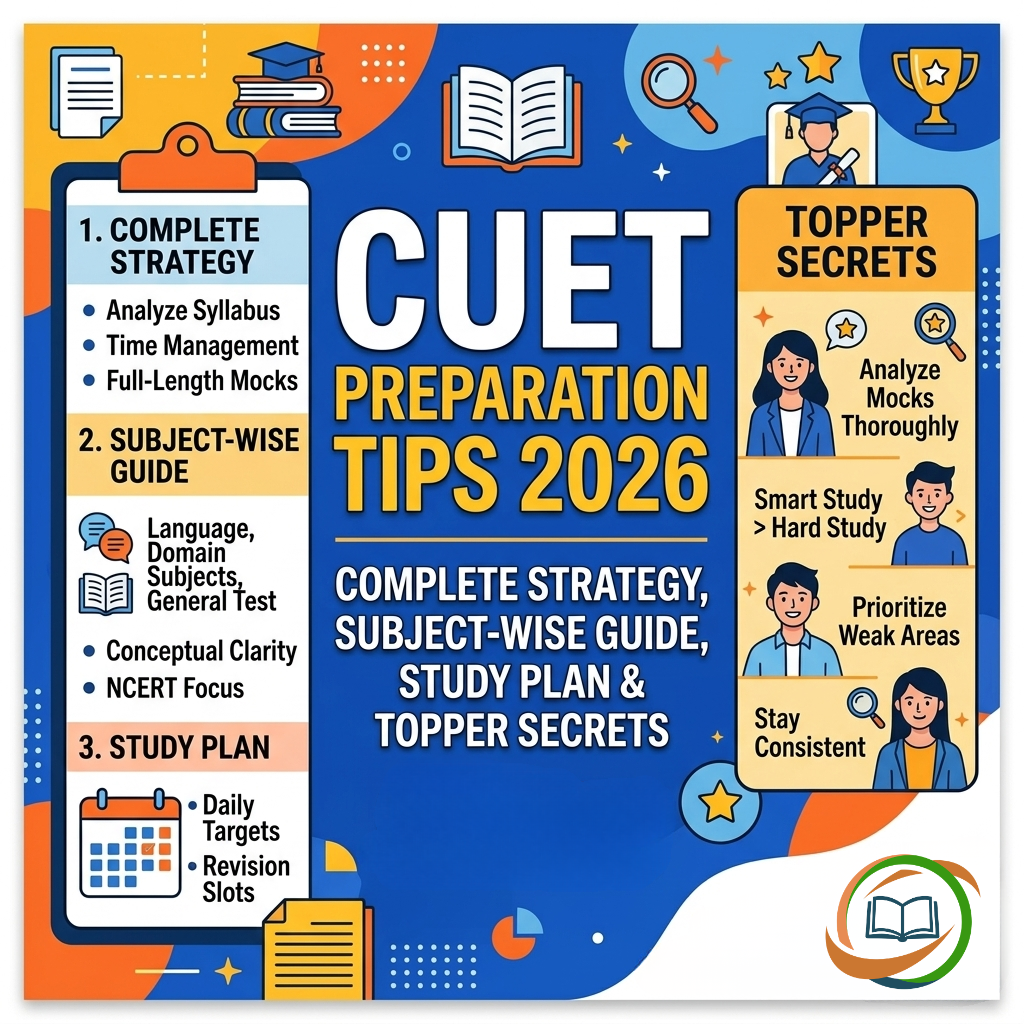
With the CUET UG 2026 exam just weeks away — scheduled from May 11 to May 31, 2026 — every preparation decision you make right now carries enormous weight. Over 14 lakh candidates are competing for approximately 3 lakh seats across 280+ universities, making CUET one of the most competitive undergraduate entrance examinations in the world. Simply completing the Class 12 syllabus is not enough — you need a smart, structured, and exam-specific preparation strategy to stand out.
This comprehensive guide brings you the best CUET preparation tips 2026 — from section-wise strategies and subject-wise study plans to topper-tested techniques, best books, time management advice, and a final-week revision plan that can make the critical difference between a good score and a great one
CUET Preparation 2026: Where to Begin
Before diving into subject-specific tips, every CUET UG 2026 aspirant must anchor their preparation on three fundamental pillars:
1. Know the Exact Exam Pattern
CUET UG 2026 has three sections:
- Section I (Language Test): 50 MCQs in 60 minutes per language paper
- Section II (Domain Subjects): 50 MCQs in 60 minutes per domain subject
- Section III (General Aptitude Test): 50 MCQs in 60 minutes
Marking Scheme: +5 for correct, –1 for incorrect, 0 for unattempted. Maximum marks per subject: 250.
Key 2026 Change: All 50 questions in every subject paper are now compulsory — there are no optional questions. This means complete syllabus coverage is non-negotiable.
2. Download the Official NTA Syllabus
The CUET UG 2026 syllabus is available free at cuet.nta.nic.in. Download subject-wise PDFs for every paper you are attempting and use them as a topic-by-topic checklist. Never rely on a third-party “syllabus summary” — always verify against the official NTA document.
3. Know Your Target Score
Research the expected CUET 2026 cutoffs for your target university and course. For top DU colleges like SRCC, aim for 920+ out of 1,000. ForBHU‘s competitive courses, target 630–690 marks. Knowing your goal score helps you set realistic daily study targets rather than preparing vaguely.
CUET Preparation Tips 2026: The 14 Best Strategies
Tip 1 — Treat NCERT as Your Primary Bible
For all 23 domain subjects, the CUET UG 2026 syllabus is explicitly based on NCERT Class 12 textbooks. This is both the good news and the trap:
- The good news: if you have studied NCERT thoroughly for board exams, you already have 60–70% of your CUET preparation done
- The trap: CUET asks “between the lines” questions — from footnotes, box items, in-text examples, and chapter-end exercises — that board exam preparation typically overlooks
Action: Read each NCERT chapter twice — once for understanding the concept, and once specifically looking for hidden MCQ sources in boxes, diagrams, timelines, and footnotes. Solve all NCERT chapter-end questions as MCQs. Every sentence in your NCERT is a potential CUET question.
Tip 2 — Prioritize High-Weightage Chapters First
Not all chapters carry equal weight in CUET UG. Based on analysis of CUET previous year question papers (2022, 2023, 2024, 2025), certain chapters consistently appear more frequently than others.
How to identify high-weightage chapters:
- Solve 2–3 years of PYQPs (Previous Year Question Papers) for each subject
- Count how many questions came from each chapter across years
- Create a chapter-wise frequency table and prioritize chapters that appear in 2+ years
By identifying and mastering high-frequency chapters first, you maximize your expected score before touching lower-weightage topics. This is especially impactful when time is limited in the final preparation weeks.
Tip 3 — Solve Previous Year CUET Question Papers Every Week
CUET has been conducted since 2022, giving you four years of actual exam papers (2022, 2023, 2024, 2025) to practice from. These are available free at cuet.nta.nic.in.
Solving PYQPs helps you:
- Understand the exact question format and difficulty level NTA uses
- Identify the most frequently tested topics across years
- Practice time management within the actual 60-minute window
- Build confidence through pattern familiarity
Strategy: Do not solve PYQPs at the very beginning of your preparation. First complete at least 60% of the syllabus, then attempt 1 PYQP per subject per week. Analyze every wrong answer before moving on
Tip 4 — Take Full-Length Mock Tests Regularly
According to CUET toppers, the best methods of CUET UG 2026 preparation include referring to the right books, taking regular mock tests, solving previous year CUET question papers, and following a disciplined and systematic approach.
Full-length mock tests are non-negotiable in the final 4–6 weeks. They:
- Simulate the real CBT environment (timer, question palette, navigation)
- Build the mental stamina needed for back-to-back subject papers
- Train you to apply negative marking discipline under pressure
- Reveal time management blind spots you would never discover through static study
Target: Attempt at least 10–15 full-length mock tests across your chosen subjects before exam day. Use the NTA’s official free mock test at nta.ac.in/Quiz at least once to experience the exact exam interface.
Tip 5 — Master the Art of Negative Marking
The –1 penalty for each wrong answer is one of the most misunderstood aspects of CUET strategy. Many candidates either:
- Attempt everything randomly (losing marks through wrong answers), or
- Skip too many questions out of excessive caution (leaving easy marks on the table)
The Right Approach:
- Attempt a question only when you are at least 65–70% confident
- When you can eliminate 2 out of 4 options, the probability is in your favor — attempt it
- When you can eliminate only 1 option or none, skip it — the expected value is negative
- Never change a first instinct unless you have a concrete reason to do so
Develop this discipline through mock tests — not on exam day for the first time.
Tip 6 — Build a Subject-Wise Study Schedule
Do not study randomly across subjects. Build a daily and weekly study schedule that allocates time based on:
- Number of subjects you are attempting
- Relative difficulty of each subject for you personally
- Weightage of each subject in your target university’s admission formula
Sample Daily Schedule (4–6 hours of CUET study):
- 60–90 minutes: Primary domain subject (Chapter completion or revision)
- 45–60 minutes: Secondary domain subject or language practice
- 30–45 minutes: General Aptitude Test (current affairs + reasoning)
- 30 minutes: Mock test / PYQ practice for any subject
- 15–20 minutes: Error log review from previous mock
Tip 7 — Prepare Separate Chapter-Wise Notes
Reading NCERT is not enough — you must also consolidate what you read into concise, exam-ready notes. For every chapter, create a single-page summary containing:
- Key definitions and terms
- Important dates, names, and events (for Humanities subjects)
- Formulas, reactions, and diagrams (for Science subjects)
- Common exceptions and special cases (where CUET loves to set traps)
These notes become invaluable during the last 5–7 days of revision when you need to quickly refresh all topics without re-reading entire chapters.
Tip 8 — Language Section: Read Daily, Practice Passages
The Language Test (Section I) is attempted by almost all CUET candidates and is often where marks are unnecessarily lost due to underpreparation. The section tests:
- Reading comprehension across Factual, Narrative, Literary, and Poem-based passages
- Vocabulary (synonyms, antonyms, one-word substitution)
- Grammar (tenses, voice, narration, articles, prepositions)
- Sentence rearrangement and para-jumbles
Best Preparation Practices:
- Read newspaper editorials (The Hindu or Indian Express for English; Dainik Bhaskar for Hindi) for 30 minutes every day — this simultaneously builds vocabulary, comprehension speed, and grammar awareness
- Solve 2–3 unseen passages daily from CUET PYQPs and English practice books
- Learn 10 new vocabulary words daily using flashcards
- Practice grammar rules through MCQ-based exercises — do not just read rules, apply them
Tip 9 — General Aptitude Test: Consistent Daily Practice
Many candidates underestimate the GAT and leave it for the last minute. This is a mistake — the GAT requires a different type of preparation that builds gradually through daily practice, not cramming.
Daily GAT Routine:
- 15–20 minutes of current affairs (monthly digest + newspaper headlines)
- 20–25 minutes of Logical Reasoning practice (seating arrangements, syllogisms, coding-decoding)
- 15 minutes of Numerical Ability (percentage, profit & loss, time & work)
Current Affairs Strategy: Focus on events from the last 6–12 months — NTA draws GAT current affairs from this window. Cover government schemes, international summits, sports achievements, science and space milestones, and important appointments.
Tip 10 — Stream-Specific Preparation: Science, Commerce & Arts
For Science Students (Physics, Chemistry, Biology, Mathematics):
- NCERT is sufficient for most questions, but Chemistry in CUET 2026 includes six chapters removed from the CBSE rationalized syllabus — cover the full original NCERT, not just the board edition
- Mathematics requires daily numerical practice — solve 15–20 MCQs per topic
- For Biology, focus on cell biology, genetics, ecology, and biotechnology applications
- Physics questions often test conceptual application — understand derivations, not just formulas
For Commerce Students (Accountancy, Business Studies, Economics):
- Accountancy requires practical problem-solving — practice journal entries, financial statements, and ratio analysis repeatedly
- Business Studies is mostly theory-based — understand concepts deeply rather than memorizing definitions
- Economics needs both concept clarity (Micro) and current economic awareness (Macro — government budget, monetary policy)
For Arts/Humanities Students (History, Political Science, Geography, Sociology):
- The volume of content is the biggest challenge — use chapter-wise mind maps to organize large amounts of information
- History requires exact dates, names, and event sequences — create timelines for each chapter
- Political Science requires understanding both factual content and analytical reasoning behind events
- Geography needs map-based practice alongside textual preparation
Tip 11 — Leverage CUET and Board Exam Synergy
If you are simultaneously preparing for Class 12 board exams in 2026, your board preparation and CUET preparation overlap significantly for domain subjects — both are based on NCERT Class 12 content.
Smart Synergy Strategy:
- Study from NCERT for both board and CUET simultaneously — do not maintain separate study tracks
- After completing each chapter for boards, immediately solve 20–30 CUET-style MCQs on that chapter
- Board exam long-answer practice deepens conceptual understanding, which directly improves CUET MCQ accuracy
- Allocate 60–70% of study time to board preparation during the board exam phase; shift to 80–90% CUET after boards conclude
Important: Board exam marks are no longer part of DU’s merit calculation — your CUET score alone determines admission. However, minimum Class 12 percentage requirements (typically 45–50%) must still be met for university eligibility.
Tip 12 — Build and Review Your Error Log
An error log is the single most powerful revision tool that most students ignore. After every mock test and PYQ practice session:
- Note down every question you answered incorrectly
- Categorize it: Was it a knowledge gap, a concept error, or a careless mistake?
- Write the correct answer and the reasoning
- Review this log before every subsequent mock test
Over time, your error log becomes a personalized collection of your most common mistakes — the exact questions you need to master before the exam. CUET toppers consistently identify this practice as one of their most effective preparation habits
Tip 13 — Final Week Strategy: Revise, Don’t Study New Topics
In the 5–7 days immediately before the exam, shift entirely to revision mode:
- No new chapters or new topics — this is not the time to explore unseen material
- Revise your chapter-wise notes daily
- Attempt 1–2 short sectional mock tests per day for confidence, not for new learning
- Review your complete error log from all previous mocks
- Focus on current affairs for the last 2–3 weeks before the exam date
- Ensure proper sleep (7–8 hours) — cognitive performance under exam conditions drops significantly with sleep deprivation
Tip 14 — Exam Day Strategy: Attempt Smart, Not Fast
On the actual CUET exam day:
- Reporting time: Reach the exam centre at least 60–90 minutes before your shift timing — factor in travel time and security checks
- Read instructions carefully: Spend the first 3–5 minutes reading all on-screen instructions before starting
- Prioritize easy questions first: In the first pass, answer all questions you are confident about — mark the rest for review
- Time per question: At 60 minutes for 50 questions, you have 72 seconds per question on average — do not spend more than 90 seconds on any single question
- Second pass: Return to marked questions with remaining time — apply negative marking discipline
- Never leave late: Submit the exam at least 2–3 minutes before time runs out to avoid accidental auto-submission errors
Subject-Wise Best Books for CUET UG 2026
| Subject | Best Books |
|---|---|
| English Language | NCERT Flamingo + Vistas, Wren & Martin Grammar, S. Chand CUET English |
| Physics | NCERT Class 12 (both volumes), HC Verma (concepts), Arihant CUET Physics |
| Chemistry | NCERT Class 12 (all 16 chapters including deleted CBSE ones), Arihant CUET Chemistry |
| Mathematics | NCERT Class 12 (both volumes), RD Sharma, Arihant CUET Mathematics |
| Biology | NCERT Class 12, Trueman’s Biology (for deeper understanding) |
| Accountancy | NCERT Class 12, TS Grewal’s Double Entry Book Keeping |
| Business Studies | NCERT Class 12, Poonam Gandhi’s Business Studies |
| Economics | NCERT Class 12 (Micro + Macro), TR Jain & VK Ohri |
| History | NCERT Themes in Indian History (Parts I, II, III) |
| Political Science | NCERT Class 12 (both books) |
| Geography | NCERT Class 12 (Human Geography + India People & Economy) |
| General Aptitude Test | Lucent’s GK, R.S. Aggarwal (Reasoning + QA), Disha CUET GAT |
CUET 2026 Topper-Tested Success Mantras
Based on insights from CUET 100 percentilers and top scorers across subjects:
Diya Bhargava (100 percentile topper): “4–5 hours of focused self-study every day is more effective than 10 hours of distracted reading. Quality of study beats quantity every time.”
Sufi Siddharth Kabir (100 percentile, Political Science): “Read NCERT like a primary source document, not like a textbook. Question everything — why did this happen, what was the consequence, who benefited?”
Prarthana Drolia (100 percentile): “Be consistent. You don’t need to study 12 hours a day. But you must study every single day without exception. Consistency beats intensity.”
Common Thread Among All Toppers:
- NCERT first, always
- Mock tests started early (at least 6–8 weeks before the exam)
- Error log maintained and reviewed regularly
- Current affairs read daily — never left for the last week
- Board exam and CUET preparation treated as complementary, not competing
Common CUET Preparation Mistakes to Avoid in 2026
Mistake 1 — Using the Rationalized CBSE Syllabus for CUET Chemistry CUET UG 2026 Chemistry includes six chapters that were removed from the CBSE rationalized syllabus. Candidates preparing only from the board edition miss these chapters entirely.
Mistake 2 — Leaving the General Test Completely for the Last Week GAT requires consistent daily practice over weeks. Current affairs, reasoning, and quantitative skills cannot be built in 7 days.
Mistake 3 — Attempting Every Question in the Exam Random guessing costs marks. The negative marking system makes it mathematically better to leave uncertain questions blank than to guess blindly.
Mistake 4 — Not Practicing on a Computer CUET is a CBT (Computer-Based Test). Many students prepare entirely from books and encounter the digital interface for the first time in the actual exam — causing anxiety and slower response times. Practice regularly on the NTA mock test portal.
Mistake 5 — Ignoring NCERT Examples and In-Text Questions NTA frequently draws MCQ options directly from NCERT examples, solved problems, and in-text exercises. Skipping these while reading leaves multiple easy marks on the table.
Mistake 6 — Starting New Chapters in the Final Week The last week before the exam is for revision, mock tests, and current affairs — not for new learning. Starting a new chapter in the final 5 days adds confusion and anxiety without proportional benefit.
Final Word
The CUET UG 2026 exam on May 11–31 is your gateway to some of India’s most prestigious universities. With only weeks left, every study session counts — but only if it is well-directed. The candidates who succeed are not those who studied the most hours; they are the ones who studied the right content, in the right way, with consistent practice and smart exam strategy.
Use NCERT thoroughly, solve PYQPs weekly, take timed mock tests regularly, maintain your error log, and stay disciplined in your daily routine. The competition is intense — but with the right preparation, a top CUET score is absolutely within your reach.
Stay connected with cuet-nta.com for the latest CUET UG 2026 updates — admit card alerts, exam day guidelines, answer key releases, result notifications, and university counselling schedules.
Frequently Asked Questions
CUET toppers consistently recommend 4–6 hours of focused, distraction-free CUET-specific study daily during the peak preparation phase. Quality and consistency matter more than raw hours. A focused 4-hour session beats 8 hours of distracted study.
For most domain subjects, NCERT Class 12 is sufficient for a strong score. However, for Chemistry specifically, cover the full original NCERT including six chapters removed from the CBSE board syllabus. Additionally, supplement NCERT with CUET-specific MCQ practice books to get familiar with the question format.
Absolutely. Many CUET toppers have prepared without formal coaching. With the official NTA syllabus, NCERT textbooks, free PYQPs from cuet.nta.nic.in, and the NTA's free official mock tests, self-study is highly effective. The key is structured planning and consistent daily effort.
Aim for 10–15 full-length mock tests per subject before the exam. Additionally, solve 30–50 sectional and chapter-wise practice tests throughout your preparation. The more tests you attempt and analyze, the stronger your exam-day performance.
Since CUET domain subjects are based on NCERT Class 12 — the same content tested in board exams — both preparations can be integrated. Study from NCERT for board exams and simultaneously solve CUET-style MCQs after each chapter. After boards conclude, shift your full focus to CUET mock tests and GAT preparation.
Daily 30–45 minutes of dedicated GAT preparation: 15 minutes of current affairs (monthly digest + newspaper), 20 minutes of Logical Reasoning practice, and 15 minutes of Numerical Ability. Use Lucent's GK and R.S. Aggarwal's books. Take at least 3–4 full-length GAT mock tests.
Choose only the subjects required by your target university and course — nothing more. Choosing extra subjects without proper preparation increases the risk of negative marking pulling your score down. Quality preparation in 3 well-chosen subjects beats shallow coverage of 5
A score above 95th percentile is generally strong for central universities. For top DU colleges (SRCC, Hindu College, Miranda House), aim for 920+ out of 1,000 in relevant subjects. For BHU's competitive programs, target 630–690 marks. For JNU and other central universities, 700+ is competitive.
No Comments yet!